
In January 2024, a quadriplegic man named Noland Arbaugh became the first person to receive a Neuralink brain implant. Weeks later, he was moving a computer cursor, playing chess, and browsing the internet — entirely with his thoughts. No mouse, no touchscreen, no voice commands. Just intention, translated directly from brain activity into digital action.
Moments like that make brain-computer interfaces feel like science fiction. But understanding how brain-computer interfaces work reveals something more interesting than magic: a careful engineering pipeline that measures the electrical chatter of neurons, cleans it up, decodes the user’s intent, and turns it into commands. This guide explains that pipeline step by step — the sensors, the algorithms, the different implant designs, what the technology can actually do today, and where the field stands in 2026.
What Exactly Is a Brain-Computer Interface?
A brain-computer interface (BCI) is a system that creates a direct communication pathway between the brain and an external device, bypassing the body’s normal output routes — the peripheral nerves and muscles. Instead of moving a hand to click a mouse, a BCI user simply intends to move, and the system detects that intention in the brain’s electrical activity and acts on it.
The term “brain-computer interface” was coined in 1973 by UCLA researcher Jacques Vidal, who proposed that brain signals recorded from the scalp could be used to control external devices. In 1977, Vidal’s team demonstrated the idea by using an EEG system to move a graphic object through a maze — crude by today’s standards, but the founding proof of concept.
Every BCI, from a consumer EEG headband to a surgically implanted electrode array, runs the same fundamental loop:
- Measure — Sensors record electrical (or sometimes blood-flow) activity from the brain.
- Decode — Software analyzes the signals and infers what the user intends.
- Command — The decoded intent drives an output: a cursor, a keyboard, a robotic arm, a speech synthesizer.
- Feedback — The user sees the result and adjusts, which is why BCIs are as much learned skill as hardware. With practice, users get better at producing clean, classifiable brain states.
How Brain-Computer Interfaces Work: The Five-Stage Pipeline
Under the hood, the measure–decode–command loop breaks down into five concrete engineering stages. This pipeline is the same whether the sensors sit on the scalp or inside the cortex:
1. Signal Acquisition
Sensors capture the brain’s electrical activity. Neurons communicate with tiny voltage spikes, and when thousands of them fire together, they generate patterns that electrodes can pick up — as individual spikes, as local field potentials (the summed activity of nearby neurons), or as rhythmic oscillations across larger brain regions. Acquisition hardware ranges from caps studded with dozens of scalp electrodes to implants with more than a thousand microelectrodes threaded into the motor cortex. The choice of acquisition method is the single biggest design decision in any BCI, and we will cover it in detail below.
2. Preprocessing
Raw brain signals are messy. A scalp electrode picks up eye blinks, jaw muscle activity (EMG), heartbeat, power-line hum, and the rustle of the electrode cap itself — all mixed with the faint neural signal of interest. Preprocessing filters out these artifacts using techniques like band-pass filtering, common average referencing, and Laplacian spatial filtering, which sharpen the neural signal and suppress noise from neighboring channels.
3. Feature Extraction
Once cleaned, the signal is distilled into features — compact numerical descriptions of the patterns that carry intent. Common features include:
- Mu rhythm desynchronization: When you imagine moving your hand, a characteristic 8–12 Hz oscillation over the motor cortex weakens. Left-hand versus right-hand imagery produces different spatial patterns — the classic control signal for non-invasive BCIs.
- Event-related potentials like the P300: A distinctive brainwave that appears about 300 milliseconds after you notice something meaningful — for example, the letter you want to type flashing on a screen. P300 spellers let users pick letters simply by paying attention.
- High-gamma power (70–150 Hz): Fast oscillations recorded from the brain’s surface that track movement and speech with fine detail — a workhorse feature for implants aimed at restoring speech.
- Single-unit spikes: The firing of individual neurons, captured only by electrodes placed directly inside brain tissue. Spikes carry the richest information of all.
4. Decoding and Classification
The decoder is the brain of the BCI — the algorithm that maps features to intent. For discrete choices (which letter? left or right?), classifiers such as common spatial patterns combined with machine-learning models decide the winner. For continuous control (moving a cursor or robotic arm), decoders like Kalman filters estimate velocity and position moment by moment. In recent years, recurrent neural networks such as LSTMs have learned to translate sequential neural activity into speech phonemes, enabling thought-to-text at speeds approaching natural conversation.
5. Output and Feedback
The decoded command drives the output device — and the loop closes when the user perceives the result. That feedback matters enormously: users unconsciously adapt their brain activity to whatever the decoder rewards, a process called co-adaptation. The best BCI systems improve in two directions at once, with the algorithm learning the user while the user learns the algorithm.
The Four Ways Scientists Listen to the Brain
How close the sensors get to the neurons determines everything else: signal quality, bandwidth, surgical risk, and cost. BCI hardware falls into four broad families along the invasiveness spectrum.
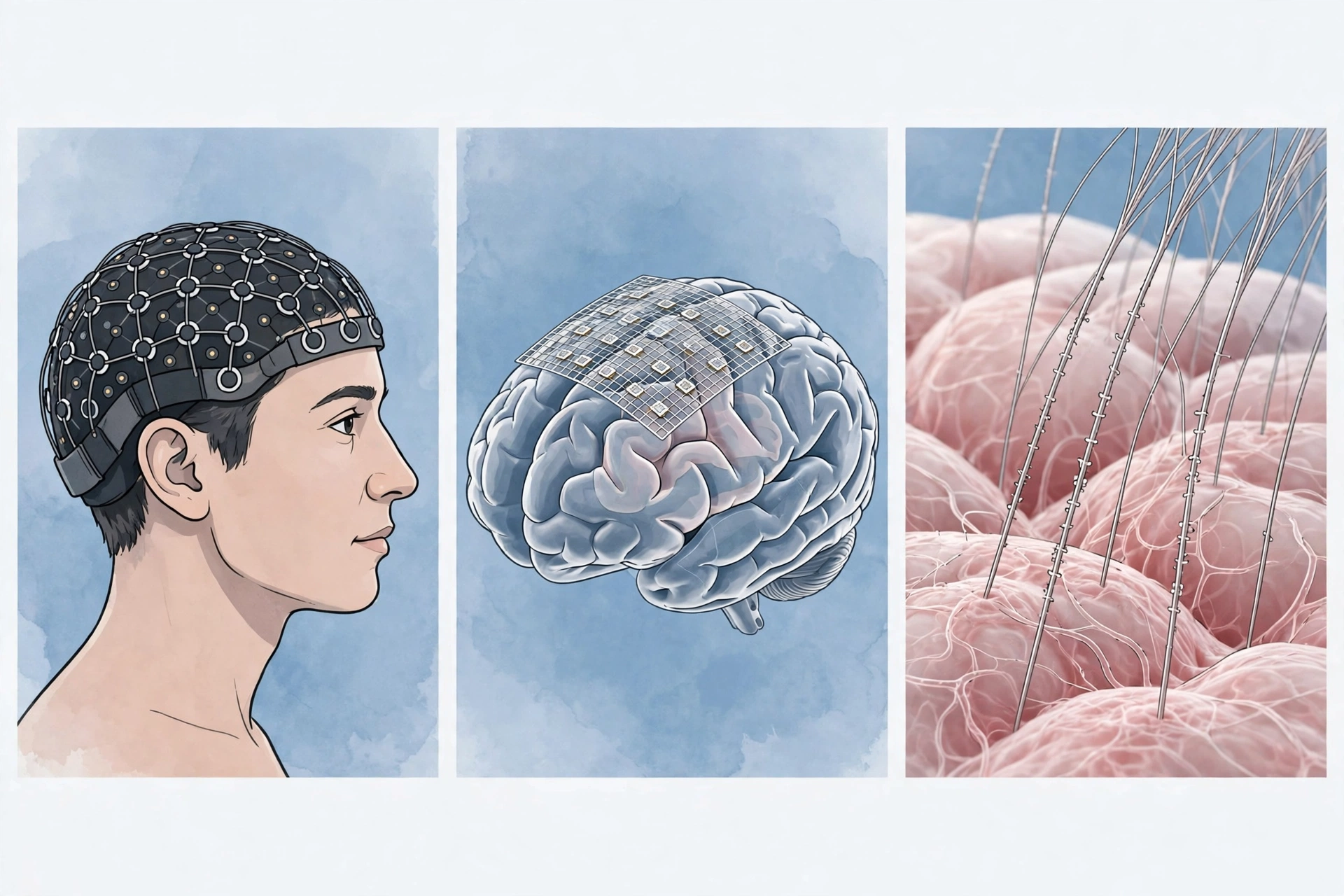
Non-Invasive: EEG and Beyond
Non-invasive BCIs read the brain from outside the skull — no surgery, no medical risk, usable at home. Electroencephalography (EEG) is the dominant method: caps with 64 to 256 electrodes detect the brain’s electrical fields through the scalp with millisecond-level timing. EEG equipment is inexpensive and portable, which is why it dominates both research and consumer applications.
Related non-invasive techniques include functional near-infrared spectroscopy (fNIRS), which uses light sensors to detect blood-flow changes as active neurons consume more oxygen, and magnetoencephalography (MEG), which measures the magnetic fields produced by neural currents with excellent precision but requires a room-sized, cryogenically cooled machine.
The trade-off is fundamental physics: the skull smears and weakens electrical signals, so non-invasive BCIs deliver only a few bits per second, noisily. Realistic non-invasive control means a small vocabulary of intents — a handful of commands — often paired with smart software that handles the fine, fast work. It is genuine thought control, just not high-bandwidth telepathy.
Semi-Invasive: ECoG Grids
Electrocorticography (ECoG) places electrode grids directly on the brain’s surface, beneath the skull but without penetrating tissue. Because the electrodes sit millimeters from the neurons, ECoG captures crisp local field potentials with high-gamma resolution (70–150 Hz) — detailed enough to decode individual fingers or speech sounds. ECoG is the preferred approach for speech-restoration research, since decoding speech benefits from signals across a broad area of the cortex. It still requires a craniotomy, so it is used only in clinical settings.
Invasive: Intracortical Implants
Intracortical BCIs push microelectrode arrays directly into brain tissue — usually the motor cortex — to record single neurons firing. The classic design is the Utah array, a bed of 100 tiny silicon needles that captures individual spikes and supports precise spike sorting. The payoff is the highest signal quality and bandwidth of any approach: paralyzed users have controlled cursors and robotic arms with remarkable accuracy.
The cost is real surgery, with risks of infection, bleeding, and brain injury — plus a stubborn long-term problem: the brain’s immune system walls off foreign objects with glial scar tissue, and signals from implanted electrodes tend to weaken over months and years. Modern designs fight back with ultra-thin, flexible threads — Neuralink’s N1 implant, for example, uses 64 threads carrying 1,024 electrodes, inserted by a surgical robot — but long-term stability remains an active engineering battle.
The Endovascular Middle Path
One clever design sidesteps the invasiveness dilemma entirely. Synchron’s Stentrode is a stent-like electrode array threaded through the jugular vein and lodged in the superior sagittal sinus — a blood vessel running alongside the motor cortex. No part of the skull is removed; the procedure takes about 20 minutes. The 16 electrodes record local field potentials through the vessel wall: weaker than intracortical spikes, but obtained with a fraction of the surgical risk. It is the clearest example of a deliberate engineering trade — less signal fidelity in exchange for a procedure far easier to scale and approve.
From Signals to Commands: How Decoding Really Works
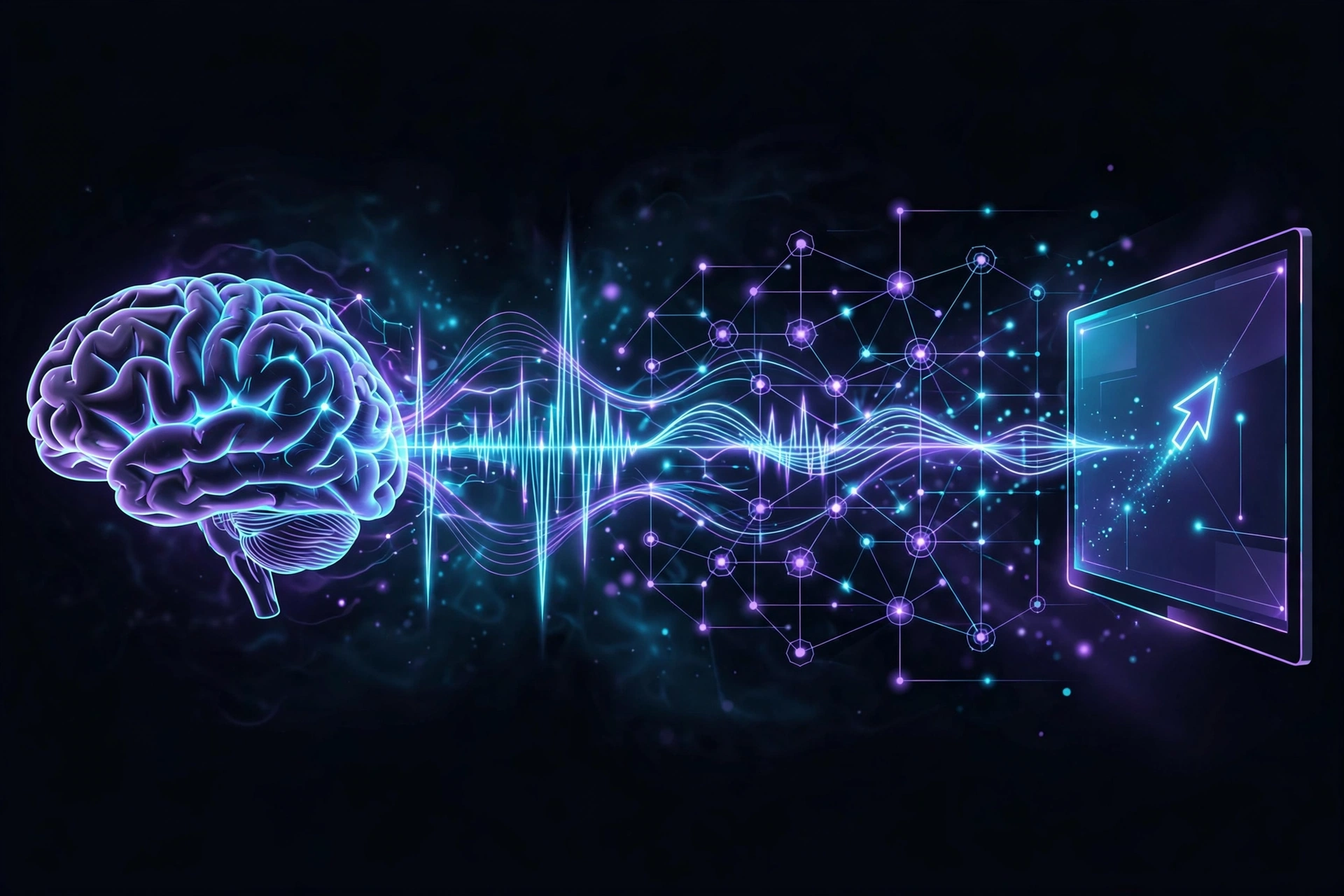
If acquisition is the BCI’s ears, decoding is its understanding. The challenge is that the same thought never produces exactly the same signal twice: neurons are noisy, the brain drifts, and electrodes shift. Decoders must find the stable core of intent inside that variability.
Two strategies dominate. Classification treats intent as a multiple-choice question — which of these letters, which direction, left hand or right hand? Algorithms learn the boundary between brain patterns in a training session where the user performs known tasks, then apply those boundaries in real time. Continuous decoding treats intent as a moving target: a Kalman filter, for instance, maintains a running estimate of where the user wants a cursor to go, updating dozens of times per second as new neural evidence arrives.
Deep learning has pushed the frontier furthest in speech. Recurrent networks trained on the sequential rhythm of neural activity can map brain signals to phonemes — the building blocks of spoken words — enabling research systems to decode attempted speech at rates approaching conversational speeds. Demonstrations of typing by thought have reached up to around 40 words per minute in research settings, a striking leap from the single digits of early P300 spellers.
Crucially, decoding is never fire-and-forget. Calibration sessions tune the decoder to each individual brain, and adaptive algorithms keep retuning as signals drift. The user, meanwhile, learns which mental strategies produce the clearest signals. That two-way learning is why a BCI that feels clumsy on day one can feel natural by week four.
What Brain-Computer Interfaces Can Do Today
BCIs are not a single product but a family of applications, most of them medical. Here is what the technology demonstrably does right now:
Communication for Locked-In Patients
The most transformative application is giving communication back to people who have lost it — patients with ALS, brainstem stroke, or locked-in syndrome. Thought-to-text systems let users compose messages by imagined handwriting or by selecting letters with attention; speech-decoding systems reconstruct attempted speech for people who can no longer speak. In 2026, Neuralink launched its VOICE trial specifically targeting speech restoration for ALS patients, and Paradromics received the first FDA investigational approval for a speech-restoration study using a fully implantable BCI.
Computer and Device Control
Cursor control is the canonical BCI demo and now a practical reality: implanted users browse the web, send email, and use apps by thought alone. Synchron has publicly demonstrated an ALS patient navigating an iPad, composing text, and opening apps using Apple’s BCI HID protocol — a standard that lets brain implants talk to consumer devices the way a mouse or keyboard would. For someone with severe paralysis, that is not a gadget; it is digital independence.
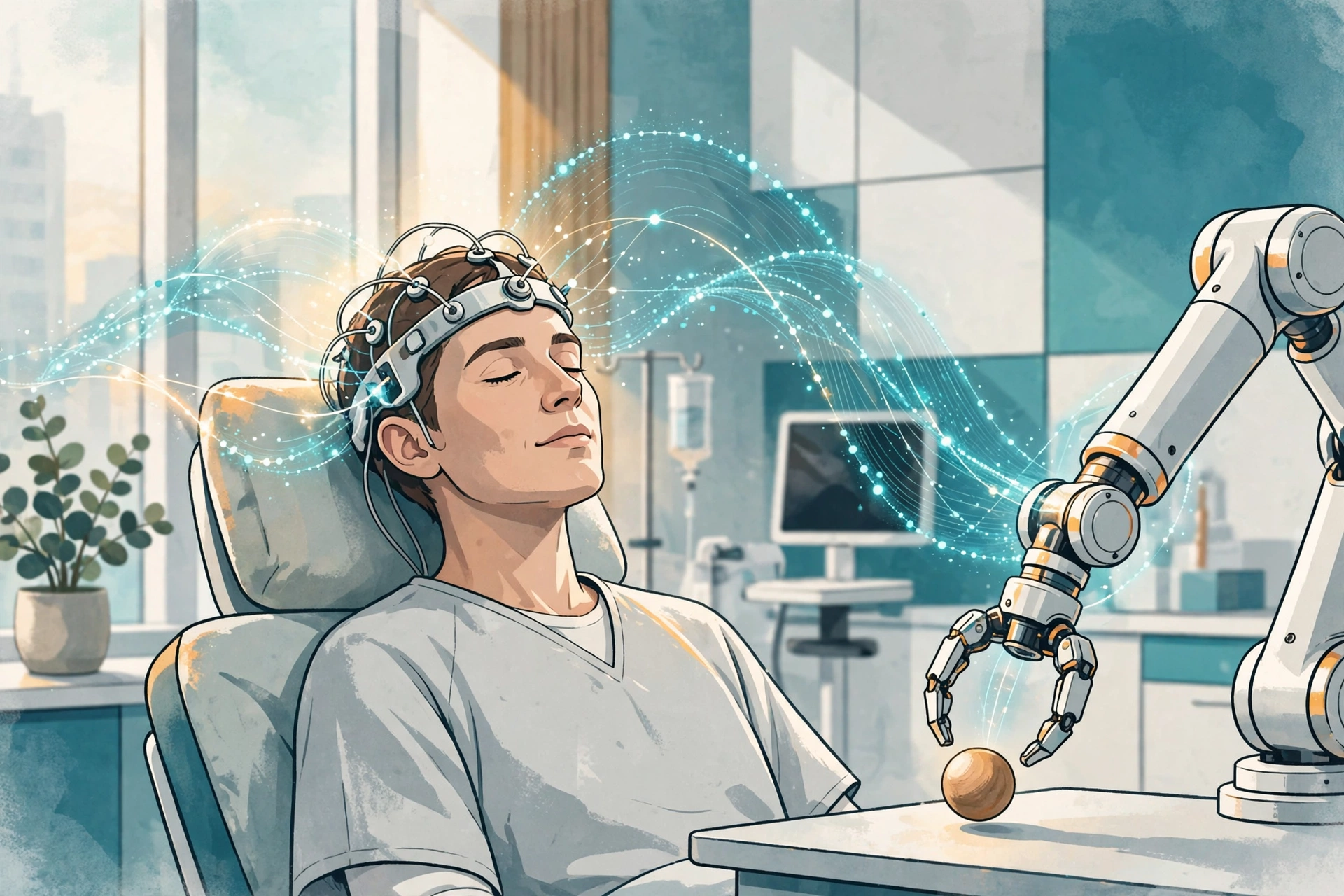
Robotic Limbs and Mobility
Decoded movement intentions can drive robotic arms, prosthetic hands, and exoskeletons. Research participants have used intracortical BCIs to grasp objects with a robotic arm and, in combination with spinal cord stimulation, to explore restored movement of their own limbs. Early trials are even pairing BCIs with thought-controlled exoskeletons and wheelchairs, with reported motor-intent decoding accuracy above 90 percent in controlled settings.
Rehabilitation and Therapy
Beyond replacing lost function, BCIs can help recover it. After a stroke, pairing attempted movement with BCI-detected intent — and rewarding the brain with visual or electrical feedback when it produces the right pattern — appears to strengthen surviving neural pathways through neuroplasticity. Non-invasive BCI pilots for mobility assistance and neurorehabilitation are expanding, particularly in aging populations where stroke and spinal injury are prevalent.
The State of the Race in 2026
The BCI field has accelerated sharply. Total funding more than doubled from about $406 million in 2024 to roughly $1.0 billion in 2025, and clinical trials that once enrolled a handful of patients are scaling toward dozens. Here is where the key players stand:
- Neuralink: The highest-profile invasive BCI, with its robot-implanted N1 device (1,024 electrodes on 64 threads). By mid-2026 the company had implanted more than two dozen participants across its PRIME study, expanded trials to the UK (the GB PRIME study), the UAE, and Canada, and opened the VOICE trial for speech restoration in ALS. Participants have demonstrated cursor control, robotic arm use, and extended daily usage.
- Synchron: The endovascular pioneer. Its COMMAND feasibility study met its primary safety endpoint across all patients with no device-related serious adverse events, and the company is preparing a pivotal clinical trial in 2026 aimed at FDA premarket approval — the milestone that would make it the first FDA-approved BCI. Roughly ten patients have received the Stentrode across its Australian and US studies.
- Paradromics: In November 2025 it received FDA investigational device approval for the Connect-One early feasibility study — the first FDA approval of its kind for speech restoration with a fully implantable BCI — and in June 2026 performed the first-in-human implantation of its Connexus device, which packs hundreds of microelectrodes and has demonstrated 200+ bits per second of information transfer in pre-clinical models.
- Precision Neuroscience: Taking a different commercial path with the Layer 7 Cortical Interface — a thin-film electrode array about a fifth the thickness of a human hair that rests on the brain’s surface without penetrating tissue. The device won FDA 510(k) clearance in April 2025 for temporary use, had been used in more than 68 patients by January 2026, and in January 2026 the company announced a strategic partnership with Medtronic.
- China / Neuracle: In March 2026, China became the first country to grant commercial approval for an invasive BCI medical device, the Neuracle NEO — a reminder that the race is geopolitical as well as technical.
Meanwhile, a new wave of non-invasive approaches is gathering momentum: ultrasound-based techniques from companies like Merge Labs, Nudge, and Gestala aim to read and even stimulate the brain through the skull without surgery. If they work at scale, they could widen BCI access from dozens of surgical patients to millions of consumers.
The Hard Problems Still to Solve
For all the progress, honest accounts of BCIs stress what does not work yet:
Signal Degradation Over Time
Implanted electrodes are foreign bodies, and the brain treats them as such. Glial scar tissue encapsulates penetrating electrodes, gradually muffling the signals they record. Flexible, ultra-thin designs degrade more gracefully than rigid arrays, but no intracortical implant has yet demonstrated decades of stable single-neuron recording. For a device meant to serve a patient for life, longevity is the central engineering problem.
The Non-Invasive Bandwidth Ceiling
Physics limits what scalp electrodes can hear: the skull blurs electrical fields, and the result is a noisy channel carrying only a few bits per second. That is enough for spelling and simple control, but far from the fluid, high-dimensional control of natural movement. Closing that gap without surgery is the field’s hardest open problem.
Surgery, Risk, and Access
Open-brain surgery will never be casual. Infection, bleeding, and tissue damage are real risks, which is why invasive trials enroll only patients with the most severe impairments. Minimally invasive routes like the endovascular approach lower the bar, but the most capable systems still demand the most invasive procedures — a tension that shapes every product roadmap.
Privacy, Security, and Ethics
A device that reads neural signals raises questions no previous technology has faced. What counts as mental privacy when a decoder can infer intent? Could neural data be intercepted or manipulated — a genuine “neurosecurity” concern as implants go wireless? Who owns the data streaming out of someone’s motor cortex? Researchers increasingly argue that ethical frameworks and security standards must mature alongside the hardware, not after it.
What’s Next for Brain-Computer Interfaces
The next decade of BCI development points in several directions at once. Bidirectional interfaces — which not only read from the brain but write back, delivering sensory feedback — could make prosthetic limbs feel embodied rather than merely controlled. Fully wireless, rechargeable implants will cut the tether to external hardware. Higher channel counts, like Blackrock Neurotech’s announced 10,000+ channel flexible arrays, promise richer signals for decoding complex intentions.
On the non-invasive side, ultrasound and improved EEG decoding could bring simple thought control to consumers — for gaming, AR/VR, and accessibility — without any surgery at all. And as speech-decoding systems approach natural conversation speeds, the line between “assistive device” and “new communication medium” will blur.
The trajectory is clear: from Vidal’s 1977 maze demo, to a handful of research implants, to hundreds of patients in regulated trials and a billion dollars of annual funding. Brain-computer interfaces are leaving the laboratory and entering medicine — and the question is shifting from whether thought can control machines to how safely, how well, and for whom.
Conclusion
Understanding how brain-computer interfaces work comes down to one elegant loop: measure the brain’s electrical activity, decode the user’s intent, issue a command, and feed the result back so both human and machine keep learning. The sensors range from scalp EEG caps to thousand-electrode implants threaded into the cortex; the decoders range from simple classifiers to deep neural networks that reconstruct speech. Today, that loop restores communication and independence to people with severe paralysis — and with 2026’s accelerating trials, expanding approvals, and surging investment, the coming years will determine how far thought-controlled technology can go.
Frequently Asked Questions
How do brain-computer interfaces read your thoughts?
BCIs don’t read thoughts the way we imagine mind-reading. They detect patterns of electrical activity associated with intentions — imagining a hand movement, focusing on a letter — and match those patterns to commands using trained algorithms. They decode what you intend to do, not the content of your inner monologue.
Are brain-computer interfaces safe?
Non-invasive BCIs (like EEG caps) are very safe — nothing enters the body. Invasive implants carry surgical risks including infection and bleeding, which is why clinical trials enroll patients with severe paralysis and report safety data carefully; Synchron’s COMMAND study, for example, reported no device-related serious adverse events. All current implants remain investigational, not approved consumer products.
Can you buy a brain-computer interface today?
Consumer EEG headsets for wellness, gaming, and focus training are available, but they offer simple, low-bandwidth control. Medical-grade implants from companies like Neuralink and Synchron are available only through clinical trials. No invasive BCI has broad commercial approval in the US or Europe as of 2026, though China granted a commercial approval for one device in March 2026.
How fast can someone type with a BCI?
Early P300 spellers managed a few characters per minute. Modern research systems decoding attempted handwriting or speech have demonstrated speeds up to around 40 words per minute — approaching slow conversational typing, though still far below able-bodied typing speeds.
Will BCIs ever let healthy people control devices with their thoughts?
Possibly, but the path runs through non-invasive technology: no healthy person will accept brain surgery for convenience. Ultrasound-based and advanced EEG approaches in development aim to deliver useful thought control without implants. If they succeed, consumer applications in gaming, AR/VR, and accessibility could follow within the decade.