
Imagine you are riding in a self-driving car when a child runs into the street. The vehicle must see the danger, decide what to do, and brake — all within a fraction of a second. If the car had to send its camera footage to a data center hundreds of miles away, wait for a computer there to analyze it, and then wait for instructions to come back, it would be too late. Instead, the car processes everything on board, instantly. That is how edge computing works: it brings the computing power to where the data is created, so decisions happen in real time.
From the smartwatch on your wrist to the factory robots building your phone, edge computing has quietly become one of the most important technologies of the modern world. In this complete guide, you will learn exactly how edge computing works, how it differs from cloud computing, where it is being used today, and why analysts expect it to grow into one of the largest technology markets of the decade.
What Is Edge Computing?
Edge computing is a distributed computing model in which data is processed close to where it is generated — “at the edge” of the network — instead of being sent to a distant, centralized cloud data center. The “edge” is simply the physical location where data originates: a factory floor, a hospital room, a car, a retail store, or even the phone in your pocket.
The idea is straightforward. Traditional computing sends nearly everything to the cloud: your device collects data, transmits it over the internet to a massive data center, the data center processes it, and the result travels back. Every one of those trips takes time and consumes bandwidth. Edge computing short-circuits the journey. It places computing resources — small servers, gateways, and intelligent devices — near the data source so that processing, analysis, and even decision-making happen locally.
A simple comparison helps. Cloud computing is like a giant central library that holds every book and answers every question: comprehensive, but you have to travel there. Edge computing is like keeping the reference books you use every day on your own desk. You still visit the library for deep research, but everyday answers are instant.
Importantly, edge computing does not replace the cloud. The two work together as a team. The edge handles the fast, local, time-sensitive work, while the cloud handles long-term storage, heavy-duty training of artificial intelligence models, and coordination across many locations. Together they form what engineers call the “cloud-to-edge continuum.”
Why the Cloud Alone Is No Longer Enough
Cloud computing was a revolution. It gave every startup the power of a supercomputer and made services like streaming video and online storage possible. But three powerful trends have exposed its limits.
First, the explosion of connected devices. Billions of Internet of Things (IoT) devices — sensors, cameras, wearables, vehicles, industrial machines — now generate staggering volumes of data every second. Sending all of it to the cloud is expensive, slow, and often unnecessary. Much of this data is only valuable for a brief moment: a sensor reading that is normal today, for example, is only worth keeping if it reveals a trend.
Second, the demand for instant responses. Modern applications cannot tolerate delay. Autonomous vehicles need to react in milliseconds. Factory robots must stop the instant something goes wrong. Remote medical devices need to raise an alarm without hesitation. Even in everyday life, gamers hate lag, and video calls break down when latency spikes. Light travels fast, but not infinitely fast — the physical distance to a data center alone creates a delay floor that no amount of bandwidth can remove.
Third, privacy, cost, and reliability. Transmitting sensitive data — factory secrets, patient health readings, video from inside a home — across the public internet creates privacy risks and regulatory headaches. Bandwidth costs money, especially for high-resolution video streams. And if the internet connection fails, a purely cloud-dependent system stops working entirely. Edge computing addresses all three problems by keeping data local.
How Edge Computing Works
Now let us walk through exactly how edge computing works, from the sensor that creates data to the insight that comes out the other side. The system is built in layers, and data flows through them in a predictable journey.
The Four Layers of Edge Architecture
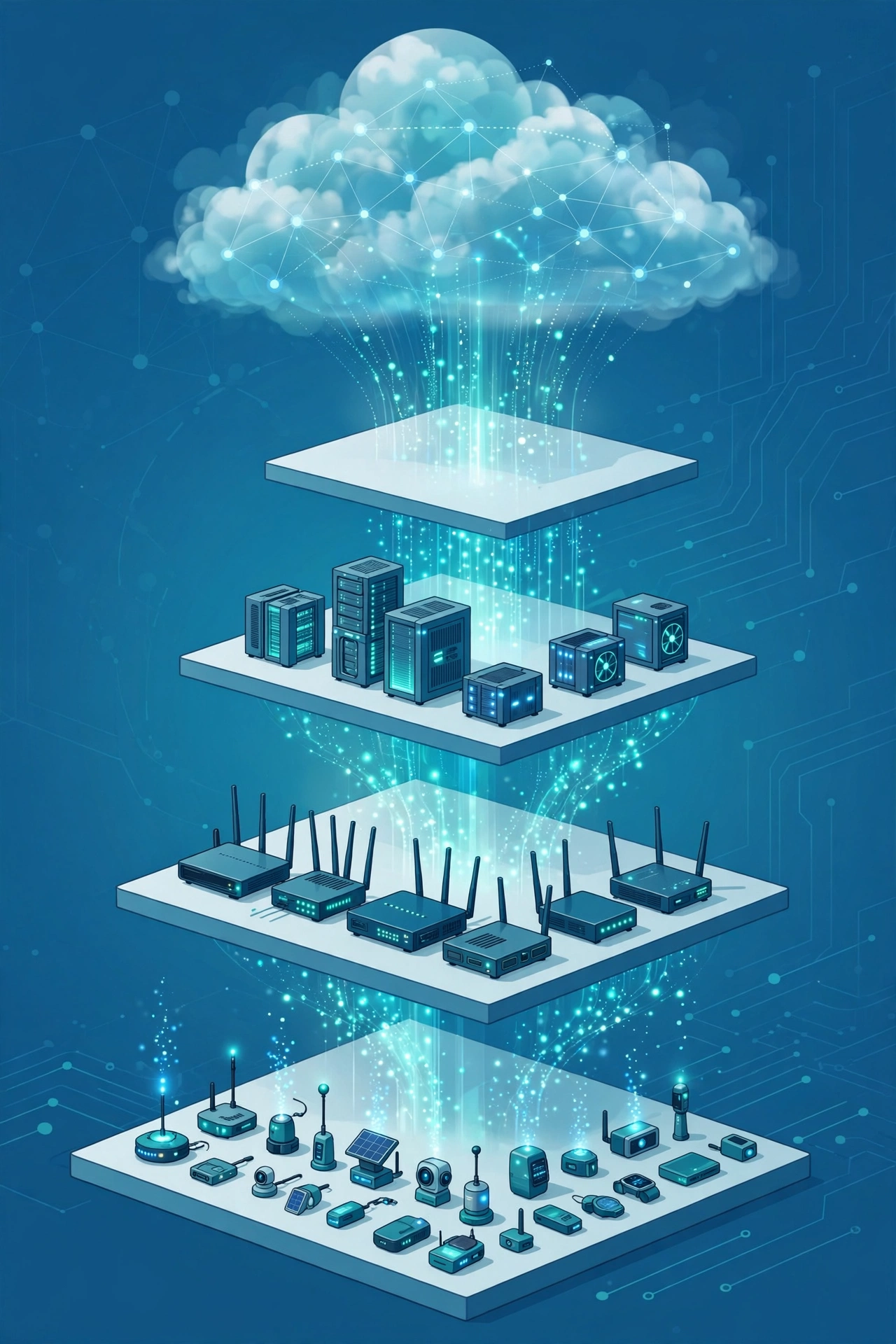
Most edge computing deployments follow a layered architecture. Think of it as a staircase: each step up moves data a little further from its source and toward greater computing power.
- Layer 1 — The device edge: This is where data is born. Smart sensors, cameras, wearables, industrial controllers, and vehicles collect raw information from the world. Many of these devices now have their own modest computing power. Your smartphone is a perfect example: it recognizes your face, enhances your photos, and translates speech locally, without needing a constant connection. This is edge computing in its purest form.
- Layer 2 — The local edge (gateways): Devices often connect to a nearby gateway — a smart router, an IoT hub, or an on-site mini server — that aggregates data from many devices at once. A factory, for instance, might have a gateway that collects readings from hundreds of sensors on the production line, runs quick checks, and triggers immediate alerts when something looks wrong.
- Layer 3 — The regional edge (micro data centers): For heavier workloads, small data centers are placed close to where they are needed: in a telecom facility, a hospital basement, or a shipping container at a mine. These micro data centers run full applications and AI models with plenty of power, but still only milliseconds away from the users they serve. Telecom companies are deploying these widely alongside 5G networks, a combination known as multi-access edge computing.
- Layer 4 — The central cloud: At the top sits the traditional cloud. It receives summarized, filtered data from the edge for long-term storage, big-picture analytics, and training new AI models that are later pushed back down to the edge. The cloud remains the brain’s memory; the edge is its reflexes.
The Data Journey, Step by Step
Let us trace what happens when a smart security camera spots movement in a warehouse at 2 a.m.:
- Generation: The camera’s sensor captures video frames — raw data, thousands of images per minute.
- Local processing: Instead of streaming every frame to the cloud, the camera’s built-in processor analyzes the video on the spot. Is that a person, an animal, or just shadows from a passing car? An AI model running on the camera itself makes the call in milliseconds.
- Filtering: If nothing important is happening, the footage is discarded or stored locally for a short time. Only meaningful events — “a person entered the restricted zone at 2:04 a.m.” — move forward. This is where the enormous bandwidth savings come from: hours of uneventful video never leave the building.
- Action: Because the decision was made locally, the response is immediate: an alert appears on the security guard’s phone, the lights switch on, and the door locks — all within a second of the event.
- Aggregation and learning: A summary of the event, not the raw video, is sent to the cloud. There, it joins data from other sites to reveal patterns — perhaps break-ins cluster around holidays — and to train better detection models, which are then updated on every camera.
This same journey — generate, process locally, filter, act instantly, learn globally — repeats across every edge computing application, from cars to clinics to retail stores.
Edge Computing in Your Everyday Life
You are probably using edge computing far more often than you realize. Newer smart speakers process the wake word (“Hey Siri” or “OK Google”) entirely on the device; only after detecting the trigger does the speaker send your actual request to the cloud, which is faster and keeps more of your voice data at home. Your smartwatch analyzes heart rate, sleep stages, and activity continuously on the watch itself, syncing only summaries to your phone to save battery. Even modern gaming consoles do most rendering and input processing locally, relying on remote servers only for matchmaking and content delivery. Every one of these is edge computing working quietly in the background.
The Major Benefits of Edge Computing
Understanding how edge computing works makes its advantages easy to see. Here are the benefits driving its rapid adoption:
- Ultra-low latency: Processing data meters away instead of miles away cuts response times from hundreds of milliseconds to single digits. For autonomous vehicles, industrial robots, and real-time gaming, this is the difference between working and failing.
- Massive bandwidth savings: By filtering and summarizing data at the source, edge computing can reduce the amount of data sent to the cloud by 90 percent or more. A factory with a thousand sensors no longer needs to stream every reading; it sends only the exceptions.
- Offline resilience: Edge systems keep working when the internet goes down. A hospital’s patient monitors, a mine’s safety systems, and a store’s checkout terminals continue operating on local infrastructure, syncing with the cloud when the connection returns.
- Better privacy and compliance: Sensitive data — medical readings, factory trade secrets, personal video — can be analyzed where it is created and never transmitted at all. This makes it far easier to comply with data-protection regulations that restrict how personal information moves across borders.
- Lower operating costs: Bandwidth, cloud storage, and cloud computing time all cost money. Processing locally and sending only what matters shrinks all three bills.
- Real-time artificial intelligence: Modern AI models are now small and efficient enough to run directly on edge devices — a trend called edge AI. Voice assistants, visual inspection cameras, and translation earbuds all rely on it.
- Scalability without bottlenecks: Adding a new factory, store, or hospital wing means adding local edge capacity, not rebuilding a central system. Growth happens at the edge, where it is needed.
Real-World Edge Computing Examples
Theory is useful, but examples show how edge computing works in practice. Here are the industries where it is already making the biggest difference.
Autonomous Vehicles
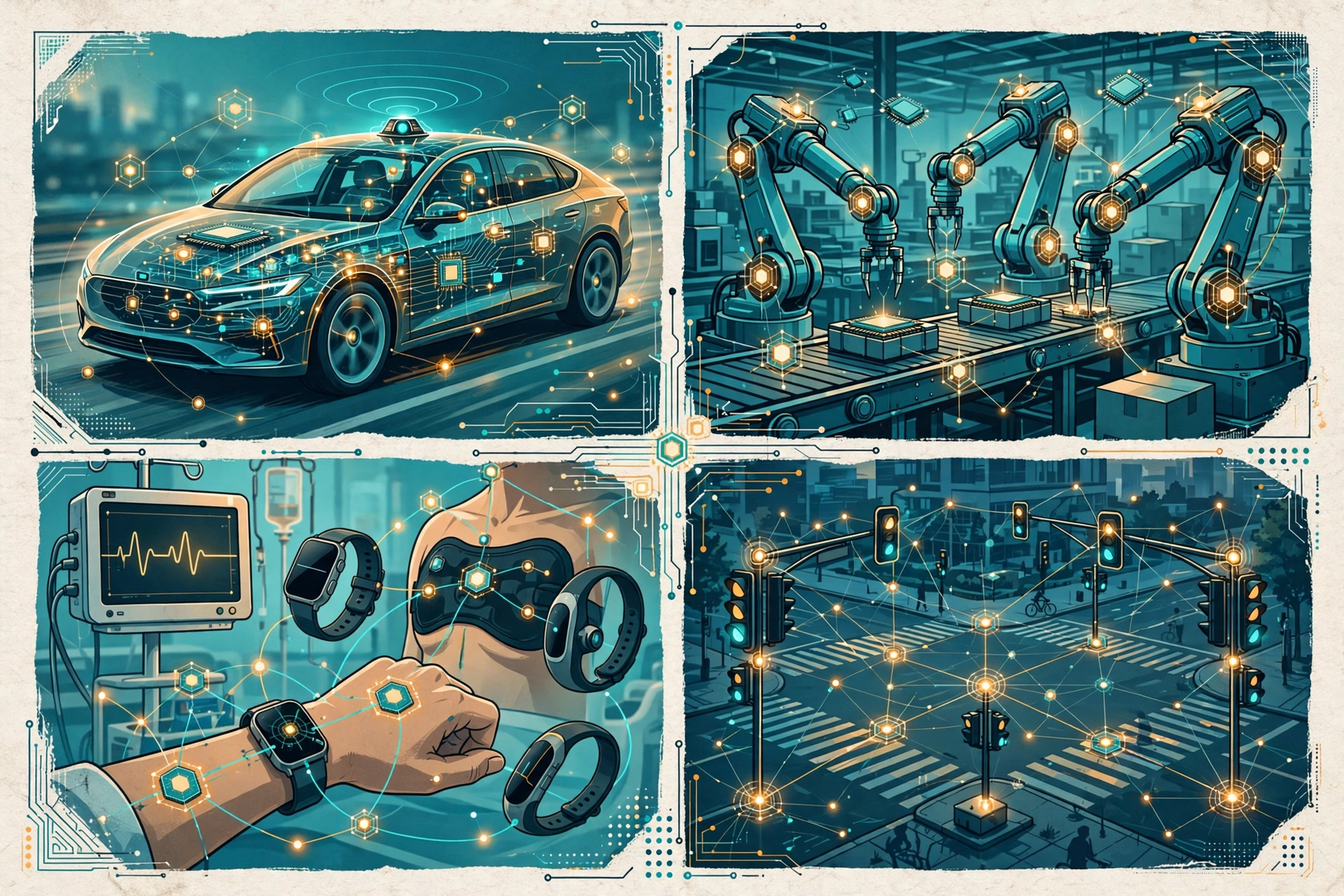
A self-driving car is essentially a data center on wheels. Its cameras, radar, lidar, and ultrasonic sensors generate terabytes of data per hour. None of it can wait for a round trip to the cloud: when a pedestrian steps into the road, the car must decide in milliseconds. Onboard computers process sensor feeds locally, run AI models that recognize objects and predict movement, and trigger braking or steering instantly. Only summarized trip data — routes, near-misses, software performance — is uploaded later so engineers can improve the fleet.
Smart Manufacturing and Predictive Maintenance
Manufacturing is the largest adopter of edge computing today, accounting for roughly a third of deployments. On a modern factory floor, sensors monitor vibration, temperature, and sound on every critical machine. Edge gateways analyze these streams in real time and spot the subtle signature of a bearing about to fail — days before it actually breaks. The result is predictive maintenance: repairs happen during planned downtime instead of causing surprise shutdowns that can cost tens of thousands of dollars per hour. Quality control benefits too: cameras inspect every product as it passes, rejecting defects the instant they appear.
Healthcare and Remote Monitoring
In hospitals, edge computing powers systems that cannot afford delay or disconnection. Patient monitors analyze vital signs at the bedside and trigger alarms locally, so a warning sounds even if the network fails. Portable ultrasound and imaging devices run AI analysis on the spot, giving doctors answers in rural clinics far from any data center. Wearable devices for chronic conditions process continuous health data on the device, alerting patients and caregivers to danger signs immediately. Because sensitive health data stays local, hospitals also find it easier to meet strict privacy regulations.
Smart Cities and Traffic Management
Cities are deploying edge computing to keep traffic flowing and citizens safe. Smart traffic lights analyze camera feeds at the intersection and adjust signal timing to actual conditions — clearing a lane for an approaching ambulance or easing congestion after a sports game ends. Edge-powered surveillance systems detect accidents or crowd surges and alert responders in seconds rather than minutes. Smart street lighting dims when no one is around, saving energy, and environmental sensors track air quality block by block, all processed locally and summarized for city planners.
Retail and Customer Experiences
Retailers use edge computing to make shopping smoother and stores smarter. Checkout-free stores, pioneered by companies like Amazon, use ceiling cameras and shelf sensors to track what shoppers pick up, processing everything in-store so there is no delay at the exit. Digital signage changes promotions based on who is nearby and what is in stock. Inventory robots roam aisles after hours, scanning shelves and updating stock records locally. During peak holiday rushes, edge systems keep point-of-sale terminals running even if the store’s internet connection falters.
5G Networks, Gaming, and Streaming
The rollout of 5G networks and edge computing go hand in hand. Telecom operators are installing small edge servers directly in their cell towers and base stations — multi-access edge computing — so that mobile applications run just one wireless hop away from the user. Cloud gaming services use these nodes to render game frames near players, cutting the lag that ruins fast-paced games. Augmented and virtual reality headsets offload heavy graphics processing to nearby edge servers, keeping the headsets light and the experience smooth. Live video streaming platforms also cache and transcode video at the edge, so a viral broadcast does not collapse under its own popularity.
Edge Computing vs. Cloud Computing vs. Fog Computing
These three terms are often confused. Here is how they relate:
- Cloud computing centralizes processing in large, distant data centers. It offers virtually unlimited scale and power, but every request pays a latency and bandwidth cost. Best for: long-term storage, training AI models, global analytics, and workloads where a delay of a second does not matter.
- Edge computing pushes processing all the way out to the data source — the device itself or a server one step away. It offers the lowest possible latency but limited computing power per location. Best for: real-time decisions, autonomous systems, privacy-sensitive processing, and places with unreliable connectivity.
- Fog computing sits between the two. It adds a computing layer in the local network — between edge devices and the cloud — that handles intermediate aggregation and processing. You can think of fog as the “local edge” layer (Layer 2 in the architecture above) given its own name. Best for: coordinating many edge devices in one building or campus before data goes to the cloud.
In practice, most organizations use all three together. A useful rule of thumb: process at the edge when milliseconds matter, in the fog or local network when coordinating a site, and in the cloud when the question is big, slow, and global. The art of modern system design is choosing the right layer for each workload.
Edge Computing in 2026: Market Growth and Trends
Edge computing has moved from experimental to essential, and the market numbers reflect it. Analyst estimates vary by methodology, but the direction is unanimous: the global edge computing market is valued in the tens of billions of dollars in 2026 and is projected to grow several-fold by the early 2030s, with compound annual growth rates commonly estimated between roughly 28 and 44 percent. Some forecasts put the market above $270 billion by 2030. Manufacturing leads adoption today, while healthcare is the fastest-growing sector as remote monitoring and telemedicine expand. North America currently holds the largest share, with the Asia-Pacific region growing fastest on the back of 5G rollouts and smart-city programs.
Several trends are shaping edge computing in 2026 and beyond:
- Edge AI goes mainstream: Generative AI is being compressed into smaller models that run directly on edge devices, bringing intelligent assistants, visual inspection, and real-time translation to places with no reliable connection.
- 5G and edge converge: As 5G coverage expands — with hundreds of operators investing worldwide — multi-access edge computing at cell sites is becoming the default way to deliver low-latency mobile services.
- Autonomous everything: Self-driving vehicles, delivery drones, warehouse robots, and agricultural machines all depend on local processing, and each new deployment adds edge capacity.
- Data sovereignty: Governments are tightening rules about where data can be stored and processed. Keeping data at the edge, inside national borders, is becoming a compliance strategy as well as a technical one.
- Sustainability: Processing data locally avoids shipping petabytes across the internet, which saves energy in networks and data centers — an increasingly important consideration as data volumes grow.
Challenges and Limitations of Edge Computing
Edge computing is powerful, but it is not free of trade-offs. Anyone planning a deployment should understand the challenges:
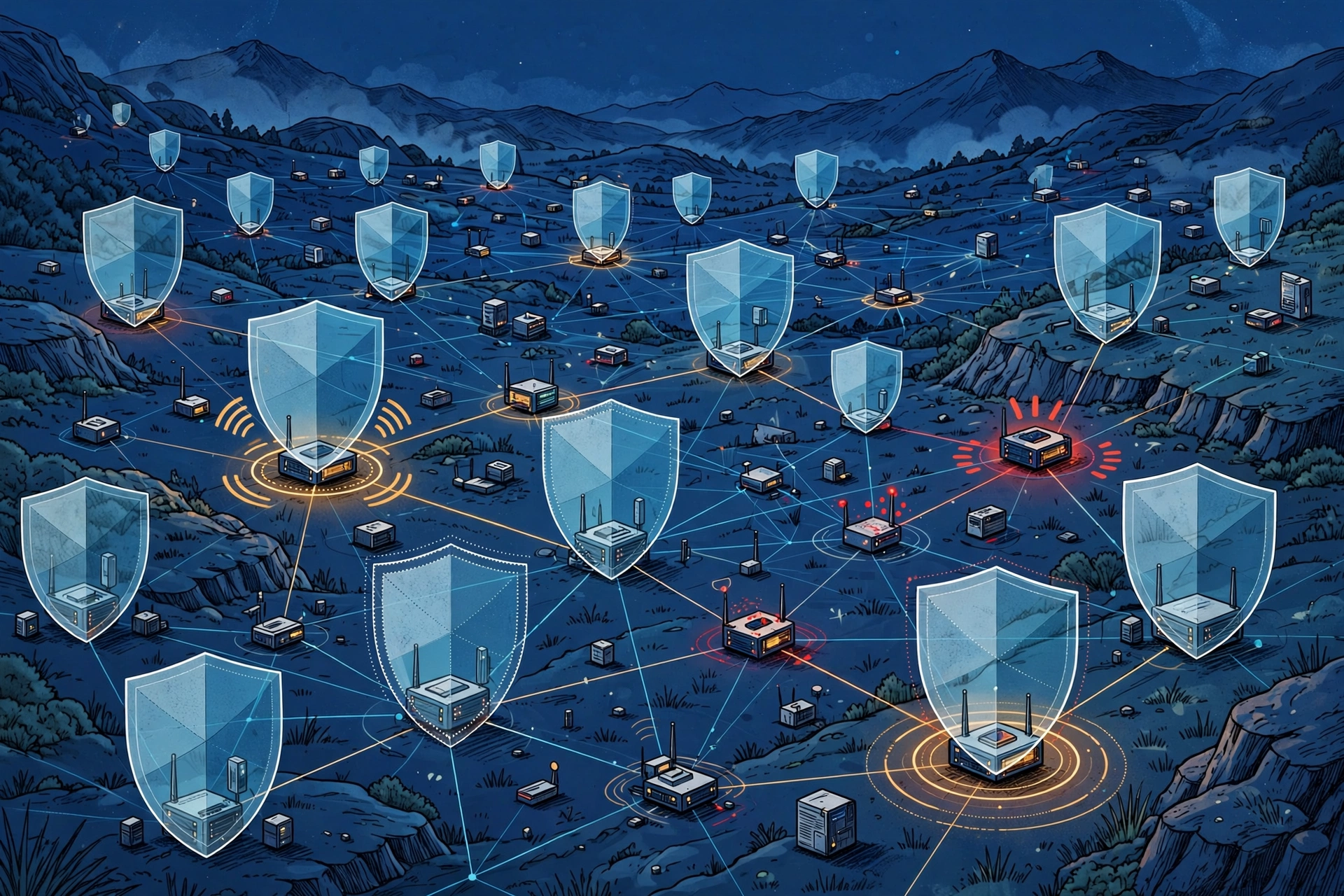
- Security across many locations: A single cloud data center can be guarded like a fortress. Thousands of edge devices spread across factories, streets, and homes cannot. Each device is a potential entry point, so edge deployments need strong encryption, secure device identities, and the ability to patch software remotely — all harder at scale.
- Management complexity: Instead of managing one central system, IT teams must monitor, update, and troubleshoot computing resources scattered across dozens or hundreds of sites. Specialized edge-management platforms exist, but the operational overhead is real.
- Limited local resources: Edge devices and micro data centers have far less computing power, storage, and cooling than hyperscale cloud facilities. Workloads must be carefully designed to fit, and the heaviest tasks still belong in the cloud.
- Upfront investment: Buying and installing edge hardware — gateways, micro data centers, ruggedized servers — costs money before the bandwidth and latency savings arrive. The return on investment is strong for the right workloads but must be calculated honestly.
- Standards are still maturing: The edge ecosystem includes many vendors with different platforms and protocols. Integration work is often needed to make devices, networks, and clouds work smoothly together.
How to Get Started with Edge Computing
If edge computing sounds relevant to your work or business, here is a practical path to begin:
- Find your latency-sensitive workloads: Look for processes where delay causes real harm — safety systems, quality control, customer-facing interactions, or anything that breaks when the internet drops. Those are your edge candidates.
- Start with a pilot: Pick one site, one production line, or one application. Deploy a gateway or a small edge server, measure the improvement in response time and bandwidth use, and build the business case from real numbers.
- Choose the right platform: Major cloud providers all offer edge extensions, and specialized platforms run code directly in global edge networks. Evaluate based on your existing tools, your team’s skills, and where your data lives.
- Design for security from day one: Encrypt data in transit and at rest, give every device a unique identity, plan for remote updates, and assume some devices will be physically accessible to attackers.
- Keep the cloud in the loop: Decide what the edge keeps (real-time decisions, raw sensor streams) and what the cloud keeps (long-term history, trained models, cross-site analytics). A clear division of labor prevents both duplication and gaps.
- Check current pricing: Edge hardware, connectivity, and platform fees change quickly. Get current quotes from vendors before budgeting, and compare the total cost against the bandwidth and downtime savings you expect.
Frequently Asked Questions
Is edge computing replacing cloud computing?
No. Edge computing and cloud computing are complements, not competitors. The edge handles fast, local, real-time work; the cloud handles storage, heavy computation, and global coordination. Nearly every real deployment uses both, with each doing what it does best.
Is edge computing secure?
It can be, but it requires deliberate design. Keeping sensitive data local reduces exposure during transmission, which is a genuine security advantage. At the same time, distributing hardware across many locations creates more physical and network entry points. Encryption, device authentication, and remote patching are essential.
What is the difference between edge computing and fog computing?
Fog computing is a middle layer between edge devices and the cloud — typically the local network infrastructure that aggregates data from many devices. Edge computing processes data at or very near the source itself. In many modern architectures, fog is simply treated as one of the edge layers.
What devices use edge computing?
Smartphones, smartwatches, smart speakers, security cameras, industrial sensors, autonomous vehicles, medical monitors, retail point-of-sale systems, drones, and gaming consoles all use edge computing today. If a device makes a quick decision on its own, edge computing is probably involved.
Conclusion
Understanding how edge computing works comes down to one simple principle: process data where it is created. By moving computing power to the edge of the network — into devices, gateways, and nearby micro data centers — organizations slash latency, save bandwidth, protect privacy, and keep critical systems running even when the internet fails.
From the car that brakes itself to the factory that predicts its own breakdowns, edge computing is already woven into daily life, and its growth through 2026 and beyond shows no sign of slowing. The cloud gave us unlimited computing at a distance; the edge gives us instant computing where it counts. Together, they are building the responsive, intelligent infrastructure the next decade of technology will run on.