
You have probably heard that quantum computers could one day crack encryption, design life-saving drugs in days, and solve problems that would take today’s supercomputers longer than the age of the universe. Those claims are exciting — and, with caveats, broadly true. But what does it actually mean for a computer to be “quantum”? If you have ever felt that explanations of this technology either drown you in physics equations or hand-wave everything away, this guide is for you. This is how quantum computing works explained for beginners: no physics degree required, no hype unchecked, and no hand-waving left unchallenged.
By the end of this article, you will understand the fundamental building blocks of a quantum computer, how they differ from the laptop or phone you use every day, how quantum algorithms turn strange physics into useful answers, where the technology is genuinely useful today, and — just as importantly — where its real limits are. Let us start with the single most important idea: the difference between a bit and a qubit.
Classical Computing vs Quantum Computing: The Bit and the Qubit
Everything your phone, laptop, or game console does comes down to bits. A bit is the smallest unit of information in classical computing, and it is ruthlessly simple: it can be a 0 or a 1, never anything in between. Millions of bits flow through logic gates — the AND, OR, and NOT operations etched into silicon chips — and from those two humble values emerge videos, spreadsheets, video games, and artificial intelligence.
Quantum computers replace the bit with a qubit (short for “quantum bit”). A qubit also reads out as 0 or 1 when you measure it, but in between measurements it can exist in a combination of both states at once. This is not a quirk of engineering; it is a consequence of the laws of quantum mechanics, the branch of physics that describes how matter and energy behave at the tiniest scales. The entire power — and difficulty — of quantum computing flows from this one difference.
Here is how the two compare side by side:
| Feature | Classical bit | Quantum qubit |
|---|---|---|
| Possible values | Exactly 0 or 1 | 0, 1, or a combination of both until measured |
| How it is read | Reading does not change it | Reading collapses it to 0 or 1 |
| Copying | Can be copied freely | Cannot be perfectly copied (no-cloning theorem) |
| Error rates | Around one error in 10^17 operations | Around one error in 10^3 to 10^4 operations |
| Best use case | Everyday computing, graphics, web, databases | Optimization, simulation, cryptography, machine learning |
The key insight is that a quantum computer is not simply a faster classical computer. It is a different kind of machine that answers a different class of questions. Your laptop will remain better at browsing the web and playing videos forever. A quantum computer’s advantage appears only for problems with a particular mathematical structure — but for those problems, the advantage can be staggering.
The Three Pillars: Superposition, Entanglement, and Interference
Every explanation of how quantum computing works rests on three ideas from quantum mechanics. You do not need to master the math, but you do need an honest, working intuition for each one.
1. Superposition: Many Possibilities at Once
The most famous quantum idea is superposition: a qubit can be in a combination of 0 and 1 simultaneously. The classic analogy is a spinning coin. A coin lying flat on the table is definitely heads or definitely tails. But while it spins in the air, it is — in a loose but useful sense — neither, and you can think of it as partly both until it lands. Measurement is the landing: the moment you read a qubit, it “collapses” to a definite 0 or 1, with probabilities set by its pre-measurement state.
Superposition becomes powerful when qubits combine. Two qubits can represent four combinations at once (00, 01, 10, 11); three can represent eight. The number of simultaneous combinations grows as 2^n, where n is the number of qubits. With just 30 qubits, a quantum system can hold roughly a billion combinations in superposition at the same time. This exponential scaling is why quantum machines can explore vast solution spaces that classical computers must grind through one candidate at a time.
2. Entanglement: The Quantum Link
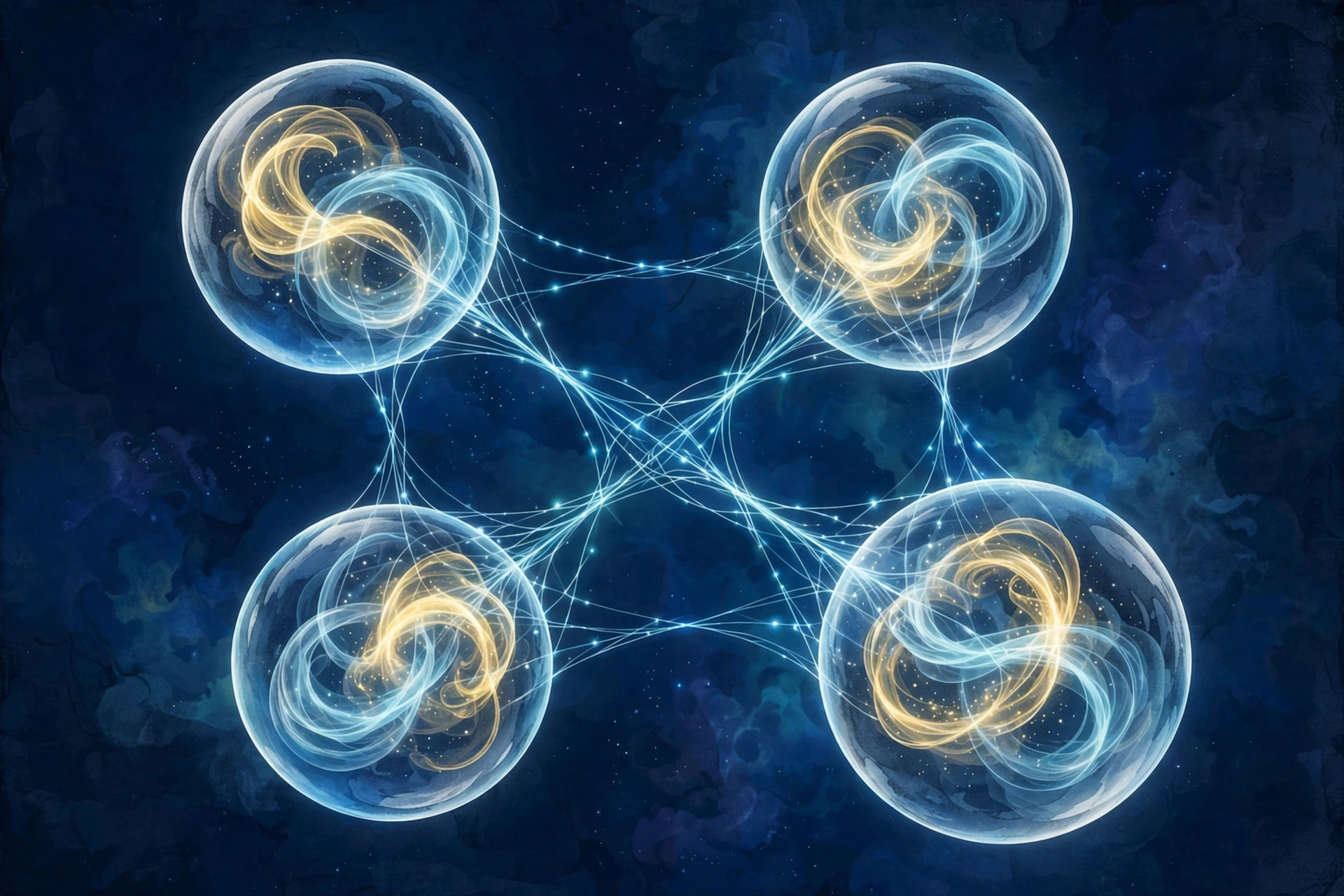
Entanglement is the phenomenon Einstein famously called “spooky action at a distance.” When two qubits become entangled, their states are linked in a way that has no classical counterpart: measuring one instantly tells you something about the other, no matter how far apart they are. Imagine two magic dice that, whenever one shows a six, the other shows a six too — every single time, instantly, even if they are in different cities.
In computing terms, entanglement lets qubits share information and coordinate in ways classical bits cannot. Entangled qubits act as a single system with joint properties, and quantum algorithms use these correlations to process information collectively. Superposition supplies the vast space of possibilities; entanglement weaves the qubits together so the machine can manipulate that entire space as one coherent whole.
3. Interference: Amplifying the Right Answers
The third pillar is the least discussed and arguably the most important for understanding how quantum computing works. Quantum interference works like waves in water: when two waves meet, their crests can add up (constructive interference) or cancel out (destructive interference). Quantum states behave the same way.
Quantum algorithms are carefully choreographed sequences of operations that make the probability waves of wrong answers cancel each other out while the waves of right answers reinforce each other. By the time the qubits are measured, the correct answer has the highest probability of being observed. This is the crucial point beginners often miss: quantum computers do not simply “try everything at once and pick the best.” They try everything at once and then use interference to make the best answer the most likely one to survive measurement.
How Quantum Computing Works: From Qubits to Answers
With the three pillars in place, here is the actual workflow of a quantum computation, simplified but accurate:
Step 1: Initialization
All qubits are prepared in a known starting state, conventionally all 0s. This is like clearing a whiteboard before you begin a calculation. Depending on the hardware, initialization might mean cooling superconducting circuits to near absolute zero, trapping individual ions with electromagnetic fields, or aligning the spins of atomic nuclei.
Step 2: Applying Quantum Gates
Classical computers use logic gates (AND, OR, NOT) to flip bits. Quantum computers use quantum gates — operations that rotate qubits through superposition and weave them into entanglement. A quantum program is a quantum circuit: a sequence of gates applied to the qubits in a precise order. Designing that sequence is what quantum algorithm development is all about. Famous algorithms like Shor’s algorithm (for factoring large numbers) and Grover’s algorithm (for searching unsorted databases) are specific gate sequences that exploit interference to deliver speedups over any known classical method.
Step 3: Measurement
Reading the qubits collapses their superpositions into definite 0s and 1s — the actual output you see. Because the pre-measurement state is probabilistic, a single run of a quantum program gives only one sample from a probability distribution. That is why well-designed algorithms use interference: they stack the odds so the correct answer dominates that distribution.
Step 4: Repeat and Analyze
A quantum computation is typically run many times — called “shots” — and the results are tallied. The most frequent outcome is taken as the answer. This repetition is normal and expected; it is how the probabilistic nature of quantum mechanics is converted into reliable classical information.
Five Types of Quantum Computing Hardware
There is no single agreed way to build a quantum computer. Different companies bet on different physical systems to serve as qubits, each with distinct trade-offs:
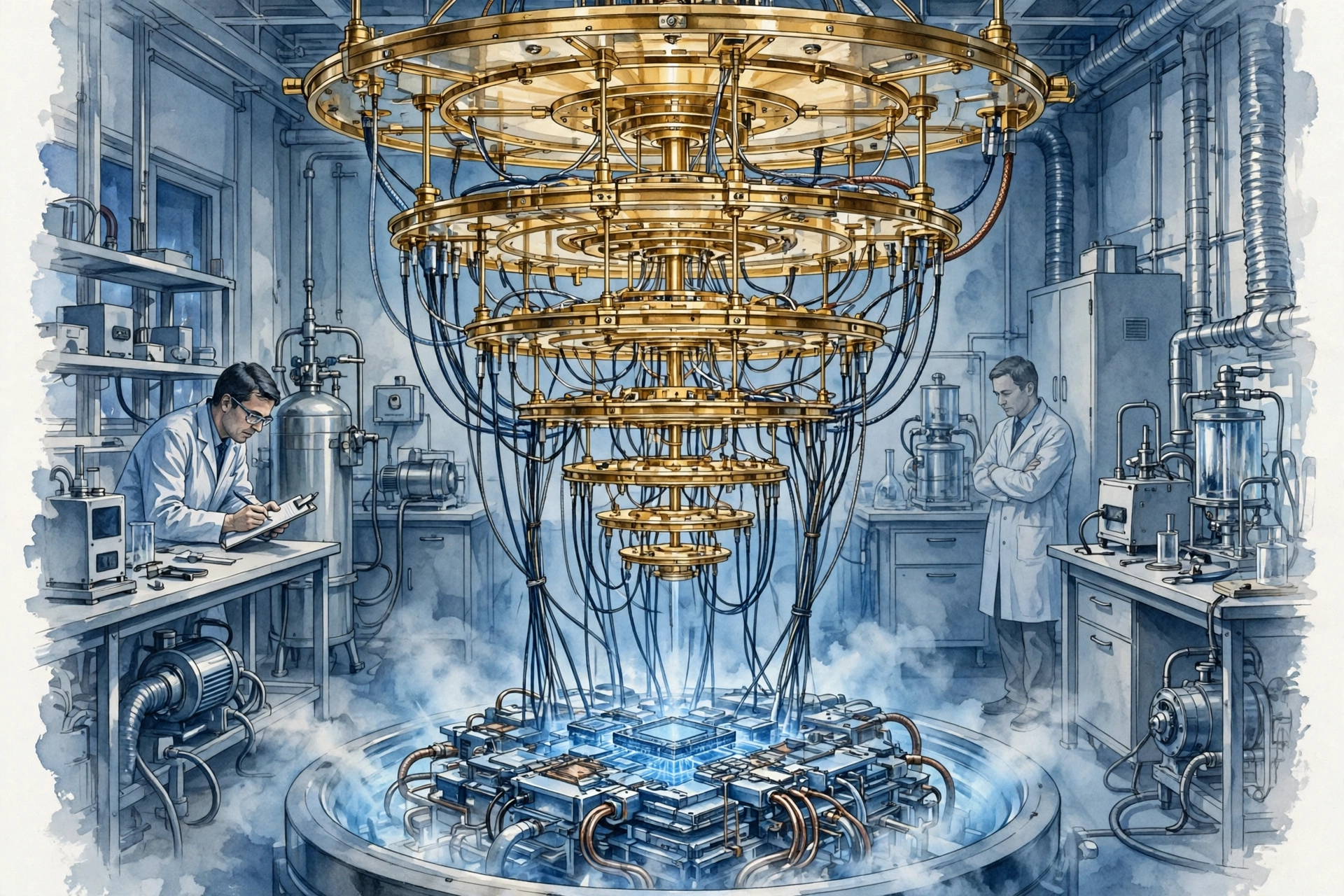
- Superconducting qubits: Tiny electrical circuits cooled to around 20 millikelvin — colder than outer space — where current can flow in quantum superposition. Used by IBM, Google, and Rigetti. Fast and increasingly scalable, but they demand extreme cooling and suffer from short-lived quantum states.
- Trapped ions: Individual charged atoms held in place by electromagnetic fields and manipulated with lasers. Used by IonQ and Quantinuum. They boast long coherence times and very high accuracy, though scaling to large numbers of ions is an engineering challenge.
- Photonic qubits: Particles of light guided through optical circuits. Used by PsiQuantum and Xanadu. A major attraction is that they can operate at room temperature, avoiding the giant refrigerators superconducting machines need.
- Neutral atoms: Uncharged atoms held in grids by optical tweezers (focused laser beams). Used by QuEra, Pasqal, and Atom Computing. They combine good scalability prospects with relatively long coherence times.
- Silicon spin qubits: Individual electrons trapped in silicon structures — the same material as conventional chips. Pursued by Intel and several startups. The dream is to leverage the existing semiconductor industry to manufacture quantum chips the way we manufacture classical ones today.
No technology has yet won decisively. The field is in a phase reminiscent of the early computer era, when vacuum tubes, relays, and transistors all competed — and it may be years before one approach dominates, if any ever does.
Real-World Applications: Where Quantum Computing Actually Helps
Quantum computers will not replace your laptop. They will, however, transform specific domains where the structure of the problem matches what quantum machines do well. Here are the areas with the strongest near- and medium-term promise:
Drug Discovery and Materials Science
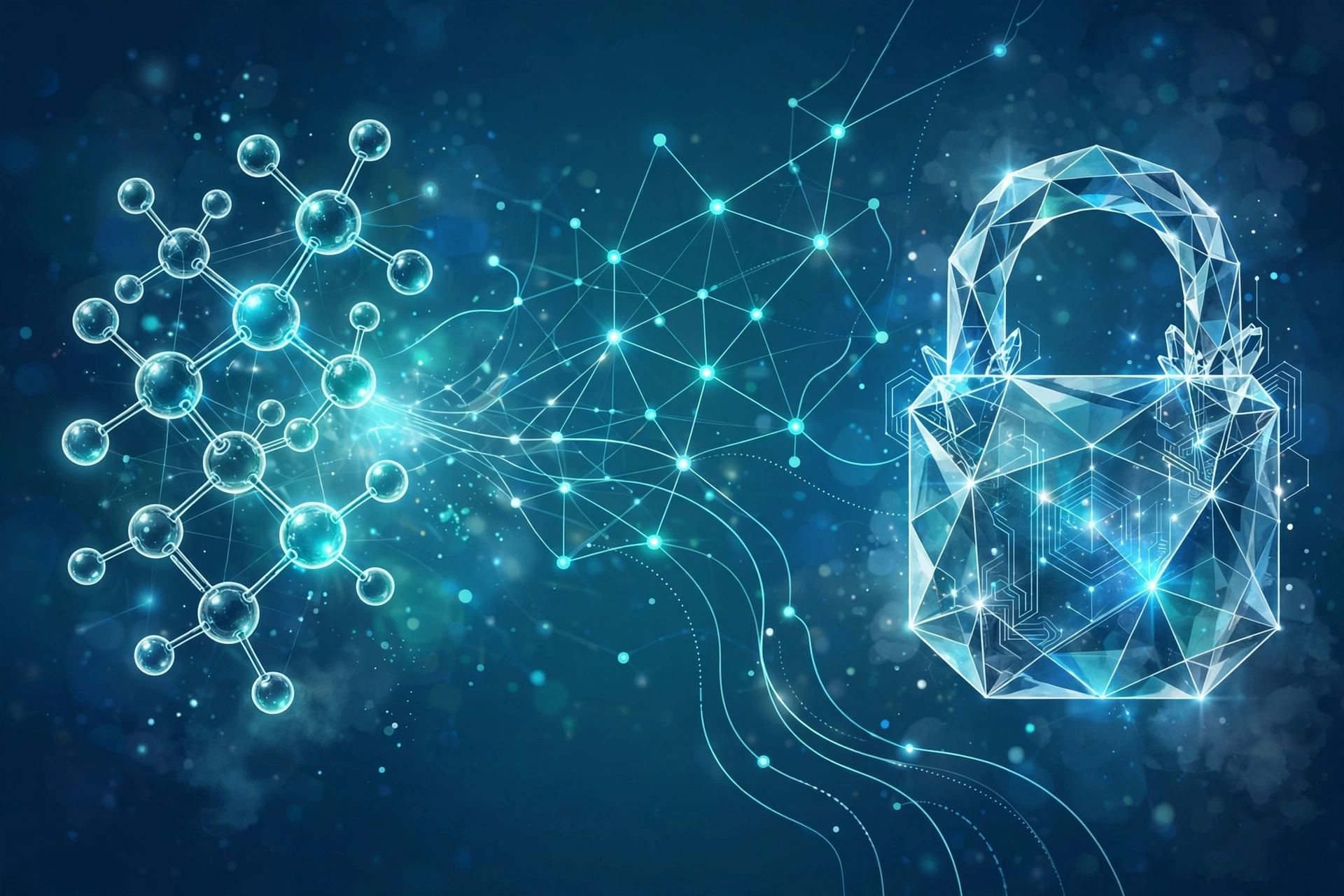
Molecules are quantum systems, and simulating them on classical computers becomes exponentially harder as molecules grow. Quantum computers can model molecular interactions natively, which could dramatically speed up the discovery of new drugs, catalysts, and materials — from better batteries to more efficient fertilizers. Pharmaceutical and chemical companies are already running early-stage experiments on today’s machines.
Cryptography and Cybersecurity
This is the application that made quantum computing famous — and infamous. In 1994, mathematician Peter Shor showed that a sufficiently large quantum computer could factor the enormous numbers that underpin RSA encryption, the system protecting most of the world’s secure communications. Building such a machine remains years away, but the threat is real enough that governments and standards bodies are already migrating to post-quantum cryptography: new encryption algorithms designed to resist quantum attack. The U.S. National Institute of Standards and Technology (NIST) has been standardizing these algorithms through the mid-2020s.
Optimization and Logistics
Many business problems — routing delivery fleets, scheduling airline crews, balancing financial portfolios — are optimization problems: find the best arrangement among an astronomical number of possibilities. Quantum algorithms, particularly a family called quantum approximate optimization, are natural fits. Logistics, manufacturing, and finance companies are exploring quantum approaches to squeeze efficiency from systems classical solvers struggle with.
Artificial Intelligence and Machine Learning
There is growing overlap between quantum computing and AI. Quantum machine learning explores whether quantum circuits can recognize patterns in data more efficiently than classical neural networks. Results are early, but the combination of two transformative technologies is attracting heavy research investment — and, fittingly, classical AI is also being used to help design better quantum hardware and error-correction schemes.
Finance and Risk Modeling
Banks and investment firms live on probabilistic modeling: pricing derivatives, assessing portfolio risk, and running Monte Carlo simulations that consume enormous classical compute. Quantum algorithms can, in principle, accelerate these simulations quadratically — turning hours of computation into minutes. Several major financial institutions now run quantum research teams.
Challenges: Why Quantum Computers Are Not Everywhere Yet
An honest beginner’s guide must cover the obstacles, because they are formidable:
- Decoherence: Qubits are exquisitely sensitive to their environment. Heat, vibration, and even stray electromagnetic noise destroy quantum states in fractions of a second. Keeping hundreds or thousands of qubits coherent long enough to finish a computation is one of the hardest engineering problems in modern science.
- Error rates: As the comparison table showed, qubit operations fail thousands of times more often than classical transistor operations. Quantum error correction — spreading one logical qubit across many physical qubits — works in principle, but it multiplies the hardware needed by orders of magnitude.
- Extreme operating conditions: Superconducting machines require dilution refrigerators that cool chips to a few thousandths of a degree above absolute zero. The infrastructure is expensive, bulky, and power-hungry.
- Limited problem scope: Quantum speedups apply only to problems with the right mathematical structure. For word processing, web browsing, video rendering, and most everyday software, a classical computer will always win.
- Cost and access: Quantum computers cost millions of dollars. Most developers access them through the cloud — IBM Quantum, Amazon Braket, and Microsoft Azure Quantum all offer pay-per-use access — but hands-on hardware time remains a scarce resource.
- Talent shortage: Quantum programming requires thinking in linear algebra and probability rather than step-by-step logic. The pool of trained quantum software developers is still small, though growing fast.
Quantum Computing in 2026: Where the Field Stands Today
As of 2026, quantum computing has moved decisively from laboratory curiosity to serious industry. Private venture capital investment in quantum technology startups reached an estimated $12.6 billion in 2025 — more than six times the 2024 figure — according to industry analyses, signaling deep long-term confidence. Surveys of enterprise technology leaders in early 2026 found that a large majority of big companies were already experimenting with quantum computing in some form, up sharply from just a few years earlier.
On the hardware front, the headline race is toward fault tolerance: machines with enough high-quality qubits, plus error correction, to run long, reliable computations. IBM, Google, Quantinuum, and IonQ have each published roadmaps targeting fault-tolerant systems within the decade, with steady progress on the two metrics that matter most — qubit count and error rate. Meanwhile, cloud access has democratized experimentation: students and startups can run circuits on real quantum processors from a laptop, often free for small jobs.
Governments have also entered the race. The United States, the European Union, China, the United Kingdom, Canada, and others have each committed billions to national quantum initiatives, treating the technology as strategic infrastructure on par with semiconductors. Expect this public investment to accelerate both hardware progress and the development of quantum-safe encryption standards.
How to Start Learning Quantum Computing
The good news for beginners is that the field has never been more accessible. You do not need a physics PhD to write your first quantum program — basic linear algebra and Python are enough to get started.
- Qiskit (IBM): The most popular open-source quantum programming framework, with extensive free tutorials and access to real IBM quantum hardware through the cloud.
- Microsoft Azure Quantum: A cloud platform offering access to multiple hardware providers plus a development kit with learning resources.
- Amazon Braket: Another cloud route to real quantum processors from several hardware companies.
- Online courses: Universities and platforms now offer introductory quantum computing courses aimed at programmers rather than physicists — look for ones that emphasize hands-on circuit building over theory.
- Textbooks for the motivated: The standard rigorous introduction remains Nielsen and Chuang’s Quantum Computation and Quantum Information, though beginners may prefer gentler, code-first guides.
A practical first project: implement a two-qubit circuit that creates entanglement (a Hadamard gate followed by a CNOT gate), run it on a simulator, then on real hardware, and compare the results. You will have touched superposition, entanglement, gates, measurement, and noise — the entire stack — in a single afternoon.
Frequently Asked Questions About How Quantum Computing Works
Will quantum computers replace regular computers?
No. Quantum computers are specialized accelerators for specific problem types — optimization, simulation, factoring, and certain machine learning tasks. Classical computers remain vastly better at everyday computing, and the future is hybrid: classical and quantum processors working together, each handling what it does best.
How long until quantum computers are useful?
It depends on the application. Narrow, specialized advantages on today’s noisy machines are already being demonstrated in research settings. Broad, commercially transformative fault-tolerant quantum computers are widely expected within the next decade, though timelines vary by company and hardware approach. Treat any precise date with skepticism — roadmaps slip.
Should I be worried about quantum computers breaking encryption?
Not today. The machines capable of breaking modern RSA encryption do not exist yet and would need millions of high-quality qubits — far beyond current hardware. However, the migration to quantum-safe cryptography is already underway precisely because encrypted data stolen today could be decrypted years from now. It is a “prepare now, worry later” situation.
Do I need to know quantum physics to learn quantum computing?
You need less physics than you think and more math than you might expect. The essential toolkit is linear algebra (vectors, matrices) and basic probability, plus programming experience. Many successful quantum developers come from computer science and software engineering backgrounds, not physics.
Can I try a real quantum computer for free?
Yes. IBM Quantum, Amazon Braket, and Microsoft Azure Quantum all offer free or low-cost tiers that let you run small circuits on simulators and, with limits, on actual quantum hardware. Start with a simulator to learn the concepts, then submit a job to real hardware to experience noise and decoherence firsthand.
Conclusion
Quantum computing is not magic, and it is not just hype either. It is a new model of computation built on three genuinely strange features of nature — superposition, entanglement, and interference — that together let certain problems be solved in fundamentally more efficient ways. The machines are real, the progress is measurable, and the investment flowing into the field in 2026 reflects a serious belief that fault-tolerant quantum computers will arrive within years, not decades.
At the same time, clear-eyed beginners should remember the limits: qubits are fragile, error rates are high, and quantum advantage applies only to problems with the right structure. Your laptop is safe. But for drug discovery, materials science, optimization, and cryptography, the quantum era is already beginning — and understanding how quantum computing works today puts you ahead of the curve for whatever comes next.