
Imagine skipping a 90-minute crawl through gridlocked city streets and instead arriving at your destination in ten quiet minutes, floating above the traffic in a clean, whisper-quiet aircraft that takes off vertically from a rooftop pad. That is the promise of the electric air taxi, and in 2026 it is closer to reality than ever before. Companies like Joby Aviation and Archer Aviation are in the final stages of certification with regulators, demonstration flights are already connecting airports to city centers, and governments are building the legal frameworks that will let these aircraft carry paying passengers. Understanding how electric air taxis work is the key to seeing why this new category of flight is both plausible and profoundly different from anything that has flown before.
This guide explains the technology step by step: the electric propulsion systems, the tilting rotors that let one aircraft behave like both a helicopter and an airplane, the batteries that make it possible, the charging and vertiport infrastructure being built, the safety systems and regulations that govern it, and the economics that will decide whether electric air taxis become an everyday transport option or a niche luxury. Whether you are an aviation enthusiast, an investor, or simply curious about the future of cities, you will finish this article with a complete picture of how electric air taxis work and where they are headed.
What Is an Electric Air Taxi?
An electric air taxi is a small aircraft designed to carry a handful of passengers — typically four to six — on short trips of roughly 20 to 100 miles, powered entirely or primarily by electricity rather than fossil fuel. The technical term you will see most often is eVTOL, which stands for electric vertical take-off and landing. Unlike helicopters, which need runways of spinning complexity and roaring turbine engines, eVTOLs use multiple small electric motors and propellers to lift off vertically, then transition to efficient forward flight like an airplane.
The concept builds on decades of electric propulsion research, but three things converged in the 2020s to make it practical:
- Battery energy density finally reached levels where a useful passenger payload could be carried for useful distances.
- Electric motors proved reliable enough, cheap enough, and light enough to be distributed across many small propellers instead of one large rotor.
- Distributed electric propulsion — using many small motors instead of one or two large ones — opened up aircraft designs that simply cannot exist with conventional engines.
The result is a new aircraft category that is quieter, cleaner, cheaper to operate, and potentially safer than the helicopter, aimed squarely at replacing ground transportation on the most congested routes in and around cities.
How Electric Air Taxis Work: The Core Technology
To understand how electric air taxis work, it helps to think of them as a hybrid of three machines you already know: a helicopter (for vertical take-off and landing), an airplane (for efficient cruise flight), and an electric car (for the battery-powered drivetrain). The magic is in how these three ideas are fused into one airframe.
Distributed electric propulsion
Conventional aircraft — and helicopters in particular — rely on one or two powerful engines driving one large rotor. If that engine or rotor fails, the situation is immediately critical. Electric air taxis take the opposite approach: they spread the work across many small electric motors, each driving its own propeller. Joby’s S4 aircraft, for example, uses six tilting propellers; Archer’s Midnight uses twelve smaller propellers on six arms, with the forward six tilting for cruise.
This distribution delivers several advantages:
- Redundancy: losing one motor out of six or twelve is far less serious than losing a helicopter’s single main rotor drive. Flight-control software redistributes thrust automatically across the remaining motors.
- Simplicity: electric motors have far fewer moving parts than turbine engines or piston engines. There is no gearbox, no complex transmission, no hot-section inspections — maintenance drops dramatically.
- Noise control: many small propellers turning at moderate speeds are dramatically quieter than one large rotor. Most eVTOL designs target noise levels of around 65 decibels during flyover — roughly the volume of a normal conversation, and about 100 times quieter (in perceived energy) than a helicopter.
- Efficiency: electric motors convert more than 90 percent of electrical energy into mechanical work, compared with roughly 30–40 percent thermal efficiency for a turbine engine. Even accounting for battery weight, the energy economics favor electricity on short routes.
The tilt-rotor transition: how electric air taxis lift and cruise
The signature maneuver of an electric air taxi is the transition between vertical and forward flight. Here is how it works in a tilt-rotor design, the most common configuration:
- Vertical take-off: the rotors point upward, acting like a multi-rotor drone or helicopter. All motors run at high power to lift the aircraft straight off the pad. This phase uses the most energy per minute of the entire flight.
- Transition: once airborne and clear of the pad, the rotor nacelles gradually tilt forward. The aircraft accelerates, and the wing begins to generate lift. As wing lift grows, the rotors shift from “lifting the aircraft” to “pulling it forward.”
- Cruise: with the rotors fully forward, the aircraft flies like a conventional airplane, with the wing doing most of the lifting work. Cruise is by far the most energy-efficient phase, which is why eVTOLs are winged aircraft rather than pure multirotor drones.
- Approach and landing: the process reverses. The aircraft slows, rotors tilt back up, and it descends vertically onto the landing pad.
Flight-control software manages this transition continuously, adjusting each motor’s speed dozens of times per second. The pilot (or, eventually, autonomous systems) commands a desired flight path; the computers decide which motors spin how fast. This is a major reason electric air taxis are expected to be simpler to fly than helicopters: the hardest parts of rotorcraft handling are automated away.
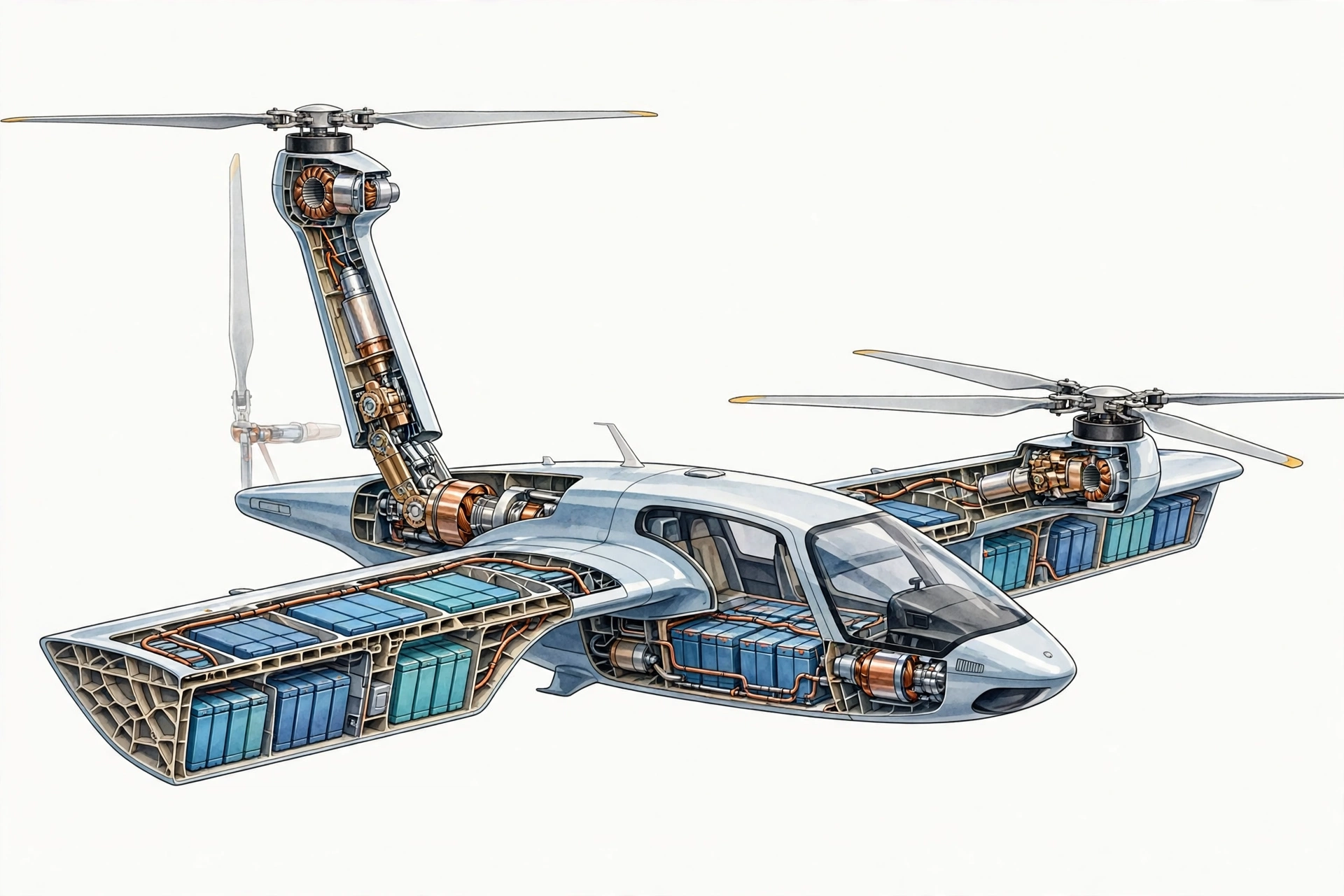
Batteries: the heart of the electric air taxi
The battery pack is the single most important — and most limiting — component of an electric air taxi. Modern eVTOLs use lithium-ion battery packs, similar in chemistry to those in electric cars but engineered for aviation’s far stricter demands around weight, power output, and safety.
Aviation batteries must satisfy three competing requirements at once:
- Energy density (how much energy per kilogram): this determines range. Take-off and landing demand enormous power for short bursts, while cruise demands sustained moderate power. Battery designers balance these with cells optimized for both high discharge rate and reasonable total capacity.
- Power density (how fast energy can be delivered): vertical lift needs far more instantaneous power than cruise. The pack must deliver surge power without overheating or degrading.
- Safety: thermal runaway — a chain reaction of overheating cells — is unacceptable in the air. Aviation battery packs use sophisticated cooling, cell isolation, fire containment, and battery-management systems that monitor every cell’s temperature, voltage, and state of charge in real time.
Typical eVTOL ranges today sit in the 60–150 mile band on a full charge, depending on the aircraft, payload, and reserve requirements. That sounds short compared with airliners, but it is exactly right for the mission: the busiest urban air taxi routes are 20–60 miles. Crucially, aviation regulations require reserve energy — enough battery to fly to an alternate landing site plus a safety margin — so the advertised range is always less than the aircraft’s theoretical maximum.
Operators are also planning rapid charging between flights, with target turnaround times of roughly 10–15 minutes at vertiports. Some designs allow battery swapping, though fast charging with high-power DC systems is the leading approach. Because electricity is far cheaper per unit of energy than jet fuel, energy costs per seat-mile are expected to be a fraction of helicopter operating costs — one of the core economic arguments for the whole industry.
eVTOL Designs: Tilt-Rotors, Lift-and-Cruise, and Multirotors
Not all electric air taxis work the same way. Three main design families have emerged, each with different trade-offs:
Tilt-rotor (vectored thrust)
In tilt-rotor designs, some or all of the propellers rotate between vertical and horizontal positions. Joby’s S4 tilts all six of its propellers. Archer’s Midnight uses a hybrid: six forward propellers tilt for cruise, while six rear propellers provide lift only and stop (folding back to reduce drag) during cruise. Tilt-rotors are the most efficient in cruise flight, which is why the leading U.S. contenders chose this approach — but the tilting mechanism adds mechanical complexity.
Lift-and-cruise
Lift-and-cruise designs use separate systems: vertical-lift rotors for take-off and landing, and a dedicated pusher or puller propeller (plus a wing) for forward flight. Beta Technologies’ Alia follows this philosophy. The advantage is mechanical simplicity — nothing tilts — at the cost of carrying extra lift motors as dead weight during cruise.
Multirotor (wingless)
Pure multirotor designs, like early Volocopter concepts, use only vertical-lift rotors and no wing. They are simple and excellent for very short hops, but inefficient in forward flight, so their range is the shortest of the three families. They are more relevant to intra-city hops than regional routes.
A related category worth knowing is the hybrid eVTOL: aircraft that pair electric motors with a small combustion engine or turbine as a range extender or generator. These sacrifice zero-emission purity for longer range and are being explored for cargo and defense missions, though the leading passenger air taxi programs remain fully battery-electric.
How Quiet Are Electric Air Taxis? The Noise Story
Noise is the make-or-break issue for urban air mobility. Helicopters are famously unwelcome in cities precisely because they are loud — and a service that annoys entire neighborhoods will never scale. This is where understanding how electric air taxis work pays off: the physics of distributed electric propulsion is inherently quieter.
- Smaller propellers, lower tip speeds: the most annoying aircraft noise comes from propeller blade tips approaching the speed of sound. eVTOL propellers are smaller and spin slower, keeping tip speeds well below that threshold.
- Electric motors are nearly silent: unlike turbine engines, electric motors produce almost no core noise. What you hear is mostly aerodynamic noise from the blades, which engineers can shape.
- Optimized blade design: many eVTOL propellers use more blades with carefully tuned shapes that spread acoustic energy across frequencies, making the sound less harsh and more broadband — closer to a rushing sound than a thumping one.
- Low-noise flight profiles: operators plan approach and departure paths that minimize time over noise-sensitive areas, and cruise altitudes that keep the sound footprint small.
The industry target is roughly 45–65 decibels at typical observer distances — comparable to a conversation or background city noise, versus 80–90+ decibels for a helicopter flyover. Independent acoustic testing during demonstration flights has been a key milestone precisely because community acceptance depends on it. If eVTOLs can genuinely blend into the urban soundscape, one of the biggest barriers to scale disappears.
Safety: How Electric Air Taxis Are Designed to Be Safer Than Helicopters
Aviation lives and dies on safety, and electric air taxis must prove themselves to regulators, insurers, and the public. The good news is that the eVTOL architecture has intrinsic safety advantages over helicopters:
- Motor redundancy: with six to twelve independent motors, the aircraft can lose one — or in some designs, two — and still land safely. Helicopters have no such luxury with a single main rotor system.
- No single point of mechanical failure: there is no main gearbox, no tail rotor drive shaft, no complex transmission. The mechanical chain from energy to thrust is dramatically simpler.
- Ballistic parachutes: several designs include whole-aircraft parachute systems as a last resort, something impractical on helicopters.
- Fly-by-wire with envelope protection: computers continuously prevent the pilot from exceeding safe flight limits — the same philosophy that made modern airliners extraordinarily safe.
- Simpler piloting: automated hover, automated transition, and automated landing reduce the workload that makes helicopter flying so demanding, cutting the largest historical cause of rotorcraft accidents: pilot error.
That said, new risks come with new technology. Battery thermal events, software faults in flight-control systems, and the unprecedented nature of the aircraft mean regulators are scrutinizing eVTOLs intensely. The certification bar being applied is essentially airliner-level safety — far stricter than what small general-aviation aircraft face. This rigor is exactly why certification is taking years, and why clearing it will be such a powerful signal.
Certification: The Long Road to Carrying Passengers
No matter how elegant the engineering, an electric air taxi cannot carry paying passengers until regulators say so. Because eVTOLs are a brand-new aircraft category, regulators had to invent the rulebook as they went.
The FAA path in the United States
In the U.S., eVTOLs are certified under the FAA’s type certification process for “powered-lift” aircraft — a category that had barely been used before. The process has multiple stages: establishing the certification basis (the specific safety rules the aircraft must meet), then compliance planning, then testing and analysis, and finally flight testing with FAA pilots on board.
As of 2026, the leaders have made remarkable progress. Joby Aviation has reached the final stages of the five-stage process and begun flying production-conforming aircraft with FAA test pilots. Archer Aviation became the first eVTOL maker to close phase three of the FAA’s process for its Midnight aircraft and is expanding piloted flight testing. The White House’s eVTOL Integration Pilot Program (eIPP) allows pre-certified aircraft to begin operating across more than two dozen states, letting companies prove real-world operations — maintenance, pilot training, passenger handling — before the final certificate arrives.
Europe, China, and the rest of the world
Europe’s EASA has its own certification framework, and several manufacturers are pursuing dual FAA–EASA approval. China moved fastest of all: its regulator, the CAAC, has already issued type certificates for eVTOL designs, and in 2026 a Chinese cargo eVTOL secured the world’s first overseas type-certificate validation in Indonesia. The Middle East — particularly the UAE, with Dubai as a planned early launch market — is positioning itself as an early adopter with dedicated vertiport infrastructure.
The realistic timeline, based on where certification stood in mid-2026: initial commercial passenger operations could begin as early as late 2026 or 2027 in the most advanced markets, starting with limited routes and expanding from there. Full-scale urban air mobility — dozens of routes in dozens of cities — is a 2030s story.
Vertiports: The Airports of the Electric Air Taxi Age
An electric air taxi is only as useful as the places it can land. Vertiports — compact take-off and landing facilities — are the ground infrastructure of the eVTOL age, and they are far simpler than airports:
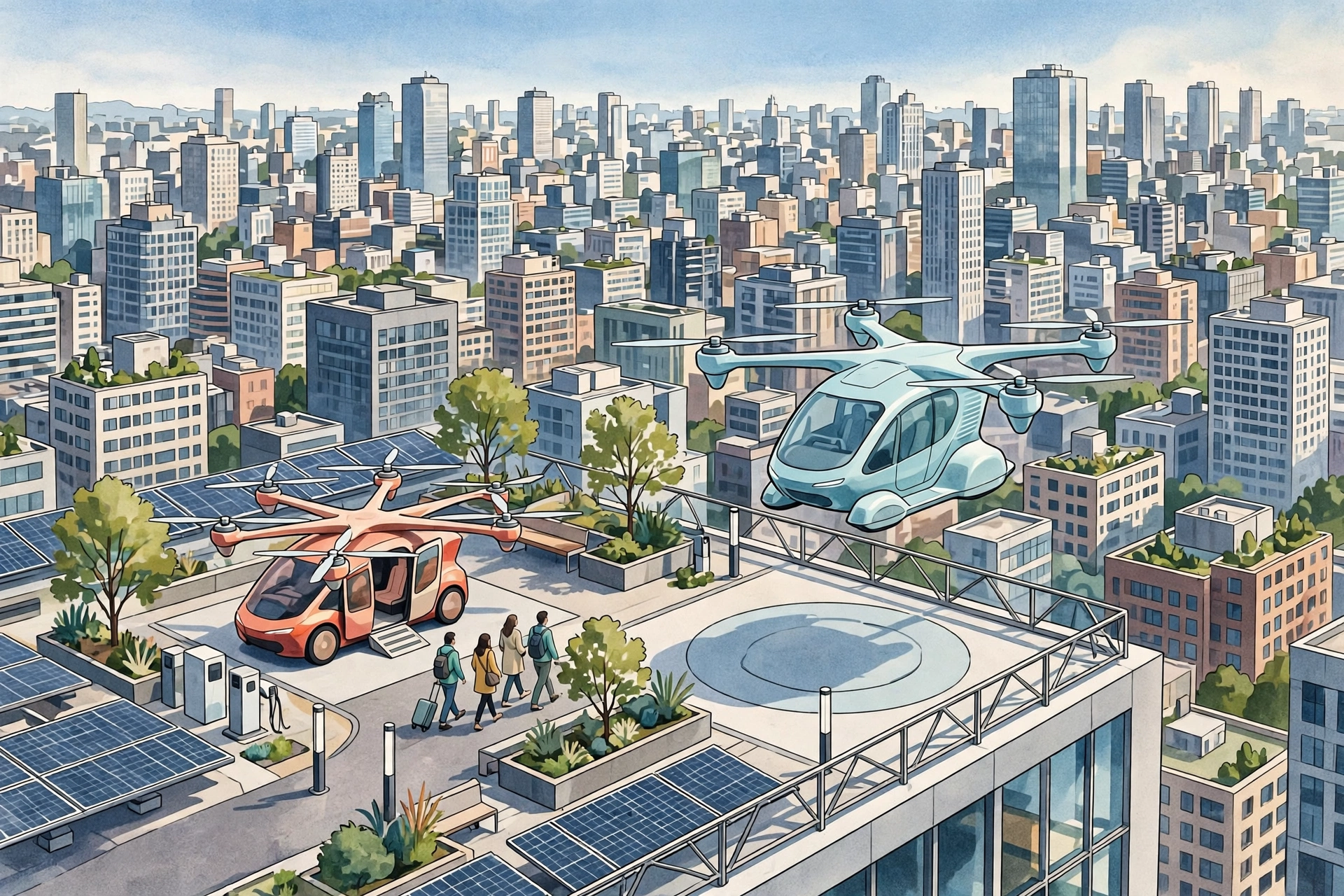
- Size: a basic vertiport needs only a landing pad, passenger waiting areas, and charging equipment — a fraction of the footprint of a heliport, let alone an airport. Designs range from single-pad “vertistops” on parking garages to multi-pad hubs at airports and transit stations.
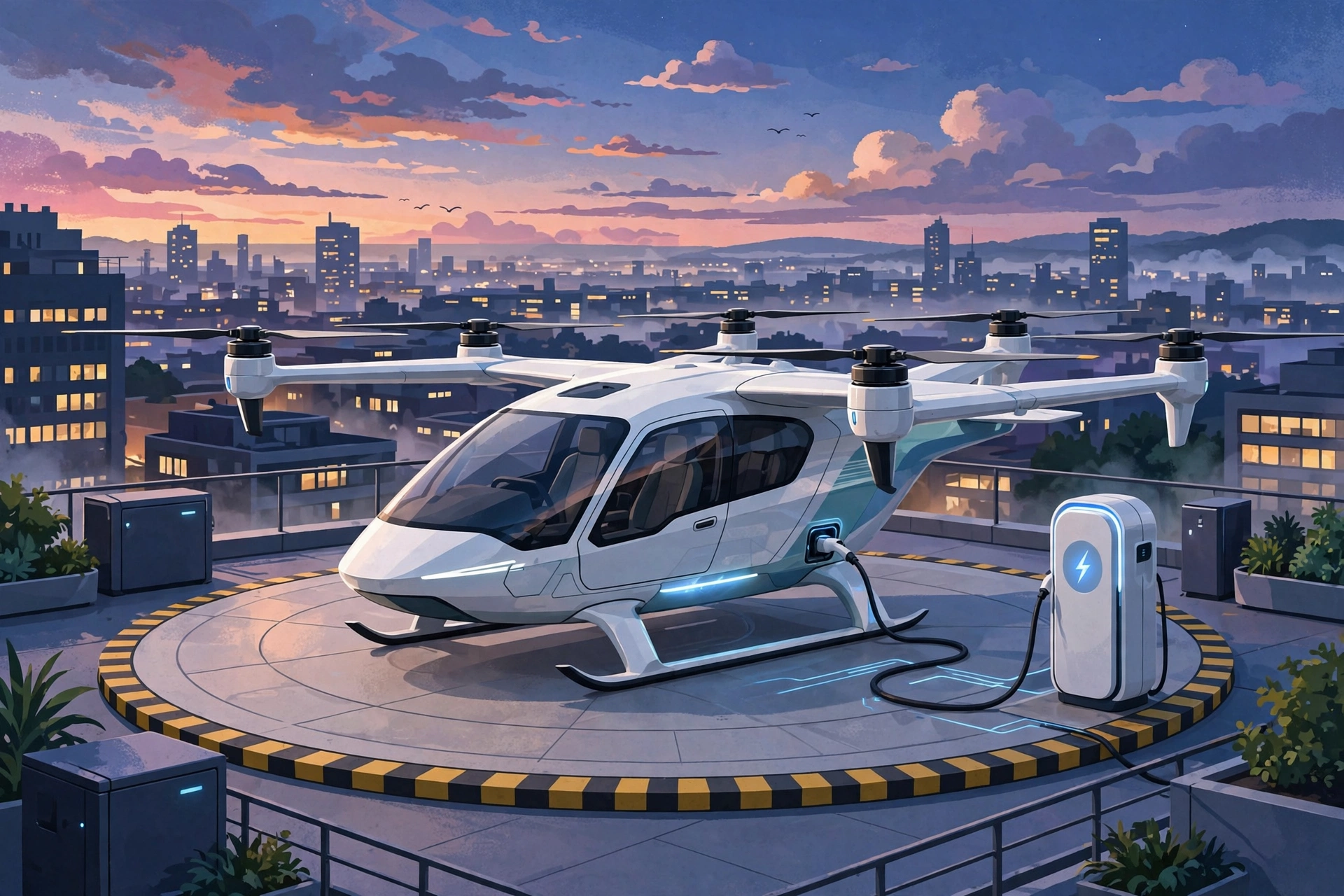
- Charging: high-power DC fast chargers refill batteries between flights, targeting turnarounds of 10–15 minutes. Grid upgrades at vertiport sites are part of the planning.
- Location strategy: early networks will connect the highest-value routes first — airports to downtowns, business districts to suburbs — using existing heliports and underused urban sites to avoid lengthy construction.
- Air traffic integration: eVTOLs will fly in controlled airspace near cities, coordinated with existing air traffic control. Digital traffic-management systems designed for low-altitude operations are being developed alongside the aircraft.
Joby’s 2026 demonstration flights between JFK Airport and Manhattan heliports were deliberately designed to prove this model: use existing infrastructure, electrify it, and show that the operational concept works in the world’s most demanding airspace. Partnerships with airlines — Joby’s deep relationship with Delta Air Lines, including its acquisition of Blade’s passenger business — give eVTOL operators ready-made customer funnels: the air taxi becomes the first or last leg of an airline journey.
The Economics: What Will an Electric Air Taxi Ride Cost?
The industry’s founding economic bet is simple: electric air taxis should cost far less to operate than helicopters, and over time, prices should fall toward premium ground-transport levels.
- Energy: electricity costs a fraction of aviation turbine fuel per unit of energy, and electric motors are far more efficient at converting it into thrust.
- Maintenance: with an order of magnitude fewer moving parts, maintenance costs are projected at a fraction of helicopter levels. Electric motors need no oil changes, no hot-section inspections, no complex transmission overhauls.
- Utilization: fast turnarounds and (eventually) high daily flight hours spread fixed costs across many revenue flights.
- Pilot costs: initially, piloted operations carry normal crew costs. Longer term, increasing automation could reduce crew requirements, though regulators will move cautiously here.
Early pricing will look like today’s helicopter charter or premium black-car service — several dollars per seat-mile on airport routes. The industry’s stated long-term goal is to reach roughly the cost of a premium rideshare per mile, which would open the market from wealthy early adopters to broad business travel. Whether that happens depends on manufacturing scale: eVTOLs must be built in the thousands, on production lines more like automotive plants than traditional aircraft factories, to drive unit costs down. Both Joby and Archer are building large-scale manufacturing facilities precisely for this reason.
It is worth being honest about the risks. Every eVTOL company is burning hundreds of millions of dollars per year on certification and development. Several well-funded competitors have already failed or been acquired. The economics only work at scale, and scale only comes after certification, manufacturing ramp-up, public acceptance, and regulatory approval for dense operations all line up. The technology is real; the business remains a high-stakes bet.
Environmental Impact: How Green Is the Electric Air Taxi?
Electric air taxis produce zero direct emissions during flight — no carbon dioxide, no nitrogen oxides, no particulates from the aircraft itself. That is a genuine improvement over helicopters and a meaningful one for cities struggling with air quality. But the full environmental picture has more layers:
- Electricity source matters: the carbon footprint of a flight depends on how the charging electricity is generated. Charged from a coal-heavy grid, the benefit shrinks; charged from renewables, it approaches true zero-emission operation.
- Battery manufacturing: producing lithium-ion batteries is energy- and resource-intensive, involving mining of lithium, nickel, and cobalt. Life-cycle analyses must account for this, though the impact is amortized over thousands of flight hours.
- Compared with what? An eVTOL carrying four passengers may use more energy per passenger-mile than a full electric bus or train — but far less than a helicopter, and potentially less than a single-occupant car stuck in traffic once congestion and detours are counted. The fairest comparison is against the trip it replaces: usually a car or helicopter ride, not a subway.
- Noise as pollution: the dramatic noise reduction versus helicopters is itself an environmental benefit for urban communities.
Over the long term, pairing eVTOL operations with renewable-powered vertiports and ever-cleaner grids makes the environmental case increasingly strong — one reason governments are actively supporting the industry rather than merely tolerating it.
What Electric Air Taxis Mean for Cities
If eVTOLs scale, the effects on urban life could be significant:
- Time geography changes: places 40 miles apart become 15 minutes apart. Suburbs, exurbs, and satellite cities become functionally closer to urban cores, potentially reshaping real estate and commuting patterns.
- Airport access transformed: the most punishing part of many journeys — getting to the airport — collapses from an hour-plus ordeal into a short flight.
- Emergency services: quiet, fast eVTOLs are natural fits for medical evacuation, organ transport, and disaster response, where helicopters are expensive and scarce.
- Cargo first: before passengers scale, cargo eVTOLs are already proving the concept — inter-island logistics, remote deliveries, and time-critical freight in places where runways do not exist.
- Equity questions: early services will serve the wealthy. Whether air taxis become broadly accessible or remain a luxury layer above congested streets is a policy choice as much as a technology outcome.
Challenges That Remain
For all the progress, honest coverage of how electric air taxis work must acknowledge what is still unresolved:
- Certification completion: as of 2026, no company holds a full FAA type certificate for a passenger eVTOL. The final stages are the hardest, and timelines have slipped before.
- Battery limits: energy density improvements have slowed; the ranges achievable today define the addressable market. A breakthrough in solid-state or next-generation batteries would expand it dramatically.
- Manufacturing at scale: building a handful of test aircraft is nothing like building thousands per year at automotive quality and cost. Production certification is its own mountain.
- Public acceptance: noise, safety perception, visual impact, and privacy concerns could constrain where and how often eVTOLs fly, regardless of what the technology allows.
- Weather: small, light aircraft are more weather-sensitive than airliners. Icing, thunderstorms, and high winds will ground eVTOLs more often than their operators would like.
- Capital intensity: the cash burn is enormous, and only the best-funded companies will survive to certification. Consolidation is likely.
The Road Ahead: What to Watch
Several milestones will tell you how the story is unfolding:
- First FAA type certificate for a passenger eVTOL — the single most important event in the industry’s history.
- First paying passenger flights in the U.S., expected in limited operations as early as late 2026 or 2027.
- Vertiport networks opening in launch cities: Los Angeles (with an eye on the 2028 Olympics), New York, Miami, Dallas, and Dubai.
- Manufacturing ramp: production lines reaching hundreds of aircraft per year.
- Ticket prices: the first published fares will reveal how close the industry is to its affordability promises.
- International expansion: EASA certification in Europe and continued CAAC-led deployment in Asia.
Frequently Asked Questions
How do electric air taxis take off without a runway?
They use multiple electric-powered propellers pointed upward to generate vertical lift, exactly like a large drone. Once airborne, tilt-rotor designs rotate their propellers forward and transition to winged cruise flight; on arrival, the process reverses for a vertical landing on a compact pad.
How far can an electric air taxi fly?
Current designs target roughly 60–150 miles on a full charge, with practical commercial routes in the 20–60 mile range after accounting for mandatory energy reserves. That covers the highest-demand urban and regional routes, such as airport-to-downtown transfers.
Are electric air taxis safe?
They are being certified to airliner-level safety standards, with multiple redundant motors, no single critical mechanical failure point, fly-by-wire envelope protection, and in some designs whole-aircraft parachutes. Final safety records can only be established once commercial operations begin.
How much will an electric air taxi ride cost?
Early services will be priced like premium helicopter charters or luxury ground transport. The industry’s long-term target is pricing comparable to premium rideshare services per mile, achievable only at large manufacturing and operational scale.
When will electric air taxis be available to the public?
Limited commercial operations could begin as early as late 2026 or 2027 in the most advanced markets, pending final certification. Widespread availability across many cities is expected in the 2030s.
How are electric air taxis different from helicopters?
They are far quieter (targeting conversational noise levels versus a helicopter’s roar), produce zero in-flight emissions, have lower projected operating costs thanks to simpler electric drivetrains, and use distributed motors for redundancy that helicopters cannot match. They are also expected to be simpler to fly.
Conclusion
Understanding how electric air taxis work reveals why they have captured so much investment and imagination: distributed electric propulsion makes possible an aircraft that is simultaneously quieter, cleaner, cheaper to run, and potentially safer than the helicopter — while cruising on wings like an airplane. The engineering is largely proven; demonstration flights are already crossing some of the world’s busiest airspace. What remains is the hardest part of any aviation revolution: finishing certification, building the factories, raising the vertiports, winning public trust, and proving the economics at scale.
If those pieces fall into place, the view from 2030 may look very different — a skyline where the quiet hum of electric rotors is as ordinary as the rumble of traffic below, and where the distance between any two points in a metro area is measured in minutes, not miles. The air taxi is no longer a rendering. It is a machine in final testing, and the countdown to its first paying passengers has already begun.