
How 6G Networks Work: The Complete Guide to the Next Wireless Revolution (2026)
Every decade or so, the world gets a new generation of wireless technology — and every generation redefines what the internet can do. 4G made smartphones truly useful. 5G made streaming, cloud gaming, and the modern Internet of Things practical. Now the industry is designing 6G, and it promises to be far more than just “faster 5G.”
So, how do 6G networks work, and why should you care years before the first commercial launch? In this complete guide, we break down the science, the architecture, and the real-world applications of the sixth generation of wireless — from terahertz spectrum and AI-native networks to satellites woven directly into the cellular fabric. By the end, you will understand exactly how 6G networks work, how they differ from 5G, when they will arrive, and how to prepare.
What Is 6G? A Simple Definition
6G is the sixth generation of cellular wireless technology, currently in the research and standardization phase. While 5G focused on three things — faster speeds, lower latency, and massive device connectivity — 6G aims for a fundamental architectural shift: instead of a network that simply moves data, 6G envisions a network that senses, computes, and thinks.
The International Telecommunication Union (ITU) has already defined the 6G vision (known as IMT-2030), and standards bodies such as 3GPP have begun the technical work that will eventually become the formal 6G standard. Industry consensus targets the first commercial 6G networks around 2030, with early trials and pre-standard deployments appearing in the late 2020s.
At a high level, researchers describe 6G with three headline ambitions:
- Extreme performance: peak data rates potentially reaching 1 terabit per second — roughly 100 times faster than typical 5G — with latency dropping from milliseconds to fractions of a millisecond.
- Intelligence built in: artificial intelligence embedded natively at every layer of the network, so the network can self-optimize, predict congestion, and heal itself without human intervention.
- Ubiquitous 3D coverage: seamless integration of terrestrial towers, satellites, drones, and high-altitude platforms into one continuous “network from the ground to the sky.”
How 6G Networks Work: The Core Technologies
To understand how 6G networks work, it helps to look at the key technical building blocks researchers are combining. None of these is science fiction — all are active areas of research and testing in laboratories and field trials today.
Terahertz Spectrum: Unlocking Enormous Bandwidth
The single biggest raw-performance leap in 6G comes from spectrum. Radio spectrum is the set of frequencies wireless signals travel on, and higher frequencies carry more bandwidth. 4G operated mostly below 6 GHz. 5G opened up millimeter-wave bands up to around 100 GHz. 6G is expected to push toward the terahertz (THz) range — frequencies above 100 GHz, in some proposals up to 300 GHz and beyond.
Why does this matter? Higher frequencies mean enormously wider channels. A 5G channel might be 100 MHz wide; a 6G channel in the sub-terahertz band could be tens of gigahertz wide. That is the physical foundation for terabit-class peak speeds, ultra-high-definition holographic media, and the ability to serve dense crowds of devices without congestion.
There is a catch: terahertz waves behave more like light than like traditional radio. They are easily blocked by walls, absorbed by rain and humidity, and fade quickly over distance. Understanding how 6G networks work therefore means understanding how engineers plan to tame these finicky frequencies — which brings us to the next set of technologies.
Massive MIMO, Beamforming, and Reconfigurable Intelligent Surfaces
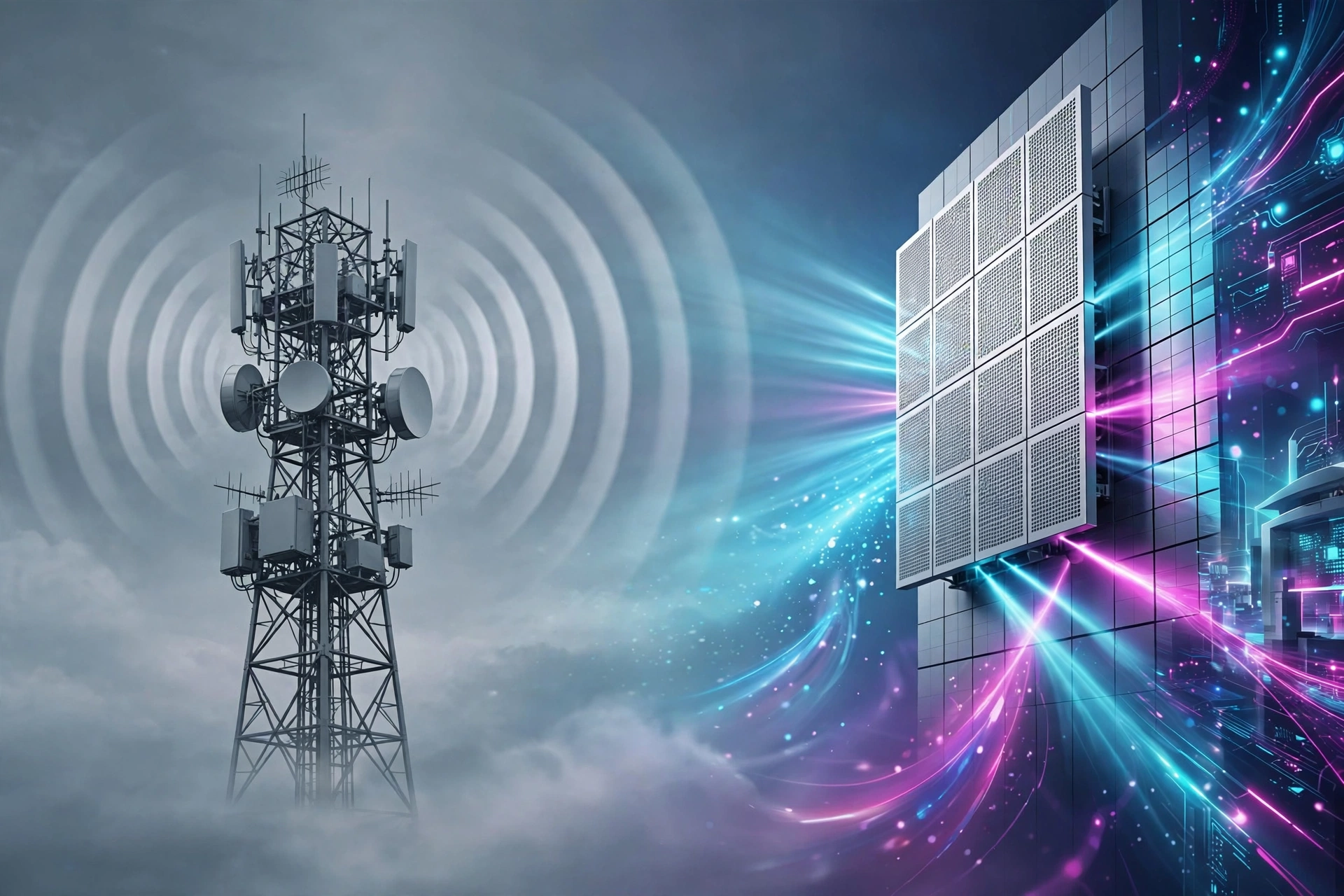
Instead of broadcasting a signal in all directions like a light bulb, 6G base stations will use massive multiple-input multiple-output (MIMO) antenna arrays with hundreds of elements to focus radio energy into precise beams aimed directly at each device — more like a laser pointer than a light bulb. This technique, called beamforming, dramatically improves efficiency, range, and capacity.
6G research goes further with reconfigurable intelligent surfaces (RIS): thin, programmable panels that can be mounted on buildings, windows, or street furniture to reflect and steer wireless signals around obstacles. Think of them as smart mirrors for radio waves. By bouncing signals off intelligent surfaces, networks can deliver terahertz-speed links even in complex urban environments where the direct signal would be blocked.
Together, massive MIMO, advanced beamforming, and intelligent surfaces solve the coverage problem that terahertz frequencies create — and they are central to how 6G networks work in practice.
AI-Native Architecture: Networks That Think for Themselves
Perhaps the most important difference in how 6G networks work is intelligence. 5G added AI-powered features on top of an existing architecture. 6G is being designed AI-native from the start: machine learning embedded directly into the radio, the core network, and the management layer.
An AI-native 6G network can:
- Predict traffic patterns and allocate spectrum and computing resources in real time, before congestion happens.
- Self-heal from faults by detecting anomalies, rerouting traffic, and reconfiguring network functions without human engineers.
- Optimize energy consumption by powering down or reconfiguring components during quiet periods — critical, since denser networks would otherwise consume far more power.
- Detect security threats by spotting unusual behavior in signaling traffic and device patterns automatically.
In short, where previous networks were dumb pipes managed by people, 6G networks are designed to be self-driving systems that continuously learn and adapt.
The 3D Network: Ground, Sky, and Space as One
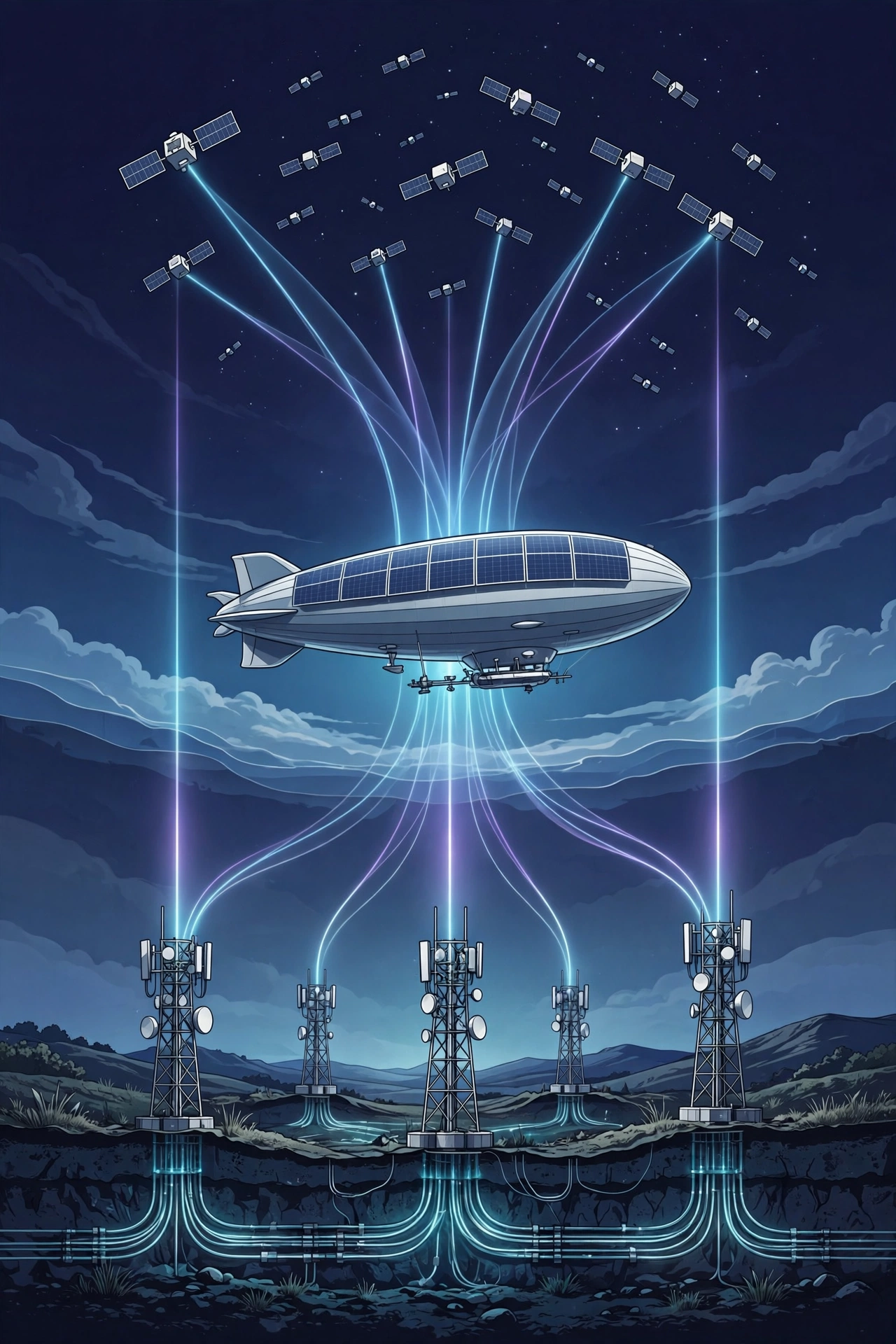
One of the most ambitious parts of the 6G vision is the move from a flat, tower-based network to a three-dimensional network that integrates ground infrastructure with airborne and spaceborne platforms. The technical term is Non-Terrestrial Networks (NTN), and it means connectivity stops being a privilege of cities and becomes a true global utility.
Here is how the layered architecture is expected to work:
- Terrestrial layer: traditional fiber-backed towers and small cells, upgraded with terahertz radios and dense deployment for ultra-high-capacity coverage in cities and suburbs.
- Airborne layer: high-altitude platform stations (HAPS) — solar-powered platforms operating in the stratosphere at roughly 20 kilometers — plus drones and unmanned aerial vehicles acting as floating base stations. These can be deployed rapidly for emergencies, festivals, or disaster recovery, creating an instant “network from the sky.”
- Space layer: constellations of low Earth orbit (LEO) satellites, orbiting between roughly 300 and 2,000 kilometers, providing low-latency broadband to ships, aircraft, and remote regions; complemented by medium and geostationary satellites for broader broadcast-style coverage.
AI-driven traffic steering will decide, millisecond by millisecond, whether your device connects through a ground tower, a stratospheric platform, or a satellite — handing over seamlessly as you move. When engineers explain how 6G networks work, this layered 3D design is often the part that surprises people the most: the “cell network” of the future is as much in the sky as on the ground.
6G vs 5G: What Is Actually Different?
It is easy to dismiss 6G as a marketing term for slightly faster 5G. The numbers tell a more dramatic story. While final specifications are still being written, the target performance jumps researchers cite are substantial:
- Peak data rates: 5G tops out around 10–20 Gbps in ideal conditions; 6G targets up to 1 Tbps — roughly 50 to 100 times faster.
- Latency: 5G promises around 1 millisecond in theory; 6G aims for tenths of a millisecond, enabling real-time haptic feedback — the sensation of touch transmitted over distance.
- Device density: 5G supports about one million devices per square kilometer; 6G research targets ten million, supporting truly massive sensor networks.
- Positioning precision: 5G can locate devices to within meters; 6G aims for centimeter-level accuracy through integrated sensing, letting networks “see” connected objects the way radar does.
- Energy efficiency: paradoxically, 6G targets far better energy efficiency per bit, because the denser, AI-optimized design must not explode power consumption.
But the deepest difference is not numeric — it is architectural. 5G is a communication system with AI features. 6G is conceived as an intelligent, sensing, computing fabric where communication, computation, and sensing merge into one platform. Understanding how 6G networks work means recognizing that shift: from a network that carries information to a network that perceives and reasons.
Integrated Sensing and Communication: Networks That Can See
One of the most fascinating innovations in how 6G networks work is Integrated Sensing and Communication (ISAC). Because terahertz signals behave almost like radar, the same waveform that carries data can also detect objects, measure distances, and map environments.
In practice, this means a 6G base station could:
- Detect vehicles, pedestrians, and obstacles in real time, feeding data to autonomous-driving systems and smart-city traffic management.
- Monitor crowds, drones, and airspace, improving public safety and urban planning.
- Enable gesture and presence detection indoors without cameras — useful for smart homes and elder care.
- Create continuously updated digital twins: live virtual replicas of factories, cities, ports, and infrastructure that mirror the physical world in real time.
What Are Digital Twins, and Why Does 6G Need Them?
A digital twin is a software model of a physical thing — a factory, a city district, a power grid — that updates in real time from sensor data. 6G’s combination of massive connectivity, microsecond latency, and built-in sensing makes real-time twins feasible at city scale. City planners could simulate traffic changes instantly; factory managers could predict equipment failures before they happen; emergency services could model a disaster zone as it evolves.
This is why analysts say 6G blurs the line between the physical and digital worlds: the network is not just connecting things, it is continuously mapping them.
Real-World Applications: What Will 6G Actually Enable?
Technology only matters when it changes what people can do. Here are the application areas where 6G’s unique combination of speed, latency, sensing, and ubiquity is expected to matter most.
Holographic Communication
Video calls are flat; 6G aims to make them volumetric. With terabit-class bandwidth and near-zero latency, researchers envision holographic telepresence — life-size, real-time 3D projections of people rendered from multi-camera capture. Remote meetings, telemedicine consultations, and family calls could feel closer to being in the same room. This is one of the flagship “beyond 5G” use cases, and it simply cannot fit inside 5G’s capacity envelope.
Autonomous Vehicles and Smart Transportation
Self-driving cars need to share sensor data with each other and with infrastructure in milliseconds. 6G’s ultra-reliable low-latency links, combined with ISAC sensing from roadside base stations, could let vehicles “see around corners” — receiving radar-like maps of hidden pedestrians or hazards from the network itself. Add satellite integration, and the same system works on remote highways far from any tower.
Industrial Automation and Smart Factories
Modern factories already use wireless robots and sensors, but they demand guaranteed, deterministic latency — a dropped packet can stop a production line. 6G’s combination of AI-orchestrated reliability, centimeter-level positioning, and massive device density could support fully wireless factories where thousands of robots, autonomous vehicles, and sensors coordinate in real time, with digital twins monitoring every machine.
The Haptic Internet and Remote Surgery
Today’s internet carries sight and sound. The haptic internet would carry touch: force feedback and tactile sensation transmitted with imperceptible delay. 6G’s sub-millisecond latency targets make remote robotic surgery more practical, let engineers “feel” machinery through teleoperated robots, and enable immersive training simulators for medicine, aviation, and heavy industry.
Immersive Extended Reality at Scale
Augmented and virtual reality headsets need enormous bandwidth and motion-to-photon latency below about 20 milliseconds to avoid nausea. 6G could deliver cinema-quality AR/VR streams wirelessly to lightweight glasses, with rendering offloaded to edge servers. Combined with satellite coverage, immersive education and remote collaboration could reach places fiber never will.

The 6G Timeline: When Will It Actually Arrive?
Wireless generations follow a roughly ten-year cycle, and 6G is on track:
- 2024–2026: vision and requirements phase. The ITU finalized the IMT-2030 vision; regional research programs (in the EU, US, China, Japan, and South Korea) are funding 6G research and early prototypes.
- 2026–2028: technology trials accelerate. Expect more field tests of terahertz links, reconfigurable intelligent surfaces, and AI-native network prototypes, plus early non-terrestrial network integrations.
- 2028–2030: standardization. 3GPP is expected to begin formal 6G specification work around the end of this window, with the first release of 6G standards.
- Around 2030: first commercial 6G deployments, initially in leading markets, much as 5G rolled out in 2019–2020.
- 2030s: mass adoption, with 5G and 6G coexisting — operators will run hybrid networks, phasing 6G in strategically while 5G continues to carry most traffic for years.
The honest caveat: timelines in telecom routinely slip, and some “6G” features may arrive as advanced 5G enhancements first. But the direction of travel — more spectrum, more intelligence, more layers — is clear regardless of the exact launch date.
Challenges: What Could Slow 6G Down?
No honest guide to how 6G networks work would skip the obstacles. The research community is open about them:
- Physics of terahertz: short range, blockage, and atmospheric absorption mean 6G needs vastly denser infrastructure — more antennas, more surfaces, more edge nodes.
- Energy consumption: a network with ten times the infrastructure must not use ten times the power. AI-driven energy optimization and new, efficient hardware are prerequisites, not luxuries.
- Spectrum and regulation: terahertz bands must be allocated internationally, shared fairly with existing users (including scientific and satellite services), and harmonized across countries.
- Security and privacy: a network that senses the physical world raises obvious privacy questions. Who controls the radar-like data? Strong encryption, privacy-by-design architectures, and clear regulation will be essential.
- Cost and business models: operators are still paying off 5G investments. The industry must prove that 6G’s new capabilities — not just speed — create enough value to justify the build-out.
How Businesses and Consumers Should Prepare
You do not need to buy anything for 6G today, but forward-looking organizations are already acting:
- Invest in edge computing now. 6G’s architecture pushes intelligence to the edge; companies with edge infrastructure in place will adopt 6G services faster.
- Track non-terrestrial connectivity. Satellite-integrated cellular is arriving through advanced 5G first — logistics, maritime, aviation, and rural operations can pilot these use cases today.
- Build AI and data capabilities. The biggest 6G payoffs — digital twins, predictive maintenance, autonomous operations — depend on data pipelines and AI expertise, not on waiting for new radios.
- Plan hybrid networks. 5G will remain the workhorse for most of the 2030s; the winning strategy is a 5G foundation that can absorb 6G capabilities as they standardize.
- For consumers: no action needed. Your next phone upgrade cycle will simply coincide with the rollout; just know that the “G” after the 6 will mean something genuinely different this time.
Conclusion: Why 6G Is More Than a Speed Upgrade
So, how do 6G networks work? At their core, they work by combining terahertz spectrum with intelligent beamforming, reconfigurable surfaces, AI-native self-management, and a three-dimensional architecture that weaves satellites and aerial platforms into the cellular fabric — plus integrated sensing that lets the network perceive the physical world.
That combination is why 6G deserves to be called a new generation rather than a faster 5G. Previous generations asked, “How fast can we move data?” 6G asks a bigger question: “What happens when the network itself becomes intelligent, sensing, and everywhere?” The answers — holographic communication, real-time digital twins, the haptic internet, and truly global coverage — will reshape how we work, travel, and connect.
The standards are still being written and the first commercial networks are years away, but the research direction is unmistakable. The wireless revolution is not over. It is just getting its next upgrade — and now you know exactly how 6G networks work.