
The human brain performs perception, learning, and decision-making on roughly 20 watts of power — about the same as a dim light bulb. Meanwhile, training and running a modern AI model can require thousands of power-hungry GPUs consuming megawatts of electricity. That enormous gap is the problem neuromorphic computing sets out to solve. Learning how neuromorphic computing works reveals one of the most promising — and most radical — shifts in computer hardware design in decades: instead of forcing brain-style intelligence onto chips built for arithmetic, we build chips that work the way neurons actually do.
In this complete guide, you will learn how neuromorphic computing works from the ground up: the von Neumann bottleneck that makes today’s computers inefficient at AI, the spiking neural networks and event-driven architectures at the heart of brain-inspired chips, the leading hardware platforms such as Intel Loihi and IBM NorthPole, real-world applications, honest limitations, and what the road ahead looks like.
Why Today’s Computers Struggle With AI: The Von Neumann Bottleneck
To understand how neuromorphic computing works, you first need to understand the problem it is trying to fix. In 1945, John von Neumann sketched out an architecture for digital computers that still underlies virtually every processor built today. It was a brilliant design — and for decades, it worked beautifully.
The von Neumann architecture separates the processor and the memory into distinct units, connected by a data bus. Every computation requires data to shuffle back and forth between them. That movement costs time and energy. As AI models grow larger — into the billions and trillions of parameters — this cost compounds dramatically. This is known as the von Neumann bottleneck (sometimes called the memory wall).
Consider what a GPU does when running a deep neural network: it multiplies and adds a vast array of numbers, again and again, at a fixed clock rate. Because the clock beats continuously, the processor burns energy whether or not there is anything meaningful to compute. The processor is constantly fetching weights from external memory, performing the math, and writing results back. Research into processor power consumption has shown that in traditional synchronous processors, the clock distribution network alone can consume a large share of a chip’s total dynamic power — power that is spent simply keeping time, regardless of computational load.
This architectural mismatch is the core inefficiency: traditional computer architectures are optimized for sequential processing, which is fundamentally inefficient for the parallel, event-driven computations that neural networks require. AI’s energy curve has become unsustainable — the International Energy Agency now expects data-center power demand to more than double by 2030, with AI as the main accelerant. That is why architectures that cut data movement, rather than simply crank up raw operations per second, are now in the spotlight.
What Is Neuromorphic Computing?
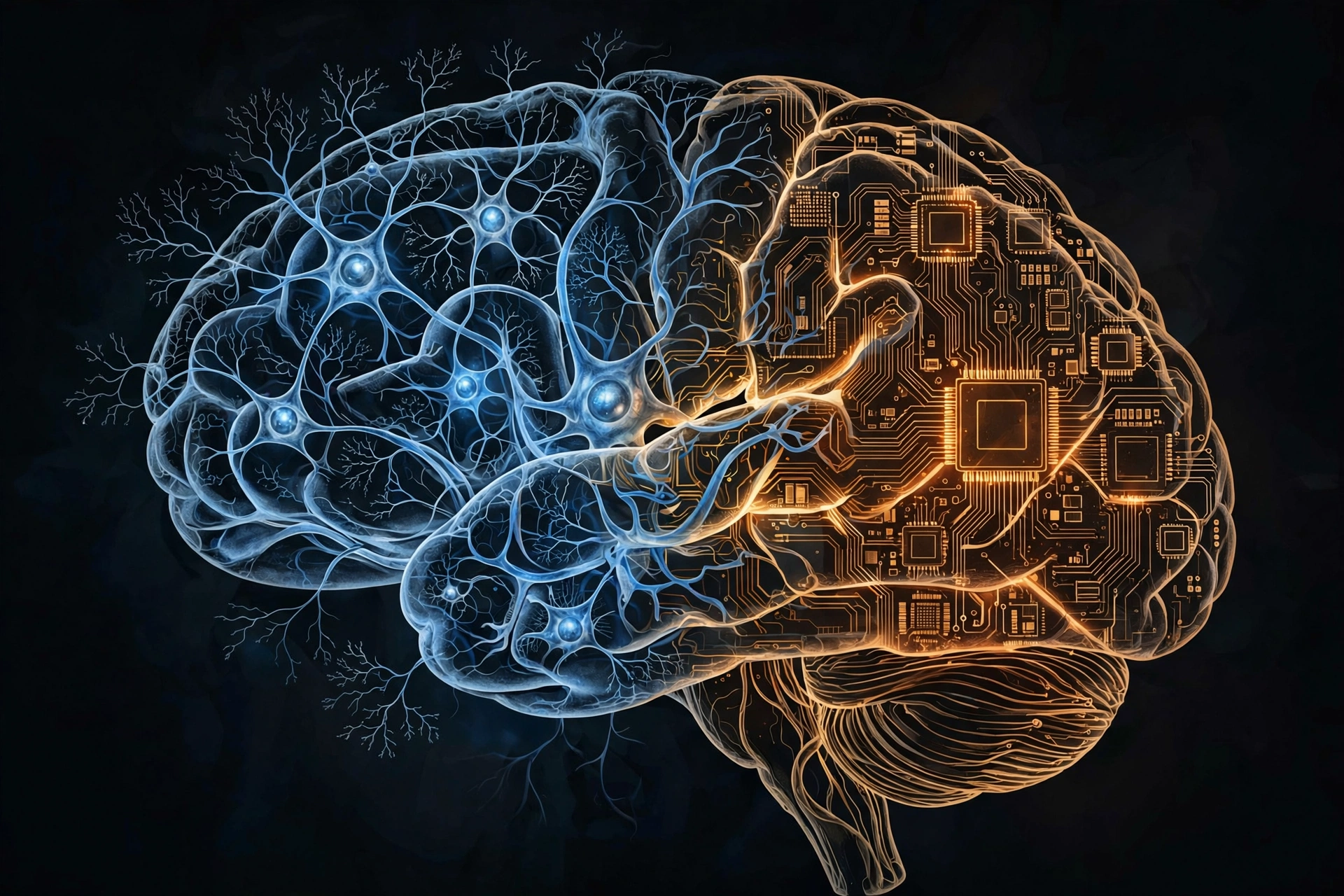
Neuromorphic computing is an approach to computer hardware design that borrows from the brain’s playbook. Rather than shuttling data between separate processor and memory chips, a neuromorphic chip is built around many small neuron cores. Each core contains model neurons, synapses that store weights, and local circuitry. Crucially, computation and memory happen in the same physical place — there is no round-trip to a separate RAM module.
The term “neuromorphic” itself means “brain-shaped” (from the Greek neuro for nerve and morphe for form). The idea dates back to the 1980s, when physicist Carver Mead pioneered analog circuits that mimicked neural behavior, but it has gained enormous momentum in the age of AI, when the energy economics of conventional computing have started to break down.
Two design principles define neuromorphic computing:
- Memory and compute are co-located. Synaptic weights live on the chip, right next to the artificial neurons that use them, eliminating the energy-intensive memory traffic that dominates conventional AI accelerators.
- Computation is event-driven. Artificial neurons communicate through discrete electrical spikes — just like real neurons — and consume energy only when they fire. When nothing is happening, the chip is nearly silent.
The result is a processor that idles almost completely most of the time, spending energy only where and when it is needed. For workloads where input arrives continuously but meaningful events are sparse — cameras watching for motion, microphones listening for a keyword, sensors monitoring industrial equipment — this can deliver extraordinary efficiency.
How Neuromorphic Computing Works: The Core Principles
Now let’s break down how neuromorphic computing works at the architectural level. Three interconnected ideas form the foundation: spiking neural networks, integrated memory and compute, and asynchronous event-driven operation.
Spiking Neural Networks: Computation Like a Nervous System
The primary technique neuromorphic systems use to mimic biological processing is the spiking neural network (SNN). In an SNN, artificial neurons maintain their own internal state — a charge value that accumulates over time as inputs arrive — and communicate using discrete temporal spikes rather than the continuous numerical values used in standard deep learning models.
The operating cycle follows a simple biological pattern:
- An artificial neuron integrates incoming spikes, building up its internal charge.
- When the charge crosses a threshold, the neuron fires a new spike to its connected neurons.
- The neuron then resets and waits, its unused charge leaking away over time.
This spike-based, asynchronous approach enables highly parallel, scalable computation that more closely mirrors how biological neural circuits actually operate. Timing matters: the precise timing of spikes carries information, which makes SNNs naturally adept at processing temporal data such as audio, video, and sensor streams without heavy preprocessing.
It is worth noting that not every chip marketed as “neuromorphic” uses spikes in this strict sense. Some systems, including IBM’s NorthPole and BrainChip’s Akida, process data as frames or discrete events without the temporal spike-train coding used by more strictly biologically inspired chips like Intel’s Loihi — trading some biological realism for easier programmability.
Memory and Compute in the Same Place
The second pillar of how neuromorphic computing works is the elimination of the memory wall. As IBM researchers describe it, in-memory computing “minimizes or reduces to zero the physical separation between memory and compute.”
There are two broad flavors of this idea:
- In-memory computing: analog crossbar arrays (often built from phase-change memory or memristors) both store synaptic weights and perform computation within the memory elements themselves. IBM’s Hermes research chip uses phase-change memory crossbars this way.
- Near-memory computing: digital neuron cores are wrapped around fast on-chip memory, so weights are stored within a few micrometers of the circuits that use them. IBM’s NorthPole and Intel’s Loihi both follow this approach in different ways.
Why does this matter so much? Because most AI work is vast matrix multiplication — simple math done trillions of times. When the weights sit on-chip next to compute, the energy and latency of fetching them from external DRAM simply disappear. Conventional AI accelerators can spend a substantial share of their energy budget transferring weights and intermediate data between processing elements and memory; neuromorphic architectures remove that tax by design.
Event-Driven, Asynchronous Operation
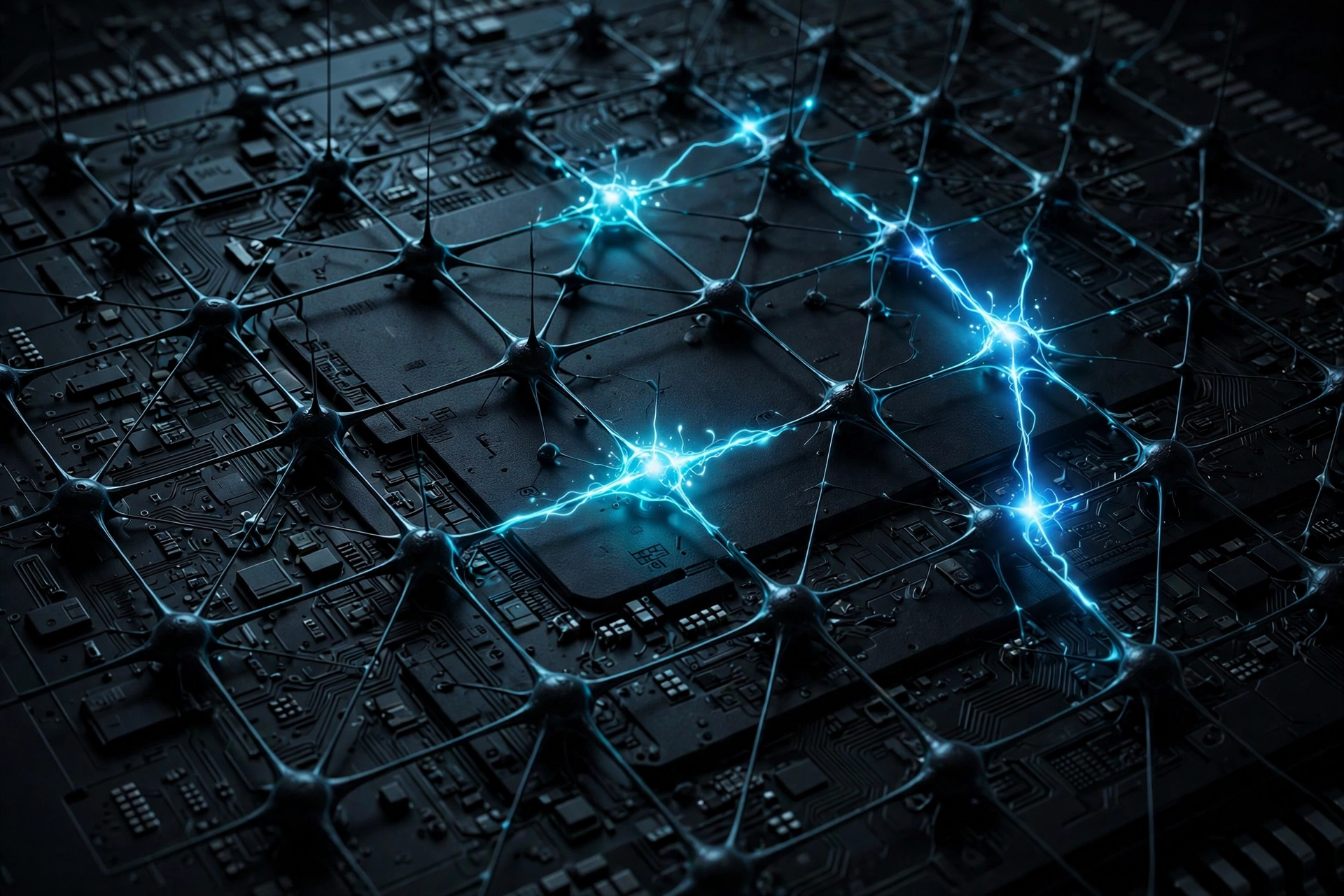
The third pillar is that neuromorphic chips generally have no global clock. In a conventional processor, a clock signal forces every part of the chip to march in lockstep, burning power on every tick whether or not there is work to do. Neuromorphic systems instead use localized handshaking protocols to route spikes across an on-chip network — nothing happens by default, and only spike events trigger computation.
The practical consequence is striking. If a security camera watches an empty hallway, a neuromorphic processor consumes near-zero power; it wakes up only when it detects motion. If no input events arrive, no neuron updates occur and no power is spent on switching activity. This “temporal sparsity” is what allows AI to be always-on without draining batteries — a prerequisite for the coming era of trillions of sensors, wearable devices, and autonomous machines.
The Leading Neuromorphic Chips and Platforms
Neuromorphic computing has moved from pure research into increasingly serious hardware programs. Here are the platforms defining the field as of 2026.
Intel Loihi: The Flagship Research Platform
Intel’s Loihi 2 is the most widely studied neuromorphic research chip. It features up to one million artificial neurons per chip, configurable synaptic models, and on-chip learning capabilities — the ability to adapt synaptic weights directly on the hardware, a key brain-like property. Intel’s Pohoiki Beach system integrated many Loihi chips to reach 8.3 million neurons.
At larger scale, Intel built Hala Point, a 6-rack-unit system containing 1,152 Loihi 2 processors — supporting up to 1.15 billion neurons and 128 billion synapses with a maximum power consumption of about 2,600 watts — deployed for research at Sandia National Laboratories. The stated goal, per Intel’s neuromorphic leadership, is to address the unsustainable rise in AI’s computing cost with event-driven, massively parallel architectures.
Reports in 2026 describe Loihi 3, fabricated on a 4nm process, packing 8 million digital neurons and 64 billion synapses — an eightfold density increase over Loihi 2 — with 32-bit “graded spikes” capable of encoding more complex information per pulse than earlier binary spiking designs. Loihi remains available primarily through Intel’s Neuromorphic Research Community rather than as a general commercial product.
On efficiency, Loihi 2 has demonstrated more than 100x energy efficiency over CPUs and roughly 30x over GPUs for spiking neural network workloads in event-driven, compute-memory co-located regimes, with some edge-workload claims reaching 150x over low-power edge GPUs.
IBM NorthPole and TrueNorth
IBM’s TrueNorth was an early landmark: 5.4 billion transistors arranged in 4,096 neurosynaptic cores, demonstrating that brain-inspired digital architectures could be fabricated at scale. Its successor, NorthPole, takes a different and highly pragmatic route: a 12-nanometer chip with 22 billion transistors, 256 cores, and 192 MB of distributed on-chip SRAM, with more than 13 TB/s of on-chip memory bandwidth.
NorthPole eliminates off-chip memory access by co-locating memory and compute directly. IBM reported up to 25 times the energy efficiency of an NVIDIA H100 GPU on image-recognition workloads, and specifically 22x energy efficiency over a GPU on ResNet-50 inference — a striking figure for a narrow, well-defined benchmark. Alongside the digital NorthPole approach, IBM Research continues to develop Hermes, an analog in-memory computing chip using phase-change memory crossbars that both store weights and perform the matrix multiplications at the heart of neural networks.
BrainChip Akida and the European Research Machines
BrainChip’s Akida stands out as one of the few neuromorphic processors sold as a commercial product rather than a research platform. It is designed for event-based edge AI — always-on sensing, keyword spotting, and vision tasks — and trades strict biological realism for programmability.
In Europe, the Human Brain Project produced two landmark neuromorphic machines: SpiNNaker at the University of Manchester, which operates in real time using digital multi-core chips optimized for exchanging spikes, and BrainScaleS at Heidelberg University, which uses accelerated analog electronic models of neurons and synapses. Both remain accessible through the EBRAINS research infrastructure, and the community-driven NeuroBench benchmark standard is emerging to give the field shared performance yardsticks.
Where Neuromorphic Computing Shines: Real-World Applications
The most compelling applications for neuromorphic computing are those where information arrives continuously but meaningful events are relatively sparse. Here is where brain-inspired chips are already making an impact or showing the most promise:
Event-Based Vision and Always-On Sensing
A conventional camera repeatedly transmits complete frames even when little has changed in the scene. An event-based vision system, by contrast, communicates only changes at individual pixels. Combined with a neuromorphic processor, this slashes unnecessary computation and lets machines react to movement with extremely low latency. Applications include:
- Security and surveillance: cameras that consume near-zero power while monitoring static scenes and wake instantly on motion.
- Industrial inspection: high-speed visual monitoring of production lines, where defects appear as rare, fleeting events.
- Automotive sensing: event-based cameras paired with neuromorphic processing for fast obstacle detection.
Robotics and Drones
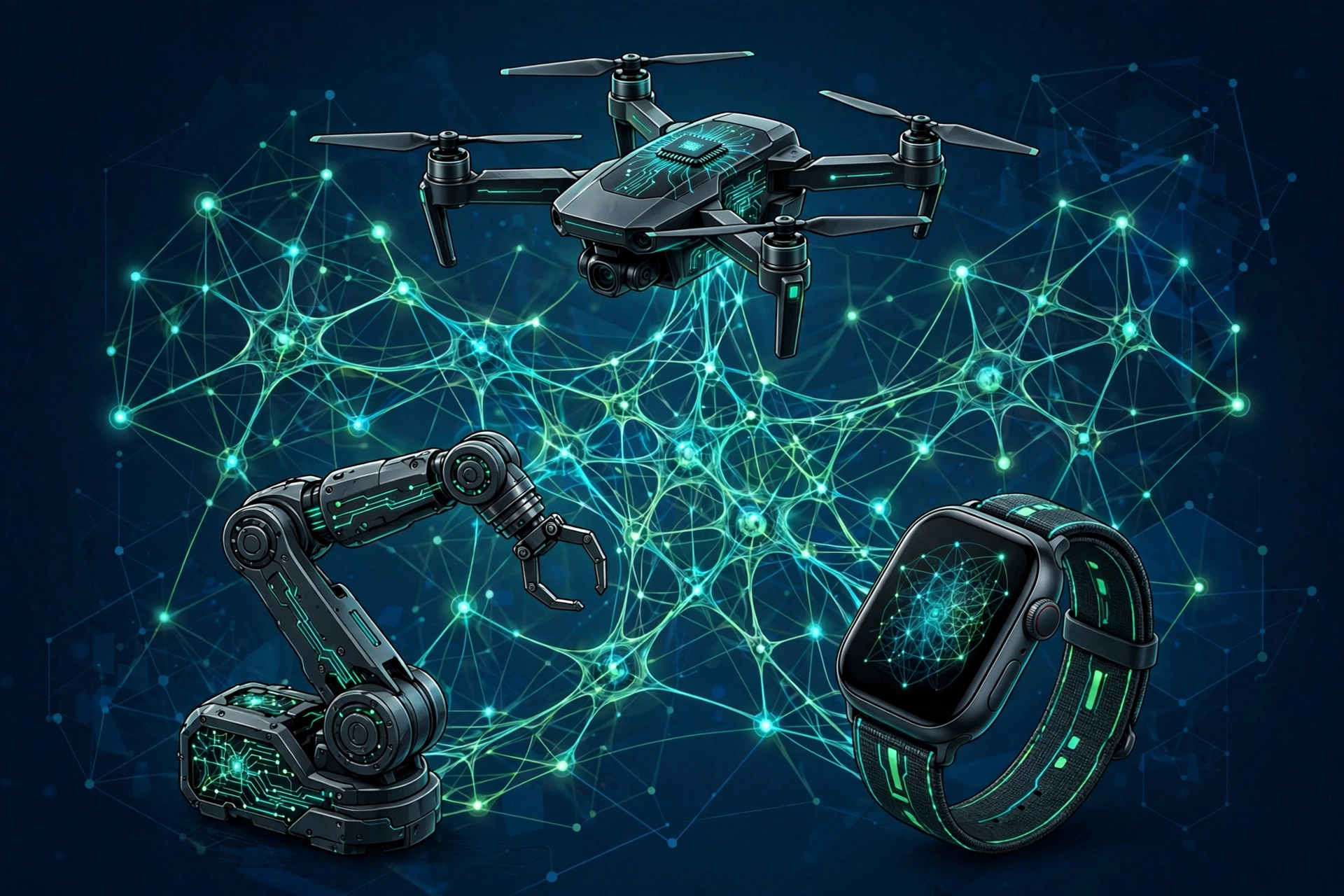
Mobile robots and drones live and die by their energy budgets. Because neuromorphic processors spend energy only when events occur, they are a natural fit for autonomous navigation, obstacle avoidance, and robotic control. A neuromorphic chip can handle real-time sensor fusion — combining vision, touch, and inertial data — while leaving the bulk of a robot’s battery for motors and payload.
Wearables and Health Monitoring
Always-on health monitoring — detecting falls, irregular heart rhythms, or seizures from continuous sensor streams — requires intelligence that never sleeps. Neuromorphic chips excel at exactly this: they sit nearly idle on a trickle of power, firing only when the sensor data contains something meaningful. This makes multi-day or even multi-week battery life feasible for smart wearables and medical devices.
Edge AI and the “Trillion-Sensor” Economy
As billions of connected sensors come online, sending every raw data stream to the cloud for processing becomes impractical — too slow, too expensive, and too power-hungry. Neuromorphic processors enable on-device intelligence: keyword spotting in smart speakers, anomaly detection in industrial equipment, and environmental monitoring, all processed locally with milliwatt-scale power draw.
Scientific Computing and Optimization
Beyond AI, neuromorphic architectures are being explored for optimization problems and scientific simulation. Researchers have applied Loihi-class systems to constraint-satisfaction problems, path planning, and partial differential equation solvers, exploiting the massive parallelism and favorable energy scaling of event-driven computation.
Neuromorphic Computing vs. GPUs vs. CPUs: An Honest Comparison
Neuromorphic chips are frequently pitched as GPU replacements. The honest picture is more nuanced: they are a complementary architecture, strongest where GPUs are weakest. Here’s how the three compare:
- CPUs: the generalists. Excellent for sequential logic, control flow, and general-purpose software; poor at the massive parallel math of neural networks. Energy efficiency for AI workloads is the lowest of the three.
- GPUs: the throughput champions. Unmatched for training large neural networks and dense, batched computation. But they burn energy continuously at a fixed clock rate, and their efficiency collapses on sparse, irregular, always-on workloads.
- Neuromorphic chips: the efficiency specialists. Superb energy efficiency on sparse, event-driven, real-time sensory workloads — often orders of magnitude better than GPUs on those tasks. But they are poor general-purpose processors, and they cannot currently match GPUs for training large conventional deep learning models.
The likely future is hybrid systems: GPUs (or other accelerators) handling heavy training and dense computation in the cloud or data center, with neuromorphic processors handling always-on perception and real-time response at the edge. Just as a modern phone combines a CPU, GPU, and neural engine, future devices may combine conventional and neuromorphic compute for the workloads each does best.
Challenges and Limitations
For all its promise, neuromorphic computing faces real obstacles. An honest guide should name them:
- The software gap. Compiling standard deep learning models (trained with backpropagation) into spiking architectures introduces translation loss and latency overhead. Without a standardized compiler ecosystem matching the maturity of NVIDIA’s CUDA, neuromorphic hardware risks remaining confined to specialized niches. Emerging standards like NeuroBench are a step forward, but toolchains remain fragmented.
- Training limitations. Training directly on analog or memristor-based neuromorphic hardware is still maturing. Most neuromorphic systems today run inference on converted models rather than training from scratch on-chip — though on-chip learning features (as in Loihi 2) are an active research frontier.
- Programming complexity. Designing for event-driven, asynchronous, spike-based computation demands familiarity with neuromorphic paradigms and toolchains — a smaller talent pool than the vast CUDA developer ecosystem.
- Narrow benchmark wins. Headline efficiency figures (25x over an H100, 150x over edge GPUs) are real numbers for specific, narrow tasks — not general-purpose replacement claims. Generalizing those wins across diverse AI workloads remains unproven.
- Commercial immaturity. As of 2026, neither Intel nor IBM has shipped a production-ready commercial neuromorphic product at scale; current deployments remain research partnerships and government contracts, with BrainChip’s Akida among the few commercially sold neuromorphic processors.
The Road Ahead for Neuromorphic Computing
Where is this technology heading? Several trends are converging:
- Commercialization pilots: expect more pilot deployments in event-based perception, robotics, and “AI appliances” for efficient inference, with ecosystem access expanding through platforms like Europe’s EBRAINS.
- Neuromorphic large language models: researchers are exploring multi-billion-parameter neuromorphic language models using hierarchical chip arrays and advanced mapping strategies for real-time language and reasoning tasks — a bold attempt to bring brain-like efficiency to the workloads driving AI’s energy crisis.
- Better learning on-chip: continued evolution of on-chip learning engines, dendritic computation, and more efficient event-routing fabrics will close the gap between training and inference.
- Hybrid architectures: tighter integration of neuromorphic cores with conventional CPUs and GPUs, letting each handle the workload it does best.
- New materials: memristors, phase-change memory, and other novel devices that naturally emulate synaptic plasticity could make analog in-memory computing practical at scale.
The fundamental driver is not going away: AI’s energy appetite keeps growing, and the von Neumann bottleneck is a physical reality, not a temporary inconvenience. Whether or not any single chip wins, the architectural ideas of neuromorphic computing — co-located memory and compute, event-driven sparsity, asynchronous operation — are reshaping how the industry thinks about efficient intelligence.
Frequently Asked Questions
What is neuromorphic computing in simple terms?
Neuromorphic computing is a way of building computer chips that mimic the structure and behavior of the human brain. Instead of separating memory and processing like conventional chips, neuromorphic chips combine them, and their artificial neurons communicate through electrical spikes — firing only when needed, which saves enormous amounts of energy.
How does neuromorphic computing differ from a regular CPU?
A CPU follows the von Neumann architecture: a central processor fetches data from separate memory, computes, and writes results back — synchronized by a global clock that burns power continuously. A neuromorphic chip distributes memory throughout its neuron cores, has no global clock, and consumes significant energy only when its artificial neurons fire.
Will neuromorphic chips replace GPUs?
Not in the foreseeable future. GPUs remain unmatched for training large neural networks and dense computation. Neuromorphic chips are complementary: they excel at sparse, event-driven, always-on sensory workloads at the edge, where GPUs are inefficient. The most likely outcome is hybrid systems using both.
What is a spiking neural network?
A spiking neural network (SNN) is the computational model used by most neuromorphic chips. Artificial neurons accumulate input charge over time and emit a discrete electrical “spike” when their internal threshold is crossed — closely mirroring how biological neurons fire. Information is encoded in the timing and pattern of spikes.
Which companies make neuromorphic chips?
Intel (Loihi 2, with Loihi 3 reported in 2026), IBM (TrueNorth, NorthPole, and the Hermes analog research chip), and BrainChip (the commercially sold Akida processor) lead the field, alongside European research machines SpiNNaker and BrainScaleS accessible through the EBRAINS infrastructure.
Conclusion
Understanding how neuromorphic computing works is really about understanding a different philosophy of computation. For eighty years, we have built ever-faster machines on the von Neumann blueprint — separate memory and processor, synchronized by a relentless clock. That blueprint carried us to the age of AI, but AI’s energy demands are now exposing its limits.
Neuromorphic computing answers with the brain’s own design language: memory woven into compute, neurons that fire only when they have something to say, and silence — blessed, power-saving silence — the rest of the time. The technology still faces serious hurdles in software, programmability, and commercialization. But the trajectory is clear: as intelligence moves from data centers to the trillion-sensor edge, efficiency matters as much as raw speed. And when it comes to efficient intelligence, nothing in nature beats the 20-watt computer inside your head — which is exactly what neuromorphic engineers are trying to build.