
They are no bigger than a wedding band, yet the newest smart rings quietly monitor your sleep, heart, temperature, and stress around the clock. How smart rings work is a story of extreme miniaturization: sensors that once filled a hospital cart have been shrunk to fit inside a few millimeters of metal or ceramic, pressed gently against the most sensor-friendly patch of skin on your body — your finger. In this complete 2026 guide, you will learn exactly how smart rings work, what the sensors inside them measure, how accurate they really are, how they compare to smartwatches, and where this remarkable wearable technology is heading next.
What Is a Smart Ring and Why Is It Having a Moment?
A smart ring is a finger-worn wearable that continuously tracks health and activity metrics — most commonly sleep quality, heart rate, heart rate variability (HRV), body temperature trends, and physical activity — and reports them through a smartphone app. Unlike a smartwatch, it has no screen, no buttons, and usually no speaker; it is designed to disappear into your life rather than demand your attention.
After more than a decade as a niche curiosity, smart rings broke into the mainstream around the middle of this decade. Worn by celebrities, professional athletes, and entire sports teams, the devices were one of the most heavily promoted product categories at CES 2026 in Las Vegas. The Finnish brand Oura remains the category’s best-known name, but Samsung’s Galaxy Ring, Ultrahuman’s Ring Air, and RingConn have turned smart rings into a genuinely competitive market with options at multiple price points.
Market analysts have taken notice. The International Data Corporation (IDC) has projected that the smart ring market will grow from roughly 800,000 units in 2023 to about 3.2 million units in 2028 — an average year-over-year growth rate of nearly 30 percent. Smart rings, sleep trackers, and stress-monitoring wearables are collectively growing at 25 to 30 percent year over year, compared with just 8 to 12 percent for established categories like smartwatches and fitness bands.
How Smart Rings Work: The Science Inside the Circle
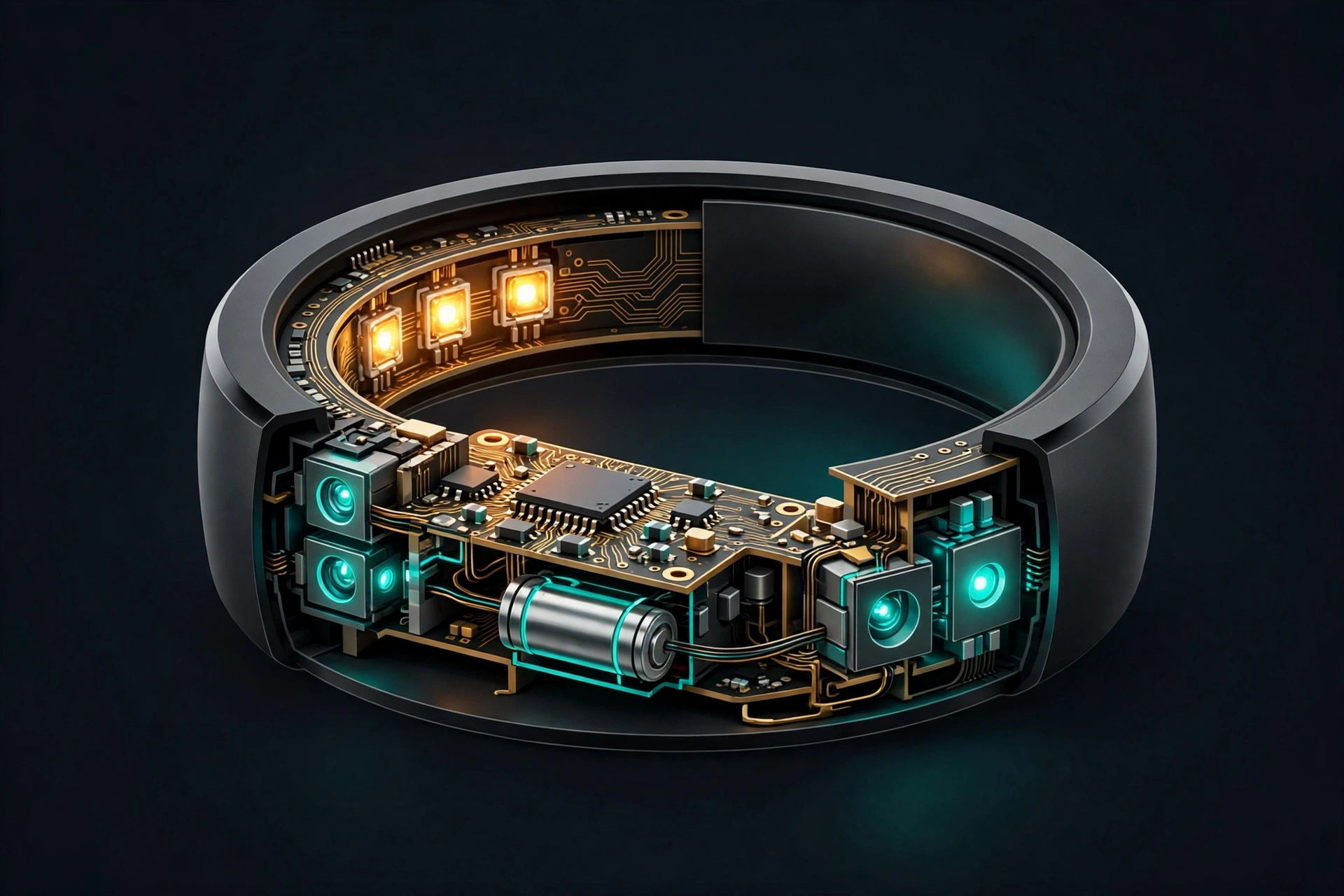
How smart rings work comes down to three engineering tricks: miniature sensors, clever placement, and sophisticated software. Beneath the ring’s polished metal or ceramic surface lies an array of tiny sensors packed into a space no thicker than a few millimeters. Most smart rings combine the following core sensor types:
Photoplethysmography (PPG) — the optical heartbeat sensor
The workhorse of every smart ring is photoplethysmography, the same optical technology used in hospitals to measure pulse. Tiny light-emitting diodes (LEDs) shine specific wavelengths of light — typically green and infrared — into the skin of your finger, while adjacent photodetectors measure how much light is reflected back. Blood absorbs light differently as it pulses through the capillaries with each heartbeat, so the reflected signal rises and falls in rhythm with your pulse.
From this wavy optical signal, the ring’s processor derives your heart rate, resting heart rate, heart rate variability (the subtle timing differences between consecutive beats), respiratory rate, and — using infrared wavelengths — trends in blood oxygen saturation. It is a measurement by reflection rather than by direct contact with blood, and it works because hemoglobin’s light absorption changes slightly with every pulse wave.
Temperature sensors — reading the body’s thermostat
Most smart rings include a negative temperature coefficient (NTC) thermometer, a sensor whose electrical resistance changes precisely with temperature. It tracks trends in your skin and estimated body temperature, primarily overnight. The absolute reading matters less than the deviation from your personal baseline: a sustained temperature elevation can signal the onset of illness, changes in your menstrual cycle, poor recovery from training, or disturbed sleep — sometimes before you feel any symptoms yourself.
Accelerometers and motion sensors — movement as context
A tiny three-axis MEMS accelerometer measures movement along three axes, allowing the ring to detect steps, estimate activity levels, and — crucially — distinguish periods of sleep from wakefulness. Tossing, turning, and stillness all leave fingerprints in the motion data, and combined with heart rate and temperature patterns, they let the ring’s algorithms classify your sleep into stages without ever touching your head or chest.
What happens to the data
The raw signals from these sensors are noisy — they are distorted by motion, ambient light, imperfect fit, and the natural variability of human physiology. So the real magic of how smart rings work happens in software. On-device and cloud-based algorithms filter the signals, combine them, and interpret the results into metrics such as heart rate, HRV, sleep stages, activity, and recovery readiness. The ring then synchronizes with a mobile app over Bluetooth Low Energy, which presents the findings as scores, charts, and personalized insights.
This is an important distinction to understand: the score or chart shown in the app is not a direct measurement from a single sensor. It is the output of several signals being filtered, calculated, and interpreted together. Fit, signal quality, algorithms, battery life, and app design all shape the experience — which is why two different rings on the same finger can occasionally disagree.
Why the Finger Gives Rings a Built-In Advantage
Manufacturers say that rings are more accurate than watches for certain measurements, and there is genuine physiology behind the claim. Sensors on the finger sit closer to key arteries and under thinner skin than sensors on the wrist, and the finger has a denser capillary network. That means the optical pulse signal at the finger is stronger, cleaner, and more stable — especially during sleep and periods of low motion, when the body is still and the ring can maintain constant contact.
Research supports this. A study comparing the Oura Ring’s sleep algorithms against medical polysomnography — the clinical gold standard for sleep measurement — found good agreement for sleep staging. The Oura-funded 2024 paper from Brigham and Women’s Hospital tested the Oura Ring Gen 3 against polysomnography and ranked it first (Cohen’s kappa 0.65) ahead of the Apple Watch Series 8 (0.60) and the Fitbit Sense 2 (0.55). A 2024 study published in the journal Sensors found the Oura Ring’s sleep staging showed no statistically significant difference from lab results across wake, light sleep, deep sleep, and REM stages, while wrist devices in the same comparison tended to underestimate wake time and deep sleep and overestimate light sleep.
Heart rate readings tell a similar story. Oura reports 99.9 percent reliability for resting heart rate measurement when compared with medical-grade ECG devices, and finger-based sensors generally produce cleaner HRV signals than wrist sensors — a meaningful edge for athletes and anyone closely monitoring stress and recovery. A 2023 study from the University of California found that wearable-derived HRV and temperature trends identified physiological pattern changes that, in retrospective analyses, preceded symptom onset by up to 48 hours — suggesting smart rings could one day serve as early-warning systems for illness.
There is one more underappreciated advantage: comfort. The absence of a screen is not necessarily a limitation — it can reduce distraction and, crucially, makes the ring easy to wear all night. Comfort for side sleepers is often rated 9 out of 10 for rings versus 4 out of 10 for watches, and since sleep data is only useful if you actually wear the device to bed, wearability is accuracy in disguise.
What Smart Rings Actually Track
Modern smart rings track far more than steps. Here is the standard metric suite you can expect from a quality ring in 2026:
- Sleep staging: Light, deep, and REM sleep broken down night by night, with sleep scores and readiness scores that summarize how recovered you are before the day begins.
- Heart rate variability (HRV): One of the most reliable indicators of recovery and stress load. Higher HRV generally means your body has handled stress well; lower HRV is a signal to pull back.
- Resting heart rate: A key marker for cardiovascular health and overtraining. A sustained rise in resting heart rate is often an early warning that something is off.
- Body temperature trends: Tracks your baseline and flags deviations that can indicate illness before symptoms show up, or track phases of the menstrual cycle.
- Activity and steps: Passive tracking throughout the day, plus automatic workout detection on newer models, without needing to log workouts manually.
- Stress and recovery: Many rings now estimate daytime stress load using HRV patterns across the day, and combine sleep, activity, and recovery data into a single daily readiness score.
- Women’s health: Devices such as the Evie Ring by Movano focus specifically on women’s health, tracking menstrual cycles and temperature variations with dedicated algorithms.
- Cardiovascular age and resilience metrics: Newer rings and their apps estimate cardiovascular age and long-term trends, turning nightly data into longevity insights.
What smart rings generally do not do: display notifications (at most a vibration), offer GPS, play music, make calls, or provide the FDA-cleared ECG readings found in some smartwatches. If you want instant feedback during a workout, a ring is the wrong tool.
Smart Ring vs. Smartwatch: An Honest Comparison
So should you buy a ring, a watch, or both? Here is how they compare on the dimensions that matter most:
Sleep and recovery tracking
The ring wins. Finger sensors produce more accurate overnight health tracking because the finger’s denser capillary network provides a cleaner PPG signal at rest, and rings are dramatically more comfortable to wear through the night. In head-to-head testing over three weeks of same-night wear, a ring was consistently better at sleep stages than a watch — partly because of sensor placement, but equally because a bulky watch is easy to leave on the nightstand.
Real-time health monitoring and safety
The watch wins clearly. Smartwatches offer FDA-cleared ECG monitoring, blood oxygen measurement, sleep apnea detection on recent models, fall detection with automatic emergency calling, and clinical-grade sensors for specific conditions. These are life-safety features that no smart ring currently matches. Cardiologists accept exported smartwatch ECG readings for initial atrial fibrillation screening; rings simply do not play in that arena.
Workouts and fitness
The watch wins. Built-in GPS, heart rate zones, structured workout modes for dozens of activity types, and a screen that shows live feedback make watches the better workout companion. Rings track daily activity passively and some detect workouts automatically, but they cannot replace a watch for serious training.
Battery life
The ring wins by a mile. With no screen to power, a smart ring typically runs 5 to 7 days per charge — some stretch to two weeks — so you charge it during the day and it is never off your finger at bedtime. Most smartwatches need charging every one to three days, which forces a choice between charging and continuous wear. That battery gap is one of the biggest practical differences between the two categories.
Price and subscriptions
Sticker prices overlap: most smartwatches land between $150 and $500, while smart rings typically fall in the $250 to $400 range. The real difference shows up over time. Many smart rings lock full health insights behind a monthly subscription — often $6 to $20 per month, which adds up to $240 per year on top of the device. Not every brand charges these fees: RingConn includes full health data access with no ongoing fee, and several newer models have moved toward subscription-free approaches. Always check subscription terms before buying any ring.
The verdict
Smart rings produce superior data for sleep tracking, resting heart rate, and HRV because the finger offers cleaner sensor readings and rings can be worn comfortably 24/7 including overnight. Smartwatches are better for active workout tracking, GPS, real-time heart rate during exercise, and ECG readings. Most serious health trackers in 2026 wear both: a ring for sleep and recovery, a watch for workouts and alerts.
The Technology Roadmap: Where Smart Rings Are Going Next
Smart rings are still early in their evolution, and the most exciting developments are happening in the lab right now. Two trends stand out:
From physical to biochemical monitoring
Today’s commercial rings only provide biophysical information — pulse, temperature, motion. They lack molecular information about biochemical markers that would offer far deeper insights into health status. That is about to change. In a paper published in Nature Communications, engineers at UC San Diego’s Jacobs School of Engineering reported the first fully integrated smart ring for daily biochemical monitoring: a ring that simultaneously and continuously monitors up to four different chemical biomarkers — including glucose, ketones, vitamin C, uric acid, lactate, and alcohol — from finger sweat, drawn passively through the skin’s surface by osmosis without any exercise required.
Separately, non-invasive glucose monitoring is reaching consumer readiness across the wearable industry, and the first FDA-approved over-the-counter continuous glucose monitors are already available without a prescription. Continuous blood pressure monitoring is approaching consumer readiness as well. The smart ring of 2030 may well measure your metabolism, not just your pulse.
AI-powered interpretation
The second trend is interpretation. Raw sensor data is only as useful as the insights drawn from it, and manufacturers are racing to turn passive data collection into genuinely intelligent health coaching. AI-powered analysis of wearable data — correlating sleep, HRV, temperature, and activity into personalized lifestyle guidance — is one of the five biggest wearable health tech trends of 2026. The devices are becoming less like pedometers and more like pocket physiologists: not diagnosing disease, but building a continuous picture of your health that a yearly physical never could.

Limitations and Honest Caveats
Smart rings are impressive, but they deserve honest scrutiny. Here are the limitations worth knowing before you buy:
- They are screening tools, not medical devices. Consumer sleep trackers can flag potential signs of problems — frequent nighttime awakenings, drops in blood oxygen, elevated heart rate during sleep — but they cannot diagnose conditions like sleep apnea. If your ring consistently shows fragmented sleep or low blood oxygen, consult a doctor for a proper sleep study.
- Study funding matters. As one 2026 analysis noted, the leaders in peer-reviewed literature differ from the leaders in manufacturer-funded literature on sleep accuracy. Treat any accuracy claim with appropriate skepticism and look for independent validation.
- Fit affects everything. A ring that is too loose lets ambient light leak into the optical sensors and produces noisy data; too tight and it is unwearable. Most brands ship a sizing kit — use it. Finger size also fluctuates with temperature, hydration, and time of day.
- Exercise tracking is limited. Motion-heavy activities degrade the optical signal, and without a screen or GPS you get no live feedback. Serious athletes still need a watch for workouts.
- Privacy is a real consideration. Your ring collects continuous physiological data — heart rate, sleep patterns, temperature — that is synced to company servers. Read the privacy policy, understand what is shared, and choose brands with strong data practices.
- Cost of ownership. Between the device price and possible subscription fees, a ring can cost more over three years than a mid-range smartwatch. Calculate the total cost of ownership before committing.
Frequently Asked Questions
How do smart rings measure heart rate without a chest strap?
Smart rings use photoplethysmography (PPG): LEDs shine green and infrared light into the finger, and photodetectors measure the reflected light, which fluctuates with each pulse of blood. Algorithms convert these fluctuations into heart rate, HRV, and related metrics. The finger’s dense capillaries and thin skin make this optical measurement cleaner than at the wrist.
Are smart rings accurate enough to trust?
For their core job — sleep tracking, resting heart rate, and HRV trends — the best rings are remarkably accurate, with sleep staging validated against clinical polysomnography at levels approaching or exceeding the best smartwatches. But they are consumer wellness devices, not medical instruments: excellent for spotting trends and early deviations, not for diagnosing disease.
Do I need to charge a smart ring every night?
No. A modern smart ring typically runs 4 to 7 days on a charge, and some stretch longer. You charge it during the day — often just once a week — so it is never off your finger at bedtime. This is the opposite of most smartwatches, which usually need a nightly top-up to have any battery left for sleep tracking.
Can a smart ring replace my smartwatch?
It depends on what you use the watch for. If your priority is sleep, recovery, and passive health monitoring, a ring can absolutely replace a watch — and many people prefer it. If you rely on GPS workouts, live notifications, ECG readings, or fall detection, a watch remains essential. Many serious health trackers wear both.
Which smart ring should I buy in 2026?
The Oura Ring remains the best-known option with the deepest sleep analysis and the largest body of validation research, but it requires a monthly subscription for full insights. Samsung’s Galaxy Ring integrates tightly with Galaxy phones and health apps. Ultrahuman’s Ring Air is popular with athletes and quantified-self enthusiasts, while RingConn stands out as a strong subscription-free alternative. Compare sensor sets, subscription terms, sizing options, and app quality — and always use the sizing kit before ordering.
Conclusion
How smart rings work is ultimately a triumph of less: fewer distractions, smaller sensors, and a form factor so unobtrusive you forget it is there. By pressing optical, thermal, and motion sensors against the finger — one of the body’s richest sources of cardiovascular signal — smart rings capture sleep, heart, and recovery data with a consistency that bulkier wrist devices struggle to match, all while lasting a week on a single charge.
The category is still maturing. Subscriptions add up, exercise tracking lags behind watches, and the most exciting capabilities — biochemical sensing, non-invasive glucose, continuous blood pressure — are still working their way from research labs to retail shelves. But the direction is unmistakable: from the sweat-biomarker ring demonstrated at UC San Diego to AI coaches that read your readiness like a weather forecast, the humble ring is becoming one of the most sophisticated health instruments you can own. For anyone whose healthiest hours are the ones they sleep through, that is exactly where it belongs.