
Autonomous AI Agents for Business: The Complete Guide to Agentic AI (2026)
Something fundamental changed in business software over the past two years. For a decade, “AI” in the workplace mostly meant tools that answered questions: chatbots that deflected support tickets, writing assistants that drafted emails, dashboards that summarized data. Useful, but passive. Then AI learned to do something very different — it learned to act.
Autonomous AI agents for business are software systems that don’t just respond to prompts — they pursue goals. Give an agent an objective like “resolve this customer’s billing dispute,” “research three competitors and brief me,” or “process these supplier invoices,” and it will plan the steps, call the right tools, check its own work, and iterate until the job is done. No one clicks a button for each step. The agent does the clicking.
The numbers behind this shift are striking. KPMG’s Q3 2026 AI Pulse Survey found that 62% of companies with more than $1 billion in annual revenue are now deploying or developing AI agents, up from 53% just one quarter earlier. Gartner projects that 40% of enterprise applications will include task-specific AI agents by the end of 2026, up from less than 5% in 2025 — a near tenfold jump in a single year.
This guide explains what autonomous AI agents for business actually are, how they work under the hood, where they’re delivering value, what the real risks look like, and how a company can deploy them responsibly. Whether you’re a founder, a manager, or simply curious about where workplace technology is heading, this is the complete picture as of late 2026.
What Are Autonomous AI Agents for Business?
An autonomous AI agent is a software system that perceives its environment, reasons about a goal, takes actions through digital tools, observes the results, and repeats that cycle until the goal is reached. The defining feature is autonomy: instead of executing one pre-written script or answering one question at a time, the agent decides for itself which steps to take next.
The difference between an AI chatbot and an AI agent is the difference between an advisor and an employee. A chatbot is brilliant counsel — it can explain, draft, and summarize, but it cannot do. An autonomous AI agent for business is closer to a digital employee: it can read your inbox, pull data from your CRM, update records, send messages, run calculations, and escalate to a human when it gets stuck.
AI agents vs. chatbots vs. automation
These terms get mixed up constantly, so let’s draw clean lines:
- Chatbots hold conversations. They react to each message, generate a response, and wait for the next input. They don’t remember context beyond the conversation, and they can’t take action outside the chat window.
- Automation (RPA, scripts, workflows) executes fixed sequences of steps. If X happens, do Y. It’s fast and reliable, but brittle: any situation the designer didn’t anticipate breaks the flow.
- AI agents combine the flexibility of a language model with the ability to act. They handle situations the designer never imagined, because they plan in real time — choosing tools, recovering from errors, and adapting when circumstances change.
The simplest mental model, used by practitioners across the industry, is this: Agent = LLM + context + tools + memory + an action loop. A large language model supplies the reasoning; tools give it hands; memory gives it continuity; and the loop lets it keep working until the job is finished.
How Autonomous AI Agents Work
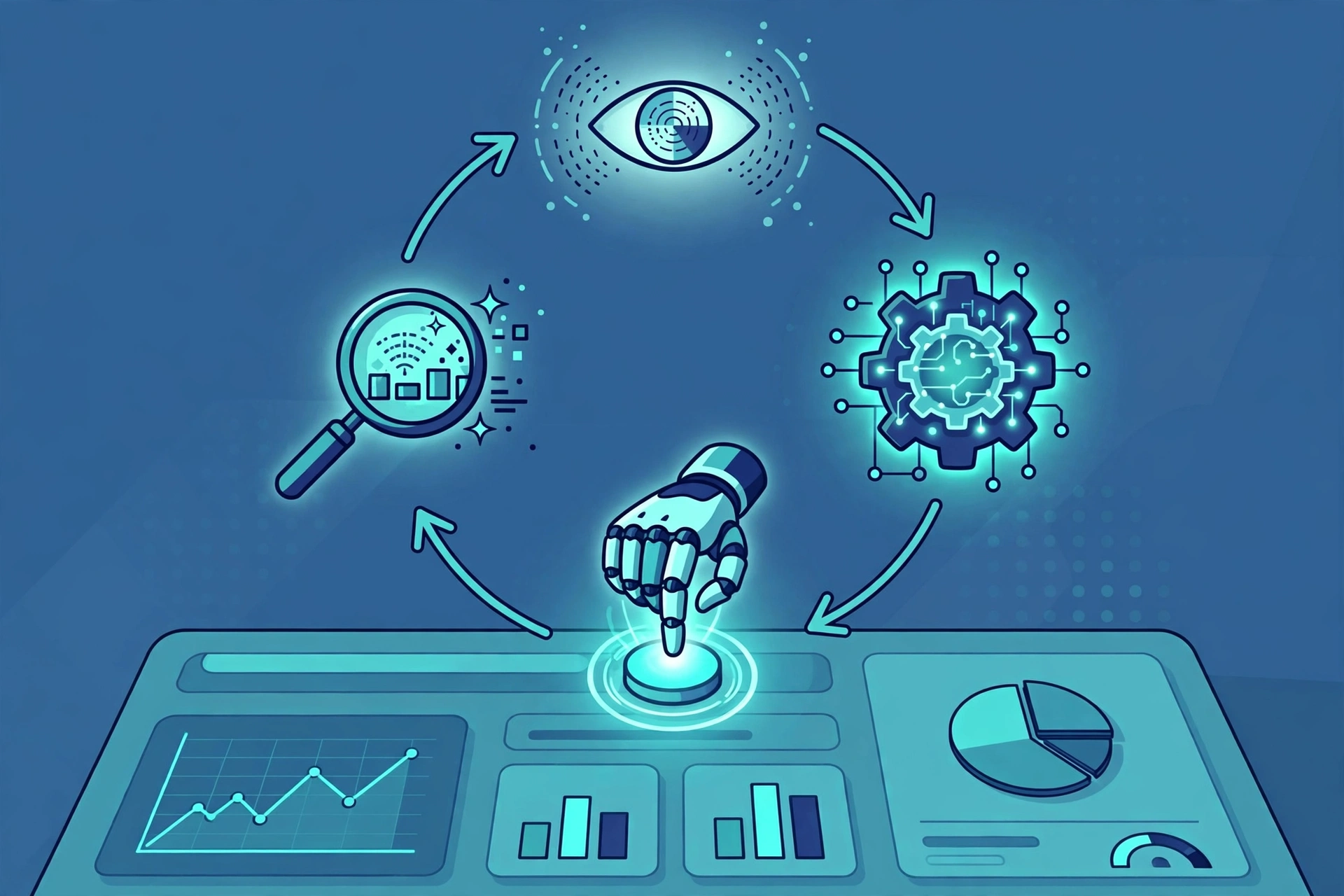
Every AI agent, regardless of framework or vendor, runs the same fundamental cycle. Engineers call it the perceive–reason–act loop:
- Perceive: the agent takes in the task and its current context — the goal, available tools, relevant data, and whatever happened in previous steps.
- Reason: it decides what to do next. This might be one step (“look up the order status”) or a full plan (“first check inventory, then check shipping, then draft the reply”).
- Act: it invokes a tool — an API call, a database query, a web search, sending an email, running code.
- Observe: it reads the result of that action and updates its understanding.
- Repeat: the cycle continues until the goal is achieved, a stopping condition is reached, or the agent decides it needs human help.
The most widely used reasoning pattern inside this loop is called ReAct (Reason + Act), introduced in a 2022 research paper and now the backbone of most agent frameworks. A ReAct agent interleaves its thinking with its doing: it writes out its reasoning (“The tool call failed with a rate-limit error, so I should wait and retry”), takes an action, observes the outcome, and reasons again. This makes agent behavior inspectable — you can read the agent’s “thoughts” the way you’d read a colleague’s notes.
The five building blocks
1. The reasoning core. This is a large language model with tool-calling ability. It interprets inputs, breaks goals into steps, and decides which tool to use. Chain-of-thought prompting — asking the model to reason step by step — is the technique that lets the core handle multi-step problems rather than one-shot answers.
2. The tool layer. Tools are how an agent touches the world: REST APIs, SQL connectors, code execution sandboxes, web search, email, calendars, document stores. Modern tooling increasingly uses standardized protocols — notably Anthropic’s Model Context Protocol (MCP), which gives agents a uniform way to discover and call tools, and Google’s A2A protocol, which lets agents from different platforms communicate with each other.
3. Memory. Short-term memory is the running log of the current task — every reasoning step and tool result, carried in the model’s context. Long-term memory persists across sessions: customer preferences, company policies, previously learned facts. Vector databases and knowledge graphs are common implementations.
4. Orchestration. This is the software that sequences everything — frameworks like LangChain, LangGraph, CrewAI, and AutoGen provide the plumbing for multi-step execution, error handling, and coordination between agents.
5. Guardrails and stopping conditions. Production agents need boundaries: maximum iterations, spending limits, allowed tools, escalation rules. An agent with no stopping condition can loop indefinitely, and one with no tool constraints is a security incident waiting to happen.
Types of Autonomous AI Agents
Not all agents are built the same way. Understanding the main types helps you match the right architecture to the right job.
By decision-making sophistication
- Simple reflex agents react to the current situation with fixed rules. A spam filter that routes email is a distant ancestor of this family. Fast and predictable, but they can’t handle anything novel.
- Goal-based agents work toward a defined objective, choosing actions that move them closer to it. Most business agents today fall here — they know the destination and figure out the route.
- Utility-based agents weigh trade-offs. When there are many ways to succeed, they pick the one that maximizes a measure of value — cheapest, fastest, or lowest risk.
- Learning agents improve over time from experience. They adjust their strategies based on what worked before, which makes them powerful but harder to audit.
Single agents vs. multi-agent systems
A single agent handles a task end to end. A multi-agent system splits the work: one agent researches, another writes, a third reviews — like a small team of specialists collaborating. Multi-agent systems are the fastest-growing pattern in enterprise AI: KPMG found multi-agent adoption reached 25% in Q3 2026, up from just 6% across all of 2025.
The trade-off is complexity. Multiple agents can divide large problems elegantly, but they also need coordination, communication protocols, and governance for the interactions between agents — a layer of management many companies are still learning to build.
Where Businesses Are Actually Using AI Agents
Adoption is no longer a pilot-project story. SailPoint’s October 2026 identity security report found that 79% of organizations are now running AI agents in production. Here are the functions where autonomous AI agents for business are most established:
- Customer support. Agents that read incoming tickets, look up order history, check inventory, issue refunds within policy, and draft — or send — the reply. Zapier’s enterprise research found 49% of enterprises had deployed agents in support teams, and LangChain’s developer survey ranked customer service as the number-one agent use case at 26.5%.
- Sales and marketing. Prospect research agents that build lead lists, enrich contact data, draft personalized outreach, and schedule follow-ups. Marketing agents that monitor campaigns and reallocate budgets when performance shifts.
- Operations and supply chain. Agents that reconcile invoices, track shipments, flag delays, and reorder stock when levels drop. 47% of enterprises in Zapier’s data had deployed agents in operations.
- Data analysis and research. Agents that pull data from multiple systems, clean it, run analyses, and produce briefings. LangChain’s survey placed research and data analysis second at 24.4%.
- Software development. Coding agents that write, test, and review code — one of the most advanced agent categories, with deep access to repositories and CI pipelines.
- Finance and HR. Expense auditing, payroll anomaly detection, candidate screening, and onboarding workflows — all high-volume, rule-adjacent tasks where agents excel.
The pattern is consistent: agents thrive on high-volume, text-heavy, verifiable tasks — work where the steps are clear enough to automate but varied enough that fixed scripts keep breaking.
The Business Case: Benefits and Adoption Numbers
The momentum behind autonomous AI agents for business is hard to overstate. Consider the trajectory:
- Adoption is surging. KPMG’s survey shows 62% of large enterprises deploying or developing agents, up from 53% the prior quarter. Among small businesses, 58% already use AI agents regularly or occasionally, with another 14% planning to (SBE Council, 2026).
- Agent density is climbing. Techaisle’s 2026 SMB research found a 59:1 ratio of AI agents to human employees in small businesses — and 144:1 in midmarket organizations that have moved past packaged AI features.
- The market is exploding. Deloitte’s TMT Predictions forecast the autonomous enterprise market growing from $8.5 billion in 2026 to between $35 and $45 billion by 2030.
- Productivity gains are real. 74% of small and mid-sized businesses report AI-driven productivity improvements, though for most those gains haven’t yet passed 25%.
- Strategic leverage is the prize. McKinsey notes that agent-based workflows are five to thirty times more computationally intensive than chatbot queries — expensive per task, but the tasks they complete are worth far more than a single chat response.
Deloitte also estimates that 50% of companies already using generative AI will adopt intelligent agents by 2027, and that by 2028 roughly 15% of everyday work decisions could be made autonomously by agents — up from nearly zero in 2024.
Risks and Challenges Nobody Should Ignore
The same surveys that show explosive growth carry serious warnings. A balanced view of autonomous AI agents for business requires facing them head-on.
The ROI gap
Only about 23% of companies deploying AI agents report seeing real return on investment. Gartner projects that 40% of agentic AI projects will be cancelled by the end of 2027, citing escalating costs, unclear business value, and inadequate risk controls. KPMG found roughly 93% of enterprises blew past their AI budgets. For small businesses, uncertainty around ROI (24%) is now the second-biggest barrier to adoption, behind only data security and compliance (27%).
The honest summary from the data: everyone is deploying; almost no one is operationalizing. Pilots that can’t demonstrate learning and improvement over time are the likeliest to land in the failing majority.
The identity and security gap
Agents need credentials — API keys, logins, database access — to do their jobs. Each agent is effectively a new digital employee with privileges, and most companies aren’t managing them like one. SailPoint’s 2026 report found that while 79% of organizations run agents in production, only 2% have deployed identity security tools designed to govern them — a forty-to-one gap.
The risks are concrete: agents with broad write access can corrupt data or leak it; agents communicating with each other across platforms create new attack surfaces; and the deep repository access required by coding agents raises supply-chain concerns. Security researchers have already demonstrated attacks that bypass safeguards in popular AI coding agents.
Cost, reliability, and workforce effects
- Cost: because agents run many model calls per task (reasoning, acting, retrying), inference spend scales fast. McKinsey’s finding that agent workflows are 5–30x more compute-intensive than chatbot queries is the number every budget owner should internalize.
- Reliability: agents can hallucinate tool parameters, get stuck in loops, or confidently execute the wrong plan. Human-in-the-loop checkpoints and strict stopping conditions are non-negotiable for consequential work.
- Workforce readiness: only 4% of companies have trained more than half their employees in AI skills. And in tech roles, unemployment among 20-to-30-year-olds has risen nearly 3 percentage points since early 2025 — a sign that generative AI is already slowing entry-level hiring in some fields.

How to Deploy Autonomous AI Agents in Your Business
If you’re convinced agents are worth exploring, here’s a practical path that avoids the most common failure modes.
1. Start with one narrow, verifiable task
Pick a process that is high-volume, well-documented, and easy to check. Support ticket triage, invoice processing, or lead enrichment are classic starting points. Avoid creative, judgment-heavy, or irreversible work for your first agent.
2. Define success before you build
Write down the metric that matters — resolution time, error rate, cost per task — and the baseline you’re beating. Gartner’s cancellation forecast is dominated by projects that never defined “value” in the first place.
3. Give the agent the smallest permissions that work
Read-only first. Add write access only where the workflow requires it, and put spending or customer-facing actions behind human approval. Treat every agent identity the way you’d treat a new employee’s access badge.
4. Run a bounded pilot with human oversight
Human-in-the-loop review on early runs lets you catch failure patterns — looping, bad tool parameters, misunderstood instructions — before they touch customers or money. Log every reasoning step and tool call; you’ll need the audit trail.
5. Measure, learn, and only then scale
Compare pilot metrics against the baseline honestly. Include total cost — compute, tooling, and the human hours spent supervising. Scale the agents that show learning over time, and kill the ones that don’t. Most experts advise assuming your first agent architecture will need redesigning once you see real-world behavior.
Choosing the Right Agent Tools and Frameworks
The agent tooling landscape is crowded, but a few names dominate 2026 deployments:
- LangChain / LangGraph — the most widely used orchestration frameworks, with LangGraph handling stateful, multi-step agent graphs.
- CrewAI — role-based multi-agent teams (“researcher,” “writer,” “reviewer”), popular for content and research workflows.
- AutoGen — Microsoft’s framework for conversational multi-agent systems.
- Hugging Face smolagents — a lightweight, open-source option offering both tool-calling and code-generating agent styles.
- MCP (Model Context Protocol) — the emerging standard for exposing tools to agents uniformly, so one agent can work with many data sources.
- A2A (Agent-to-Agent) — Google’s protocol for cross-platform agent communication, important as multi-vendor agent ecosystems grow.
When evaluating vendors or frameworks, check three things: observability (can you see the agent’s reasoning and tool calls?), guardrails (stopping conditions, permission scopes, approval workflows), and evaluation (how do you test whether the agent actually works before deploying it?).
The Future of Agentic AI: 2027 and Beyond
Where does this go next? The forecasts paint a clear direction:
- From pilots to infrastructure. Deloitte projects half of generative-AI-using companies will adopt agents by 2027, and the market could reach $35–45 billion by 2030.
- Autonomous decisions at scale. By 2028, an estimated 15% of everyday work decisions could be made autonomously by agents.
- Agent-to-agent economies. Protocols like A2A and payment standards for agent transactions (such as the x402 protocol) point toward agents that transact with each other — booking, buying, and negotiating with minimal human involvement.
- The governance reckoning. The 40-to-1 gap between agent deployment and agent identity security will close one way or another — through tooling, regulation, or painful incidents. Companies that build agent governance now will be ahead of the curve.
- The job transformation story. The World Economic Forum estimates that by 2030, around 22% of jobs will be affected by AI — with about 170 million new roles created against 92 million displaced, for a net gain of 78 million. Goldman Sachs puts the share of U.S. jobs at direct risk of loss at just 2.5%. The dominant pattern so far is transformation of roles, not elimination.
Conclusion
Autonomous AI agents for business have moved past the hype phase and into the messy middle of real deployment: 62% of large enterprises are building them, 79% of organizations run them in production, and the market is projected to quadruple by 2030. They work by combining a reasoning model with tools, memory, and a perceive–reason–act loop — a design that lets them handle multi-step work no fixed script could cover.
But the data also delivers a sober message: most deployments don’t yet show ROI, costs routinely overrun, and the security controls for agent identities are years behind the deployment curve. The companies winning with agentic AI in 2026 share a playbook — start narrow, define value, limit permissions, keep humans in the loop, measure honestly, and scale only what learns.
AI agents are becoming the newest members of the workforce: fast, tireless, and literal-minded. Like any new hire, they need clear goals, limited access, good supervision, and time to prove themselves. Businesses that manage them that way will capture the upside of the agentic era; those that deploy them on autopilot will likely join the 40% of projects Gartner expects to be cancelled. The technology is ready. The question is whether the management is.
Frequently Asked Questions
What is an autonomous AI agent in simple terms?
An autonomous AI agent is software that takes a goal you give it, figures out the steps itself, uses digital tools (email, databases, APIs) to do the work, checks its own results, and keeps going until the task is done — without a human driving each step.
How are AI agents different from chatbots?
Chatbots answer questions in a conversation. AI agents take action: they can look up data, update systems, send messages, and run multi-step workflows. A chatbot advises; an agent executes.
Are AI agents safe for business use?
They can be, with the right guardrails: limited permissions, human approval for sensitive actions, full logging of the agent’s steps, and identity security for agent credentials. Deploying agents without these controls is where most incidents and cost overruns happen.
How much do AI agents cost?
Agent workflows are 5 to 30 times more computationally intensive than simple chatbot queries, according to McKinsey — so inference costs scale quickly. Total cost includes the model spend, the tooling/platform, and the human hours spent supervising and evaluating the agent.
Which business tasks are best for AI agents?
High-volume, text-heavy, verifiable tasks: customer support triage, invoice processing, lead research, data analysis, report generation, and code assistance. Start where success is easy to measure and mistakes are cheap to fix.