
Introduction: Why Gamification in Education Matters More Than Ever
Gamification in education has moved from a classroom experiment to a mainstream teaching strategy. Teachers, professors, and corporate trainers around the world are discovering that game mechanics — points, badges, leaderboards, quests, and instant feedback — can transform passive learners into active participants. But what exactly is gamification in education, why does it work so well, and how can educators use it effectively without turning the classroom into a mere video game?
In this complete guide, we will explore the science behind gamification, its proven benefits for student engagement, the most effective game mechanics, real-world examples, common pitfalls, and a practical step-by-step framework for bringing gamification into any learning environment in 2026.
What Is Gamification in Education?
Gamification in education is the application of game design elements and game principles in learning environments that are not games themselves. It is important to distinguish gamification from game-based learning: game-based learning uses actual games to teach (such as a simulation or an educational video game), while gamification layers game-like features on top of ordinary learning activities. A math quiz becomes gamified when students earn points for correct answers, unlock badges for streaks, and see their progress on a class leaderboard — even though the quiz itself is not a game.
The concept is not entirely new. Teachers have awarded gold stars and held spelling bees for generations. What has changed is the scale and sophistication: digital platforms now make it possible to track progress in real time, personalize challenges for every learner, and deliver instant feedback that keeps students in a productive state of engagement. The global gamification in education market, estimated at around $2.96 billion in 2026, is projected to grow to nearly $40.8 billion by 2035 — a sign of how seriously institutions are taking this approach.
At its core, gamification answers a simple question: if games can hold a teenager’s attention for hours, what can education learn from their design?
The Science Behind Gamification: Why It Works
Gamification in education is not just a gimmick. It works because it aligns with well-established principles of human motivation and cognitive psychology. Understanding the science helps educators design experiences that genuinely improve learning rather than merely entertaining students.
The Dopamine Loop: Reward and Motivation
Games are engineered around reward schedules. Every point earned, badge unlocked, or level completed triggers a small release of dopamine, the neurotransmitter associated with pleasure and motivation. This reward circuitry keeps players coming back for “one more level.” When learning activities are structured with clear goals and frequent, achievable rewards, students experience the same motivational pull. The key insight is that the brain does not sharply distinguish between rewards earned in a game and rewards earned in a lesson — progress feels good either way.
However, neuroscience also offers a caution. Rewards that arrive too easily lose their power, while rewards that feel unattainable cause frustration. The most effective gamified systems use variable reward schedules and escalating challenges, mirroring the design of the world’s most engaging games.
Self-Determination Theory: Autonomy, Competence, and Relatedness
Psychologists Edward Deci and Richard Ryan’s self-determination theory identifies three core psychological needs that drive intrinsic motivation: autonomy (feeling in control of one’s actions), competence (feeling capable and effective), and relatedness (feeling connected to others). Well-designed gamification supports all three:
- Autonomy: Quests, branching storylines, and choice of challenges let learners decide how to approach their goals.
- Competence: Progress bars, levels, and mastery badges make growth visible, giving learners constant evidence that they are improving.
- Relatedness: Team challenges, guilds, and collaborative missions build social connection around learning.
When these three needs are satisfied, motivation shifts from extrinsic (“I have to do this for a grade”) to intrinsic (“I want to do this because it is satisfying”) — the holy grail of education.
The Flow State: Challenge Meets Skill
Psychologist Mihaly Csikszentmihalyi described “flow” as a state of complete absorption in an activity, occurring when challenge and skill are balanced. Too easy, and learners get bored; too hard, and they become anxious. Games excel at keeping players in the flow channel through adaptive difficulty — and modern gamified learning platforms do the same. Adaptive quizzes that get harder as students succeed, for example, keep every learner in their personal sweet spot between boredom and overwhelm.
Key Benefits of Gamification in Education
The research on gamification in education is increasingly robust. A 2026 field survey of university students found that 71% rated gamification strategies as effective or very effective at enhancing their engagement. A 2026 study published in the International Journal of Creative Research Thoughts found a statistically significant positive correlation between gamification and academic motivation, with gamification accounting for approximately 28% of the variance in student engagement. Here are the most well-documented benefits:
1. Higher Student Engagement
Engagement is the most immediate and visible benefit. Analyses of eLearning data report engagement gains of up to 60% in gamified contexts compared to traditional approaches. Game mechanics give students a reason to pay attention: there is always a next milestone, a rival to catch on the leaderboard, or a badge within reach. For disengaged learners — the students who tune out halfway through a lecture — this structure can be transformative.
2. Improved Knowledge Retention
Gamified learning experiences have been shown to increase retention rates by as much as 90% in some studies, with broader analyses reporting retention improvements of around 40%. The mechanism is straightforward: games encourage repetition through replayability, spaced practice through daily streaks, and active recall through challenges — all techniques that cognitive science identifies as powerful for long-term memory.
3. Increased Motivation and Effort
Surveys consistently show that learners in gamified environments report higher motivation. One widely cited workplace survey found that 83% of employees undergoing gamified training felt motivated, compared to 61% who received regular, non-gamified training, and 72% said gamification inspires them to work harder. In educational settings, studies have shown student performance increasing by nearly 35% when gamified elements are introduced thoughtfully.
4. Dramatically Better Completion Rates
Perhaps the most striking statistic: e-learning courses with gamified elements see completion rates around 90%, compared to roughly 25% for courses without gamification. For online courses and corporate training programs — where dropout rates are notoriously high — this difference can determine whether a program succeeds or fails.
5. Instant, Actionable Feedback
Traditional education often suffers from delayed feedback: students submit work and wait days for a grade. Games provide immediate feedback on every action, and gamified platforms replicate this. Instant feedback shortens the learning loop, letting students correct misconceptions while the material is still fresh in their minds. This is one of the reasons AI-powered gamified tutors, which can answer questions and monitor engagement in real time, are gaining traction in 2026.
6. Safe Failure and Experimentation
Games normalize failure: you lose a life, learn from the mistake, and try again. Gamified learning environments can adopt the same philosophy by allowing multiple attempts, “respawning” after failed quizzes, and rewarding persistence. This reduces the fear of failure that paralyzes many students and encourages the kind of productive struggle that leads to deep learning.
7. Stronger Collaboration and Social Learning
Team-based game mechanics — guild quests, collaborative challenges, peer voting — turn learning into a social experience. Students who might never speak up in a lecture will strategize with teammates, explain concepts to peers, and celebrate shared victories. Research shows that teaching others is one of the most effective ways to learn, and gamification creates natural opportunities for it.
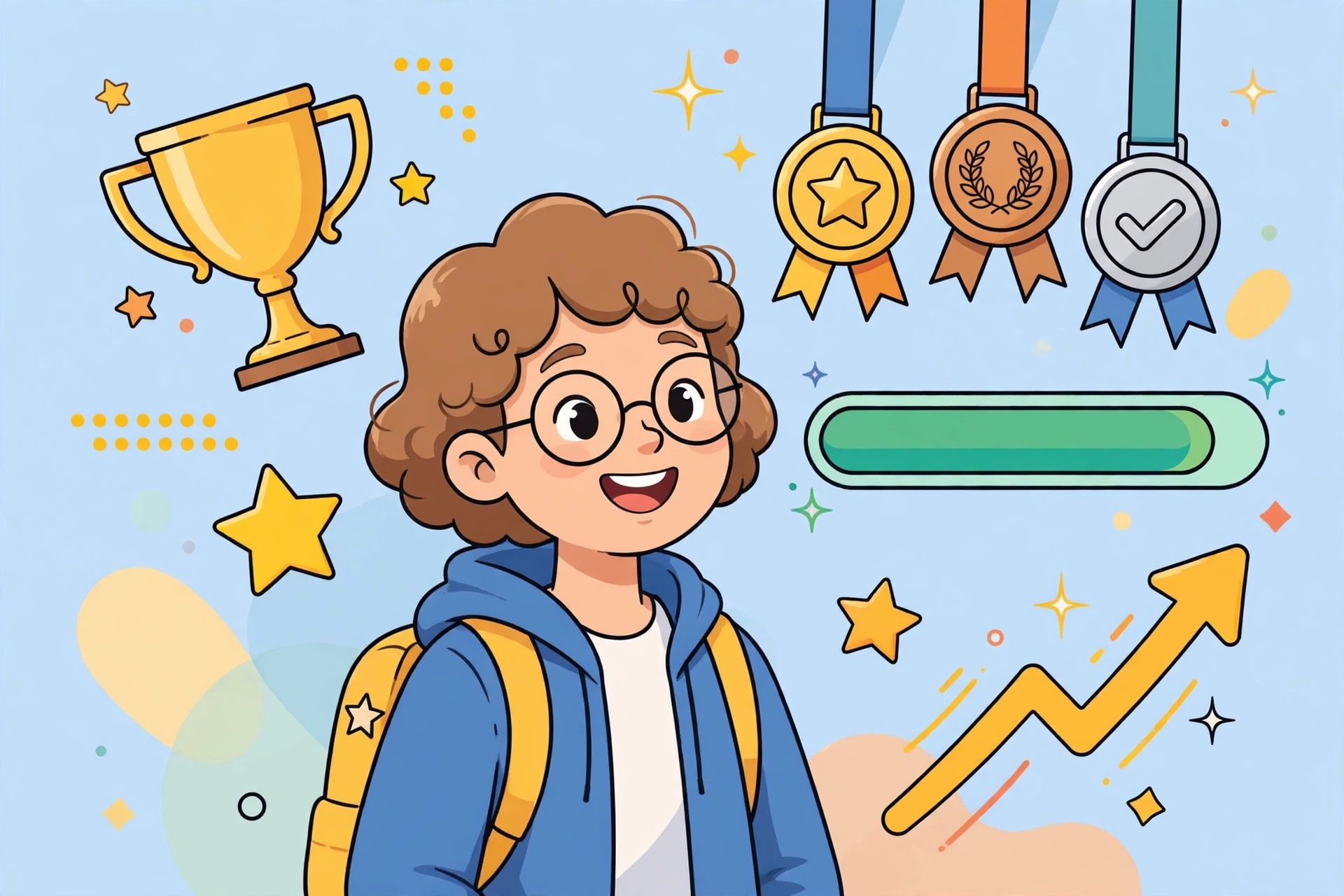
Core Gamification Mechanics Every Educator Should Know
Effective gamification in education is built from a toolkit of proven mechanics. You do not need all of them — the art is choosing the right combination for your learners and goals.
Points and Experience Systems (XP)
Points are the simplest mechanic: award them for completing activities, answering correctly, participating in discussions, or helping peers. Experience points (XP) that accumulate over a semester give students a running total of their effort, making progress tangible. Tip: award XP for effort and process (attempting challenging problems, revising work) as well as correct answers, so struggling students can still progress.
Badges and Achievements
Badges mark specific accomplishments: “Perfect Week” for five days of on-time submissions, “Peer Mentor” for helping three classmates, “Deep Diver” for completing optional extension work. Digital badges can be displayed on student profiles or portfolios. Unlike grades, badges can recognize a wide range of valuable behaviors — creativity, persistence, collaboration — that traditional assessment overlooks.
Leaderboards
Leaderboards rank participants by points, XP, or achievements, tapping into healthy competition. They are powerful motivators for competitive learners but can demotivate those at the bottom. Best practices: use team leaderboards instead of individual ones, create multiple leaderboards (most improved, most helpful, most creative), or let students opt in. The goal is motivation, not humiliation.
Levels and Progression Paths
Levels structure a long journey into manageable stages. A semester-long course might progress from “Novice” to “Apprentice” to “Expert” to “Master,” with each level unlocking new privileges — choosing a project topic, skipping a low-stakes quiz, or accessing bonus content. Visible progression gives students a sense of forward motion that a static gradebook cannot.
Quests and Challenges
Quests reframe assignments as missions: instead of “write a 500-word essay,” students receive “The Investigator’s Briefing: uncover three primary sources and present your findings to the council.” Narrative framing costs nothing but transforms the emotional texture of the work. Timed challenges, boss battles (difficult cumulative assessments), and side quests (optional enrichment) add variety.
Narrative and Storytelling
A compelling story can tie an entire course together. A history class becomes a time-travel expedition; a biology course becomes a mission to save an ecosystem; a programming course becomes a quest to build a startup. Narrative provides context that makes abstract content meaningful and memorable.
Streaks and Daily Challenges
Streaks reward consistency: consecutive days of practice, weeks of on-time submission. Language-learning apps have demonstrated how powerfully streaks drive daily habits. Short daily challenges — a five-minute quiz, a single problem — lower the barrier to starting, and starting is usually the hardest part.
Avatars and Personalization
Letting students create avatars, customize profiles, and choose their learning paths increases ownership. When learners see themselves in the experience, they invest more of themselves in it. Personalization also extends to adaptive difficulty, where AI adjusts challenge levels to each learner’s ability.
Real-World Examples of Gamification in Education
Gamification in education is not theoretical — it is already working at every level of learning, from primary schools to corporate boardrooms.
K-12 Classrooms
Platforms like Kahoot! have turned review sessions into high-energy competitions, with millions of teachers using game-based quizzes to energize their classrooms. Classcraft transforms classroom management into a role-playing game where students earn powers for positive behavior and lose health points for disruptions — and can heal teammates by helping them. Teachers report that these tools are especially effective for review, formative assessment, and building classroom community.
Higher Education
Universities are experimenting with gamified courses in fields from computer science to medicine. Medical schools use simulation-based challenges where students diagnose virtual patients under time pressure. Business schools run semester-long market simulations where teams compete for market share. A 2026 study of hybrid-learning undergraduates found significant pre-to-post gains in engagement after gamification activities were introduced, with effects on motivation confirmed through regression analysis.
Language Learning
Duolingo is the flagship example of gamification in education done at scale: XP, streaks, leagues, hearts, and a friendly owl mascot have made it one of the most successful learning apps in history. Its premium tier adds AI-powered conversational practice, showing how gamification and artificial intelligence reinforce each other. Millions of learners maintain months-long streaks — a testament to how game mechanics build durable habits.
Corporate Training and Professional Development
Companies were early adopters of gamified learning because the ROI is measurable. Gamified onboarding programs, sales training simulations, and compliance courses consistently outperform their traditional counterparts: employees in gamified training report feeling more productive and engaged, with some studies showing up to 48% higher engagement and 50% productivity gains. TalentLMS surveys found that 89% of employees felt more productive in a gamified workplace.
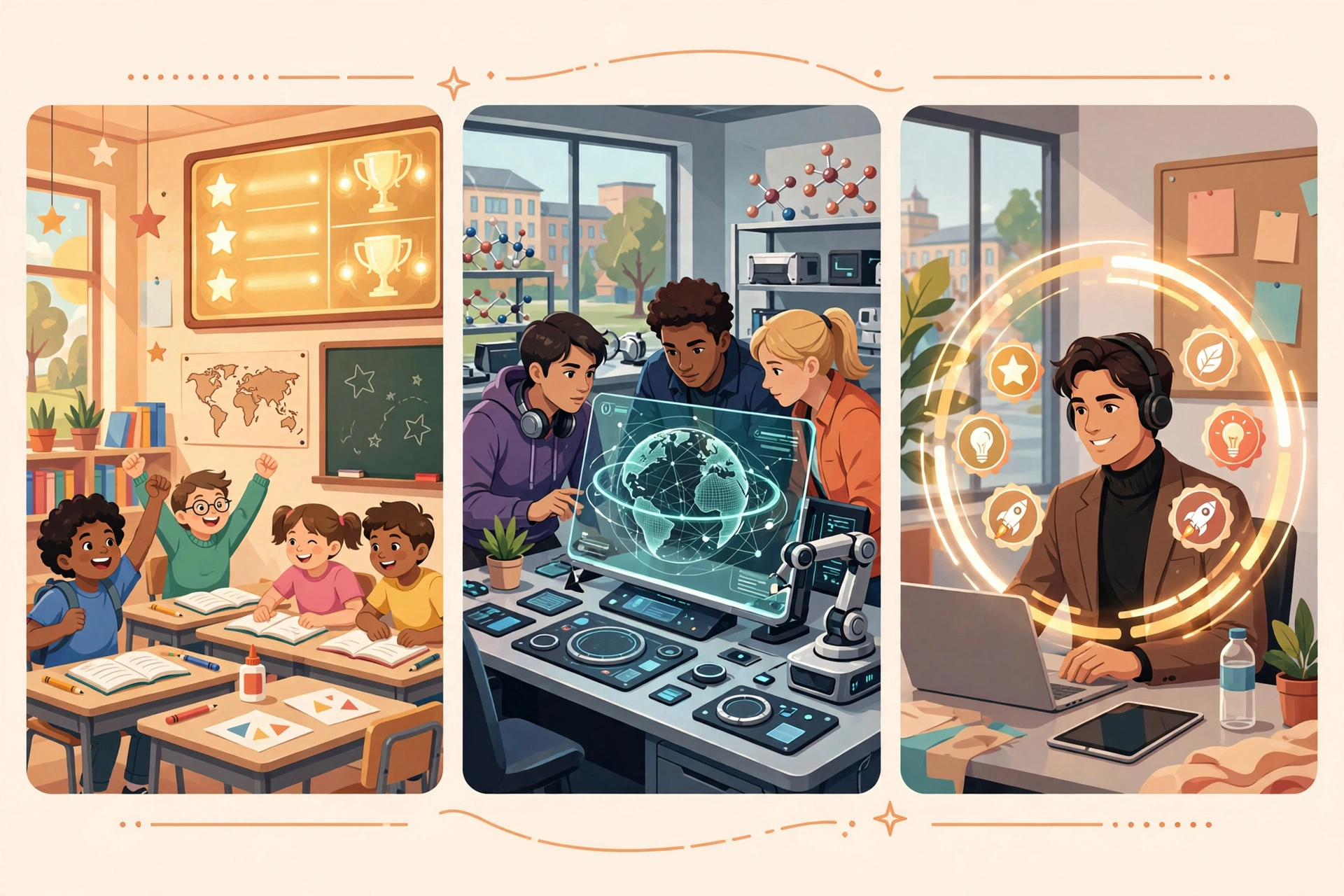
AI-Powered Gamification: The Next Frontier in 2026
The most exciting development in gamification in education is its convergence with artificial intelligence. AI transforms static game mechanics into adaptive, personalized experiences.
Adaptive Difficulty in Real Time
Traditional gamified quizzes have fixed difficulty; AI-powered platforms adjust question difficulty based on each student’s performance moment by moment. A student who is breezing through gets harder challenges to stay in flow; a struggling student gets scaffolded support. This personalization was once impossible at scale — now it is becoming standard, with adaptive learning platforms expected to be the norm rather than the exception.
Personalized Rewards and Motivation
AI can learn what motivates each individual learner. Instead of generic points, AI-powered systems tie rewards to specific learning milestones and tailor recognition to what drives each student — competition for some, personal goal achievement for others, collaboration for others still. Predictive analytics can even identify when a student is at risk of disengaging and intervene with encouragement or a well-timed challenge before motivation collapses.
AI Tutors and Intelligent Companions
AI teaching assistants that answer student questions, provide hints during quests, and monitor engagement are lightening teacher workloads while giving students on-demand support. Industry leaders predict that in 2026, classrooms will be supported by intelligent AI companions delivering deeply personalized learning experiences, adapting to each learner’s pace, style, and needs with real-time feedback.
Emotion-Aware Learning
Next-generation platforms are beginning to detect frustration, confusion, or disengagement through interaction patterns — hesitation, repeated errors, declining response times — and adjust their approach accordingly. An AI tutor that notices a student struggling might offer a hint, switch to an easier problem, or suggest a break. This emotional intelligence makes gamified learning more humane, not just more efficient.
A word of balance: as AI literacy becomes a core subject — with two-thirds of students now considering AI essential to their education — schools must teach students not just to use these tools but to understand them. The most successful implementations in 2026 are those developed in close partnership with educators, ensuring that technology enhances teaching rather than attempting to replace it.
Potential Pitfalls: When Gamification Goes Wrong
Gamification in education is powerful, but it is not foolproof. Poorly designed systems can backfire. Here are the most common pitfalls and how to avoid them.
Overjustification: Killing Intrinsic Motivation
The overjustification effect occurs when external rewards undermine intrinsic interest: a student who loved reading for its own sake may read less once reading becomes merely a way to earn points. The defense is to use rewards to recognize mastery and effort rather than to bribe compliance, and to gradually fade extrinsic rewards as intrinsic motivation takes root. Rewards should celebrate learning, not substitute for it.
Leaderboard Anxiety and Unhealthy Competition
Public rankings can humiliate struggling students and create toxic competition. Research on gamification perceptions shows that while most students respond positively, a minority report stress and disengagement from competitive elements. Mitigate this with team-based competition, multiple paths to recognition, private progress tracking, and opt-in leaderboards.
The Digital Divide and Access Disparities
Sophisticated gamified platforms assume reliable devices and internet access — assumptions that exclude many learners. Studies repeatedly flag digital access disparities as a barrier to gamification adoption. The solution is to design low-tech alternatives: paper-based point systems, classroom badge boards, and team challenges that require no devices at all can deliver most of the benefits with none of the access barriers.
Distraction and “Chocolate-Covered Broccoli”
Critics coined the term “chocolate-covered broccoli” for gamification that merely decorates boring content with superficial game elements without improving the underlying learning. If students are more focused on earning points than understanding concepts, the design has failed. Every mechanic should serve a learning objective: points should reward meaningful practice, narratives should illuminate content, and challenges should require genuine thinking.
Instructor Resistance and Implementation Fatigue
Teachers already face heavy workloads, and poorly supported gamification initiatives add to the burden. Successful programs provide training, ready-made templates, and realistic expectations. Notably, while 83% of K-12 teachers now use generative AI tools, many learn through trial and error — a training gap that institutions must close for any educational technology to reach its potential.
How to Get Started: A Practical Framework for Educators
Ready to bring gamification into your teaching? Follow this step-by-step framework, whether you teach third graders, undergraduates, or adult professionals.
- Step 1: Define clear learning objectives. Start with what students should know or be able to do — never with the game mechanics. Every element you add later must serve these objectives.
- Step 2: Know your players. Survey your students: What motivates them? Are they competitors, explorers, collaborators, or achievers? Different player types respond to different mechanics.
- Step 3: Start small with one mechanic. Add a single element — a class leaderboard, a badge system, or weekly challenges — rather than overhauling everything at once. Measure the impact before expanding.
- Step 4: Build a progression structure. Map the journey from novice to mastery across your course timeline. Define levels, milestones, and what unlocks at each stage.
- Step 5: Design meaningful rewards. Tie points and badges to effort, improvement, collaboration, and mastery — not just correct answers. Include recognition for behaviors you want to encourage.
- Step 6: Add narrative framing. Wrap your course or unit in a story that gives activities context and emotional resonance. Even a light theme transforms the experience.
- Step 7: Provide instant feedback loops. Ensure students know immediately how they performed and what to do next. Use auto-graded quizzes, peer review, or AI assistants to close the feedback gap.
- Step 8: Make failure safe and instructive. Allow retakes, award partial credit for persistence, and frame mistakes as part of the quest. Track “most improved” alongside “highest score.”
- Step 9: Measure and iterate. Track engagement, completion, and learning outcomes. Survey students about what works. Refine or remove mechanics that do not serve learning.
- Step 10: Keep the human element central. Technology should amplify your teaching, not replace it. The teacher-student relationship remains the most powerful motivator in any classroom — gamified or not.
Measuring the Success of Gamification in Education
How do you know your gamified approach is working? Track a balanced mix of metrics:
- Engagement metrics: participation rates, time on task, voluntary activity completion, login frequency.
- Learning outcomes: assessment scores, knowledge retention over time, skill demonstration in authentic tasks.
- Motivation indicators: student surveys, self-reported interest, willingness to attempt challenging work.
- Completion metrics: course or module completion rates, dropout reduction, on-time submission rates.
- Behavioral signals: collaboration frequency, help-seeking behavior, persistence after failure.
Compare these against a baseline — the same course before gamification, or a non-gamified control group — to isolate the effect. And remember that the ultimate measure is learning: engagement without improved understanding is entertainment, not education.
Conclusion: The Future of Gamification in Education
Gamification in education has proven itself as far more than a passing trend. Grounded in the psychology of motivation, supported by growing evidence — from 60% engagement gains to 90% completion rates — and supercharged by artificial intelligence, game-based approaches to learning are reshaping how we teach and how students learn.
The educators who will benefit most are not those who gamify the most aggressively, but those who gamify the most thoughtfully: starting from clear learning objectives, choosing mechanics that serve those objectives, protecting intrinsic motivation, ensuring equitable access, and keeping the human relationship at the center of the classroom.
Games figured out long ago how to make effort feel like play. Education is finally learning the same lesson — and students are the winners.
Frequently Asked Questions
What is the difference between gamification and game-based learning?
Gamification applies game elements (points, badges, leaderboards) to non-game learning activities, while game-based learning uses actual games as the teaching medium. A gamified quiz awards points for a regular test; game-based learning might teach fractions through a cooking simulation game.
Does gamification in education actually improve grades?
Research suggests it can: studies have reported student performance increases of around 35% with well-designed gamified instruction, alongside higher engagement and retention. However, results depend heavily on design quality — mechanics must be aligned with genuine learning objectives.
What are the best gamification tools for teachers in 2026?
Popular options include Kahoot! for live quizzes, Classcraft for classroom role-playing, Duolingo-style streak systems for habit building, and AI-powered platforms like Khanmigo for personalized tutoring. The best tool is the one that fits your learning objectives, your students’ access to technology, and your own comfort level.
Can gamification work without technology?
Absolutely. Paper-based point systems, classroom badge boards, team challenges, narrative framing, and privilege-based rewards require no devices at all. Low-tech gamification is often more equitable and can be just as effective as digital alternatives.
Is gamification suitable for all age groups?
Yes, with age-appropriate design. Young children respond to stories, avatars, and simple rewards; teenagers engage with competition, social mechanics, and meaningful choices; adult learners prefer professional framing, skill mastery, and recognition relevant to their careers.