
Every time an aircraft accident makes headlines, reporters soon start talking about the search for the “black box.” The little orange device is treated almost like a magical witness — an impartial observer that remembers everything. But how aircraft black boxes work is a story of remarkable engineering, decades of evolution, and some of the toughest design standards in any industry. In this complete 2026 guide, we explain exactly what a black box is, how it records flight data and cockpit audio, how it survives crashes that destroy everything else, how investigators recover and read it, and where the technology is headed next.
Why Is It Called a “Black Box” When It Is Bright Orange?
One of the most common misconceptions in aviation is right there in the name: the “black box” is not black at all. Modern flight recorders are painted a vivid, heat-resistant orange — sometimes called “international orange” — so that they stand out against wreckage, mud, and ocean floors. The nickname dates back to early electronics, where mysterious electronic assemblies were casually called “black boxes” by engineers, and the media picked it up. The name stuck even though the actual devices are about as visible as engineers can make them.
It is also worth knowing that the black box is not one box. Aircraft carry two separate recording systems, each housed in its own crash-survivable container:
- The Flight Data Recorder (FDR) — logs measurements from sensors throughout the aircraft: altitude, airspeed, heading, engine performance, control positions, and hundreds more parameters.
- The Cockpit Voice Recorder (CVR) — records audio from the flight deck: pilot conversations, radio calls to air traffic control, alarms, and ambient sounds.
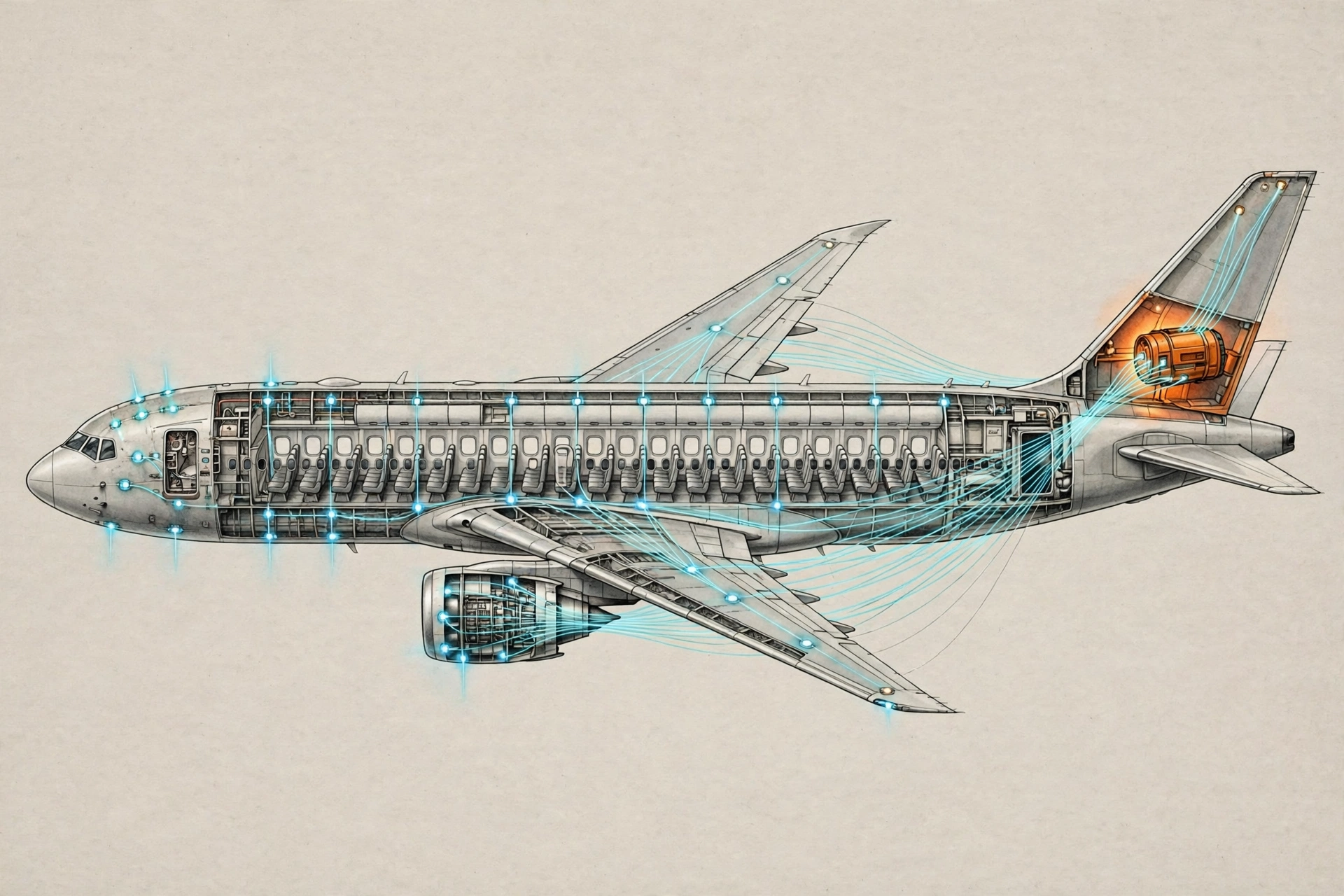
On many newer aircraft, these two functions are combined into a single unit called a CVDR (Cockpit Voice and Data Recorder). Both recorders are installed near the tail of the aircraft, which is statistically the part most likely to survive a crash.
The Flight Data Recorder: A Thousand Measurements Every Second
The FDR is the aircraft’s numerical diary. Its job is to capture, in objective numbers, exactly what the airplane was doing at every moment of the flight. The earliest FDRs, dating to the 1950s, were almost comically primitive by modern standards: they scratched a handful of measurements onto 400-foot rolls of metal foil using mechanical scribe arms, and the foil had to be replaced after every flight.
Today’s solid-state FDRs are entirely different machines. Modern units on advanced jets such as the Boeing 787 or Airbus A350 can monitor more than 1,000 distinct parameters — everything from flap and rudder positions to fuel flow, cabin pressure, autopilot mode, and whether specific warning systems triggered. US federal regulations currently require a minimum of 88 parameters for newer aircraft (up from 29 before 2002), and most FDRs record roughly 17 to 25 hours of data in a continuous loop, overwriting the oldest data once the loop is full.
Each parameter is typically sampled a few times per second, though some units capture “bursts” of data at much higher frequency when values start changing rapidly. Aircraft regulations also require an annual FDR readout check to verify that every mandatory parameter is being recorded correctly, and many flight decks include an “event” button the crew can press to mark a moment of interest on the recording if something unusual happens in flight.
The Cockpit Voice Recorder: Four Channels of Flight-Deck Audio
While the FDR explains what the aircraft did, the CVR helps investigators understand why it happened — the human factors. A modern CVR captures up to four simultaneous audio channels: the captain’s headset microphone, the first officer’s headset microphone, a cockpit area microphone that picks up ambient sounds, and the radio channel used for communications with air traffic control.
That area microphone is more powerful than it sounds. Experienced investigators can hear switch clicks that confirm whether a pilot moved a specific control, the sound of landing gear extending, engine noises that hint at malfunctions, and even the characteristic tones of automated warnings. These acoustic details have repeatedly proved decisive in investigations.
History-wise, CVRs followed the same arc as FDRs: the earliest units in the 1960s recorded the last 30 minutes of audio on magnetized steel wire (derived from the German Minifon dictaphone), then magnetic tape became the standard, and by the 1980s audio was digitized and stored on solid-state memory boards. Regulations historically required only the last two hours of audio to be retained, but starting with aircraft manufactured from 2026 onward, the requirement expands to 25 hours of cockpit voice recording — a major change that gives investigators the full audio story of long-haul flights.
CVR audio is also handled with unusual care. Only authorized accident investigation personnel may listen to the recordings, and most jurisdictions forbid public release of the audio itself to protect crew privacy and encourage honest cockpit communication. Investigators typically publish written transcripts instead.
How the Data Gets Recorded: From Sensor to Memory
Understanding how aircraft black boxes work means following the data on its journey from the wingtip to the memory chip. Here is the path a typical FDR measurement takes:
- Sensing. Sensors distributed throughout the airframe measure raw values — pitot tubes and static ports capture airspeed and altitude, accelerometers measure forces, thermocouples track engine temperatures, and position sensors watch control surfaces.
- Computing. An onboard Air Data Computer (ADC) takes the raw readings and computes useful flight values such as calibrated airspeed, true altitude, and heading.
- Acquisition. The Flight Data Acquisition Unit (FDAU) gathers the computed values — and in some designs raw analog signals, which it converts to digital form — and formats them into structured data frames.
- Storage. The formatted data is written into the Crash-Survivable Memory Unit (CSMU), a solid-state memory core armored to survive catastrophe.
The CVR path is simpler: microphones feed audio continuously into the recorder, which stores it in solid-state memory in a loop. The whole system is powered by the aircraft’s electrical system, and both recorder types are designed so that recording stops only when the aircraft’s power is gone — which is why the final seconds of a recording can be so informative.
Built to Survive: The Toughest Box in Aviation
What makes the black box famous is not that it records, but that it survives. The crash-protected memory unit is engineered to endure conditions that would obliterate virtually any other electronics on board. Certification standards require flight recorders to withstand:
- Impact forces exceeding 3,400 Gs for several milliseconds — equivalent to being smashed into a wall at full speed.
- Static crush forces of thousands of pounds, simulating debris piling onto the unit.
- Fire at 1,100°C (2,000°F) for up to an hour — hotter than most jet-fuel fires burn.
- Submersion to 20,000 feet (about 6,000 meters) of water pressure for at least 30 days, deeper than most of the ocean floor where searches have ever needed to go.
This survivability comes from layered design. The memory core sits inside a casing of corrosion-resistant stainless steel or titanium, wrapped in high-temperature insulation. The recorder is mounted in the tail section, the most crash-survivable part of the aircraft. That said, engineers are honest about one point: black boxes are crash-survivable, not crash-proof. No device is truly indestructible, but certification standards are calibrated so the recorder survives the vast majority of real-world accidents — and each generation of design improves on scenarios where earlier recorders failed.
The Underwater Locator Beacon: The “Pinger” That Calls for Help
If an aircraft goes down over water, finding the recorder is the hard part — the ocean is enormous and the box is small. That is why every FDR and CVR carries an Underwater Locator Beacon (ULB), nicknamed the “pinger.” The moment the beacon is submerged in fresh or salt water, it activates automatically and begins emitting an ultrasonic pulse.
- Frequency: 37.5 kHz — an ultrasonic tone well above human hearing.
- Pulse pattern: a short pulse, at least 9 milliseconds long, about once per second.
- Depth rating: operates from the surface down to 20,000 feet.
- Operating life: a minimum of 30 days once activated (newer designs are pushing toward 90 days).
- Battery shelf life: six years or more, after which the beacon must be replaced during maintenance.
Search teams listen for the ping using specialized towed hydrophone arrays — underwater microphones dragged behind ships that triangulate the signal. This is exactly how recorders were located in deep-ocean searches: the ping does not carry any data, it simply says “I am here.” Once located, remotely operated vehicles or divers recover the unit, and only then does the data extraction begin. Importantly, the recorded data itself remains intact in solid-state memory indefinitely after the beacon battery dies — the challenge is purely one of finding the box.

From Recovery to Report: How Investigators Read a Black Box
Recovering the recorder is only the beginning. The Crash-Survivable Memory Unit is transported under strict chain-of-custody rules to a specialized laboratory — agencies such as the US NTSB, the French BEA, or the relevant national authority run dedicated flight-recorder labs. Technicians connect the memory module to readout equipment, verify the data’s integrity, and begin the painstaking process of synchronization.
Synchronization is the detective work that makes the data meaningful: investigators align the FDR’s numerical timeline with the CVR’s audio timeline, then cross-reference both against air traffic control radar recordings, weather data, maintenance logs, and wreckage analysis. A spike in vertical acceleration on the FDR at 14:32:08, a stall warning audible on the CVR area microphone at the same moment, and a pilot’s verbal reaction a second later — together these build a minute-by-minute reconstruction no single source could provide.
The goal of this work is not to assign blame. International investigation standards (ICAO Annex 13) state explicitly that the purpose of accident investigation is prevention: finding the sequence of causes so that procedures, training, or aircraft design can be changed. Black box data has driven improvements ranging from cockpit crew resource management training to redesigned warning systems and new certification rules.
Real Investigations the Black Box Made Possible
Case history shows just how decisive recorder data can be:
- Air France Flight 447 (2009). The Airbus A330 vanished over the Atlantic, and its recorders lay nearly 4,000 meters down for almost two years before recovery. When finally read, the combined data revealed the full chain: iced-over pitot tubes fed bad airspeed data to the autopilot, which disconnected, and the crew’s handling of the stall — audible on the CVR — explained why the aircraft never recovered. The findings transformed pilot training on high-altitude stalls worldwide.
- USAir Flight 427 (1994). A Boeing 737 nosedived near Pittsburgh, killing all 132 aboard, with almost no survivable mechanical evidence. The FDR’s record of the rudder’s movement was the thread investigators followed, ultimately uncovering a rudder control-system defect that led to a redesign affecting thousands of 737s.
- Air India crash, Ahmedabad (June 2025). In a much more recent investigation, preliminary recorder analysis reportedly suggested the fuel control switches were moved to “cutoff” shortly after takeoff — and the CVR captured one pilot questioning the other about the cutoff. It is the kind of detail that physical wreckage alone could never establish.
- American Airlines regional jet, Potomac River (January 2025). Investigators emphasized the complementary roles of the two recorders: the FDR reconstructing the flight path and mechanics of the midair collision, the CVR shedding light on the human and communication factors behind it.
There are also the famous gaps. The search for Malaysia Airlines Flight 370’s recorders — never found despite the largest search in aviation history — is precisely what pushed regulators to mandate autonomous distress tracking and longer-lasting locator beacons.
The Future of Flight Recorders: Beyond the Box
For all their toughness, traditional black boxes have a weakness: they only tell their story if someone finds them. Three developments are changing that:
- Deployable recorders. Some recorders are now designed to eject from the aircraft on impact (or on water contact) and float, equipped with their own radio beacons — eliminating the deep-ocean search entirely.
- Autonomous distress tracking (ADT). New standards require modern aircraft to automatically transmit their position every minute when abnormal conditions are detected, so searchers start with a tight location box rather than an ocean.
- Real-time data streaming. Satellites and high-bandwidth links are making it technically feasible to stream key flight parameters to the ground continuously. Cost and bandwidth still make full streaming impractical for routine operations, but triggered streaming — sending data automatically when sensors detect an emergency — is already in development.
- Longer voice recordings. As noted, aircraft built from 2026 onward must retain 25 hours of cockpit audio instead of two, closing a gap that sometimes left investigators with only part of the story.
Combined recorders (CVDRs), image recorders that capture cockpit instrument displays, and data-link recording (logging the text messages crews exchange with controllers) round out the picture. The “box” of the future may be less of a box and more of a distributed safety net.

Frequently Asked Questions
How long do black boxes record?
Modern flight data recorders keep roughly 17–25 hours of data in a continuous loop. Cockpit voice recorders have traditionally retained the last 2 hours of audio, but aircraft manufactured from 2026 onward must retain 25 hours.
Why are black boxes placed in the tail?
The tail is statistically the part of the aircraft most likely to survive a crash, so both recorders are installed there to maximize the chance of recovery.
Can investigators listen to the cockpit voice recording?
Yes, but access is strictly limited to authorized accident investigators, and the audio is protected from public release in most countries. Transcripts may be published instead.
Do black boxes transmit their location?
Traditional recorders do not transmit during flight. The underwater locator beacon only activates when submerged. Newer autonomous distress tracking systems on modern aircraft do transmit position automatically during abnormal conditions.
What happens if the black box is never found?
The recorded data stays safely in solid-state memory even after the beacon battery dies — the problem is purely finding the box. When recorders are never recovered, as with MH370, investigators rely on satellite data, radar, and wreckage, which is why streaming and deployable recorders are being developed.
Conclusion
How aircraft black boxes work, at its core, is a chain of thoughtful engineering: sensors measure, computers calculate, acquisition units format, and an armored memory core preserves the result through forces that destroy the aircraft around it. The flight data recorder tells investigators what the airplane did; the cockpit voice recorder tells them what the crew experienced; and the underwater locator beacon makes sure the story can be found even at the bottom of the ocean. Decades of recorder data have quietly made flying the safest form of long-distance travel in human history — every investigation feeding back into better training, better procedures, and better aircraft. The next time you hear that the “black box” has been recovered, you will know exactly what was found, how it survived, and why it matters.