
How Digital Twins Work: The Complete Guide to Virtual Replicas of the Real World (2026)
Imagine being able to test a repair on a jet engine without touching the real one, predict a factory breakdown weeks before it happens, or redesign an entire city block and watch how traffic responds — all without moving a single physical object. That is not science fiction. It is what digital twins make possible, and the technology has become one of the most consequential ideas in modern technology.
In this complete guide, we explain how digital twins work, step by step, in plain language. You will learn what digital twins actually are, the technology that powers them, how they differ from ordinary simulations, where they are used in the real world — from smart factories to hospitals to entire cities — and what is driving their explosive growth. Whether you are a curious reader, a business decision-maker, or a student of technology, this guide will give you a full working understanding of the concept.
Quick answer: A digital twin is a live virtual copy of a physical object, process, or system. Sensors on the real thing continuously feed it data, so the copy mirrors what is happening right now. Analytics and artificial intelligence then use that living model to predict problems, test scenarios, and guide better decisions — and the insights flow back to improve the real-world original.
What Is a Digital Twin?
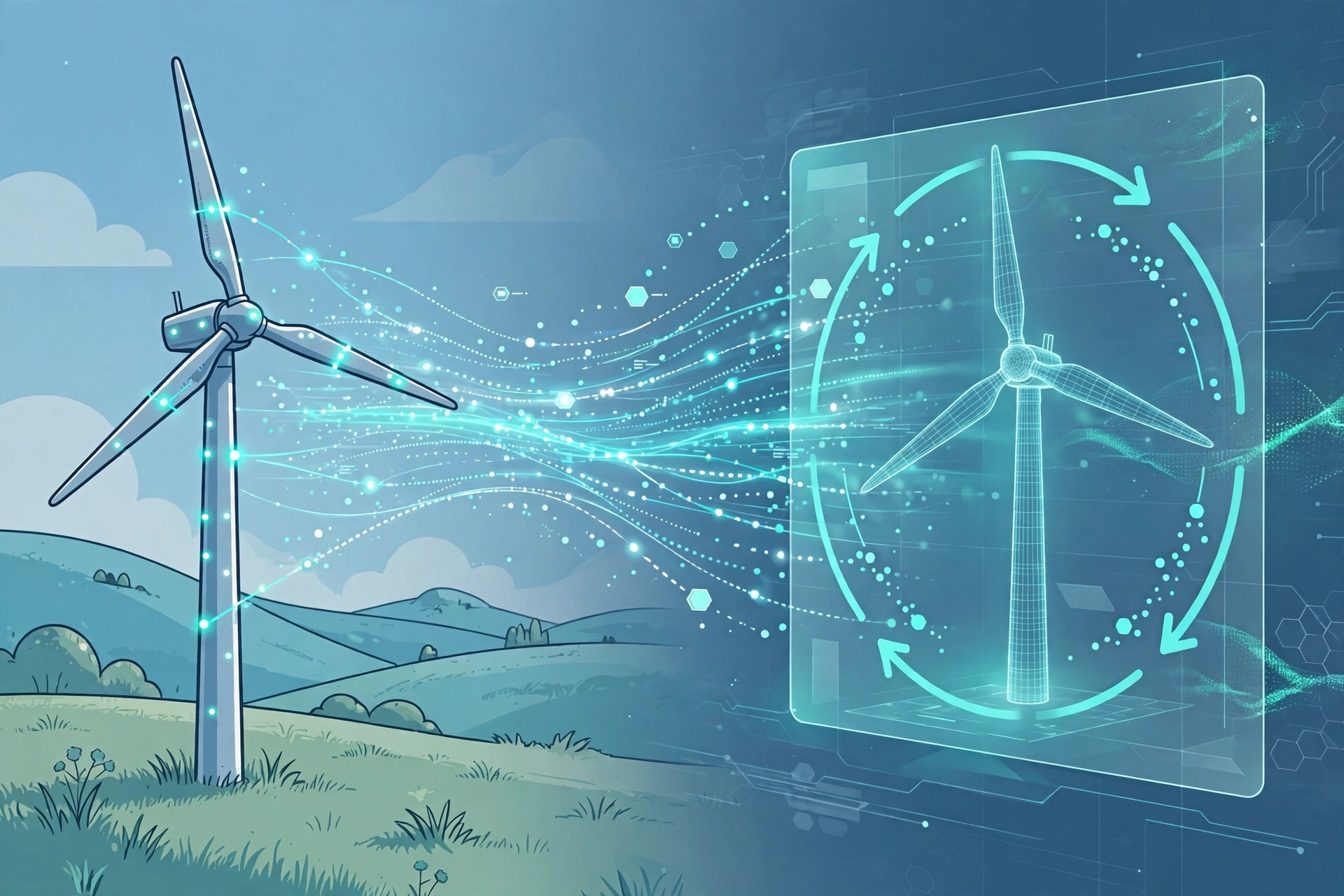
A digital twin is a virtual representation of a real-world object or system that is kept continuously up to date with data from its physical counterpart. The core idea is simple: build a digital copy of something real, then keep feeding that copy live data so it always reflects the current state of the original.
But a digital twin is much more than a 3D model or a photograph. A photograph does not change. A basic 3D model does not change either. A digital twin keeps changing — hour after hour, minute after minute — because sensors on the physical object keep talking to it.
Think of a delivery van. Sensors track its engine heat, brake wear, fuel consumption, and mileage. Its twin on a screen copies all of that in real time. A fleet manager can then watch a brake problem forming days before the van would break down on the road. That living connection between the physical and the virtual is the whole point of the technology.
Digital twins can represent almost anything:
- A single component: one wind turbine blade, a pump, an electric motor
- An asset or product: an entire aircraft engine, a car, a building
- A system: a manufacturing line, a power grid, an airport
- A process: a supply chain, a hospital’s patient flow, a construction schedule
- A place: a city district or an entire city
- A person: a “digital human twin” modeling a patient’s physiology for precision medicine
The concept itself is not brand new — NASA pioneered the thinking behind it decades ago, when engineers used ground-based physical duplicates of spacecraft to solve problems during the Apollo missions. What changed is the combination of cheap sensors, ubiquitous connectivity, cloud computing, and artificial intelligence, which together turned an expensive engineering exercise into a mainstream technology.
How Digital Twins Work: The Five-Step Process
Understanding how digital twins work is easiest when you follow the data from the physical world to the virtual one and back again. The process has five essential steps.
Step 1: The Physical Asset
Everything starts with a real-world object, system, or process that generates data during operation. This could be a factory robot, a wind turbine, a hospital ward, a fleet of delivery trucks, or even a human patient. The physical asset is the “original” that the twin will mirror.
Step 2: Sensors and Data Collection
The physical asset is outfitted with Internet of Things (IoT) sensors that continuously measure its condition. Typical sensors track temperature, vibration, pressure, speed, location, energy consumption, humidity, and dozens of other parameters, depending on the application.
For example, a single modern jet engine can carry hundreds of sensors generating gigabytes of data per flight. A smart building might have thousands of sensors monitoring HVAC systems, security, lighting, and occupancy. This sensing layer is the twin’s eyes and ears.
Step 3: Data Transmission
The collected data is transmitted to the digital platform through wired or wireless communication technologies — Wi-Fi, Ethernet, cellular networks, or specialized industrial IoT protocols such as OPC UA and MQTT. In many deployments, edge computing processes data close to the source first, sending only the important exceptions upstream to reduce bandwidth and latency.
Step 4: The Virtual Model
The incoming data feeds a digital model of the physical asset. This model is built from engineering data — CAD designs, material properties, physics-based models — and is continuously updated by the live data stream so it reflects the asset’s actual current condition, not how it was designed to behave.
Modern twins combine three ingredients: geometric models (what it looks like), behavioral models (how it behaves, based on physics), and data-driven models (what the live data says is actually happening). Artificial intelligence and machine learning analyze this combined picture to detect anomalies, recognize patterns, and predict future states.
Step 5: Analysis, Simulation, and the Feedback Loop
This is where the real value appears. Engineers, operators, and managers use the twin to:
- Monitor: see exactly what is happening right now, in one unified view
- Predict: forecast failures, demand, or performance degradation before they happen
- Simulate: test changes virtually — “what if we raise the operating temperature?” — without risking the real asset
- Optimize: find the most efficient operating settings and schedules
Crucially, the insights flow back to the physical world. A maintenance crew replaces a part before it fails. A building manager adjusts energy use. A city planner retimes traffic signals. Those actions change the physical asset, the sensors detect the change, and the twin updates — creating a continuous cycle of improvement.
This bidirectional data flow is the defining feature of digital twin technology. Data goes from the physical world to the digital one, and decisions go from the digital world back to the physical one.
The Four Types of Digital Twins
Not all digital twins are the same. Industry analysts generally recognize four levels of twins, each broader in scope than the last.
1. Component Twins (Part Twins)
The simplest form: a twin of an individual part, such as a gear, a battery cell, or a pipe valve. Component twins help engineers understand how a single part wears, stresses, and fails under real operating conditions.
2. Asset Twins (Product Twins)
Multiple component twins combine into a twin of a complete product or asset — an entire car, a wind turbine, an aircraft engine. Asset twins are the workhorses of predictive maintenance: they tell operators when the whole machine needs attention.
3. System Twins (Unit Twins)
A system twin mirrors a collection of assets working together — a production line, a power substation, an airport terminal. Here the interactions between assets matter as much as the assets themselves: how one machine’s slowdown cascades through the line, for instance.
4. Process Twins
The most ambitious level: a twin of an entire process or environment, such as a supply chain, a hospital’s emergency department, or a whole city. Process twins reveal system-wide patterns that no single asset twin could show — traffic congestion forming across a city, or demand surges rippling through a supply network.
Market analyses suggest system twins currently account for roughly 41% of deployments, process twins about 34%, and asset twins around 25% — reflecting how the technology is maturing from monitoring individual machines to orchestrating entire operations.
Digital Twin vs. Simulation: What Is the Difference?
Many people confuse digital twins with traditional simulations. The difference matters, and it is worth understanding clearly.
A simulation is typically a one-way, model-based prediction: you set the parameters, run the model, and get an answer about what might happen. Once built, it does not learn from reality. It answers: “Based on current parameters, here is what might happen.”
A digital twin, by contrast, is connected to live reality. It receives a continuous stream of real operational data, adapts and learns from it, and sends insights back. It answers: “Here is what is happening right now, and here is what comes next based on live data.”
| Aspect | Simulation | Digital Twin |
|---|---|---|
| Data flow | One-way predictions from a model | Bidirectional, live connection |
| Learning | Static, model-based | Adaptive, AI-powered, learns from real data |
| State | Frozen at design time | Always reflects current reality |
| Output | Theoretical outcomes | Predictive, actionable optimization |
| Impact | Scenario testing | Continuous operational improvement |
In short: a simulation is a snapshot; a digital twin is a living mirror.
The Technology That Powers Digital Twins
A digital twin is really a convergence of several technologies working together. Understanding the enabling stack helps you see why the concept has exploded in recent years.
Internet of Things (IoT) and Sensor Networks
Sensors are the foundation. Without cheap, reliable sensing, there is no live data and no twin. The industrial IoT boom — factories wiring up every motor, pump, and conveyor — is the single biggest reason digital twins moved from theory to practice.
Artificial Intelligence and Machine Learning
Raw sensor data is noise until something interprets it. AI models detect subtle anomaly patterns a human operator would miss, forecast remaining equipment life, and recommend optimal operating parameters. The newest industrial deployments run AI inference at the edge — right on or near the asset — for millisecond-level anomaly detection.
Cloud Computing
Cloud platforms provide the scalable storage and computing power needed to ingest millions of data points per second, maintain models across thousands of assets, and serve twins to users anywhere in the world.
3D Visualization and Virtual Reality
Interactive 3D models and real-time rendering turn abstract data into something humans can explore. Engineers can “walk through” a virtual factory, zoom into a turbine, and overlay live sensor readings on the geometry. Drone-based photogrammetry has also become a practical way to capture accurate twins of buildings and infrastructure quickly.
Edge Computing
Processing data near the source cuts latency and bandwidth costs, and keeps sensitive operational data on-site. Edge-deployed twins are becoming critical for real-time manufacturing and energy applications.

Real-World Examples of Digital Twins in Action
Digital twins have moved well beyond pilot projects. Here are the major application areas, with concrete examples of how they work in practice.
Manufacturing and Smart Factories
Manufacturing is the largest digital twin market. Factories build twins of production lines to optimize throughput, test layout changes virtually, and predict equipment failures. Honeywell’s Forge platform, for example, processes more than 3 billion data points daily from client plants and has cut unplanned downtime by 35% in deployments. Car manufacturers operate virtual programmable logic controllers through edge-deployed twins that optimize cycle times on real production lines.
Energy and Power
Energy companies create twins of wind farms, solar installations, and power plants to maximize output and schedule maintenance. General Electric has enhanced digital twin solutions supporting predictive monitoring across more than 50 gigawatts of power generation assets, improving maintenance planning efficiency by roughly 19%. The digital twin in energy market is projected to grow from about $6.66 billion in 2025 to $7.85 billion in 2026.
Healthcare
Hospitals use twins of operating rooms and emergency departments to optimize patient flow and resource allocation. More strikingly, “digital human twins” — virtual models of individual patients built from medical scans, lab data, and wearables — are becoming a core component of precision medicine in cardiology, oncology, pharmacogenomics, and neurology. Studies indicate these models can improve early disease prediction, though final clinical decisions continue to rest with experienced doctors.
Smart Cities and Urban Planning
Cities build twins of entire districts to manage traffic, plan infrastructure, and improve sustainability. Traffic engineers map whole roadway systems, analyze real-time traffic data, spot bottlenecks, and test adjustments before changing anything physical. Singapore is among the most cited pioneers, with a detailed virtual model used for urban planning and emergency response.
Aviation and Aerospace
Airlines and manufacturers maintain twins of aircraft engines that track every flight’s sensor data, enabling predictive maintenance that keeps planes safe and reduces costly unscheduled repairs. Aerospace was one of the earliest adopters — the industry’s roots in the technology go back to NASA’s Apollo-era engineering practices.
Construction and Real Estate
Builders compare drone-captured as-built twins against BIM design models to spot deviations from plans, track weekly progress, and hand over an accurate permanent record when a project closes. Real estate companies create twins of building ecosystems, monitoring HVAC, security, lighting, and tenant interaction data in real time.
Automotive
Car manufacturers twin individual components, whole vehicles, and entire factories. Twins anticipate component failures to improve safety, optimize crash testing virtually, and accelerate design cycles — a vehicle can be tested in thousands of simulated scenarios before a single physical prototype is built.
Key Benefits of Digital Twin Technology
The reason organizations invest heavily in digital twins comes down to measurable benefits:
- Predictive maintenance: detect equipment problems before failure, cutting unplanned downtime — often by 30% or more in documented industrial deployments
- Cost savings: test changes virtually instead of running expensive physical trials; predictive maintenance applications now generate measurable ROI within 14 to 18 months for capital-intensive operators
- Better design: iterate on products thousands of times in simulation before building physical prototypes
- Operational optimization: continuously tune processes for energy efficiency, throughput, and quality
- Risk reduction: rehearse emergency scenarios — a plant shutdown, a grid failure, a surge in hospital admissions — without real-world consequences
- Faster decisions: one unified, live view of complex operations replaces scattered dashboards and gut instinct
- Sustainability: optimize energy use, reduce waste, and model the environmental impact of design choices
Challenges and Limitations
Digital twins are powerful, but honest coverage requires acknowledging where the technology struggles.
- Data quality and integration: twins are only as good as their data. Disconnected legacy systems, inconsistent formats, and unreliable sensors produce unreliable twins. Connecting multiple enterprise systems into one unified environment remains one of the hardest parts of any deployment.
- Cost and complexity: building an accurate twin requires serious investment in sensors, platforms, integration, and expertise — though costs are falling as standardized protocols like OPC UA and MQTT reduce integration friction.
- Cybersecurity: a twin connected to live operational systems is a high-value target. A compromised twin could leak sensitive operational data or, worse, be used to issue bad instructions back to physical systems.
- Skills gap: designing and maintaining twins requires a blend of domain engineering, data science, and software skills that is still scarce in many industries.
- Model accuracy: hybrid physics-and-data models are improving, but no model is perfect. Overconfidence in a twin’s predictions is a real organizational risk — twins should support human decisions, not replace human judgment.
- Privacy: digital human twins in healthcare raise serious questions about who owns and controls deeply personal health data.
A useful rule of thumb from practitioners: a digital twin is designed to answer “What would this do?” — predict outcomes, test scenarios, identify risks early, and support human decisions. It cannot think, cannot be conscious, and cannot accept responsibility. The final call always belongs to people.
How Organizations Get Started With Digital Twins
If you are evaluating digital twins for a business, the successful deployments tend to follow a common pattern:
- Start with one high-value asset or process. Pick something where downtime is expensive or performance matters — a production line, a fleet, a critical building system. Do not try to twin everything at once.
- Get the data flowing first. Instrument the asset with the right sensors and establish reliable data pipelines before worrying about fancy visualization.
- Build a simple twin, then enrich it. A basic monitoring twin delivers value immediately; add predictive models and scenario simulation as data accumulates.
- Integrate with existing workflows. The twin must feed decisions into the systems people already use — maintenance management, operations dashboards, planning tools.
- Measure ROI from day one. Track downtime avoided, energy saved, or maintenance hours reduced so the business case is clear.
- Scale what works. Extend the pattern from one asset to a system, from a system to a process — compounding the data advantage over time.
The Future of Digital Twins: Key Trends for 2026 and Beyond
The technology is evolving fast. Here are the trends shaping digital twins right now.
Digital Twins Meet AI Agents
The combination of digital twins with autonomous AI agents is one of the most important developments. Instead of merely showing operators a prediction, agent-equipped twins can propose actions, coordinate across systems, and execute approved responses — moving from insight to action automatically.
Hybrid Physics-Data Models
Pure simulation and pure data-driven models are converging. Hybrid models that combine engineering physics with machine learning are displacing both approaches as the dominant architecture, because they are more accurate with less data.
Edge-Enabled Real-Time Twins
As analytics move from the cloud to the edge, twins are becoming fast enough for truly real-time control — millisecond-level responses in manufacturing lines and energy grids.
The Twin as a Workplace
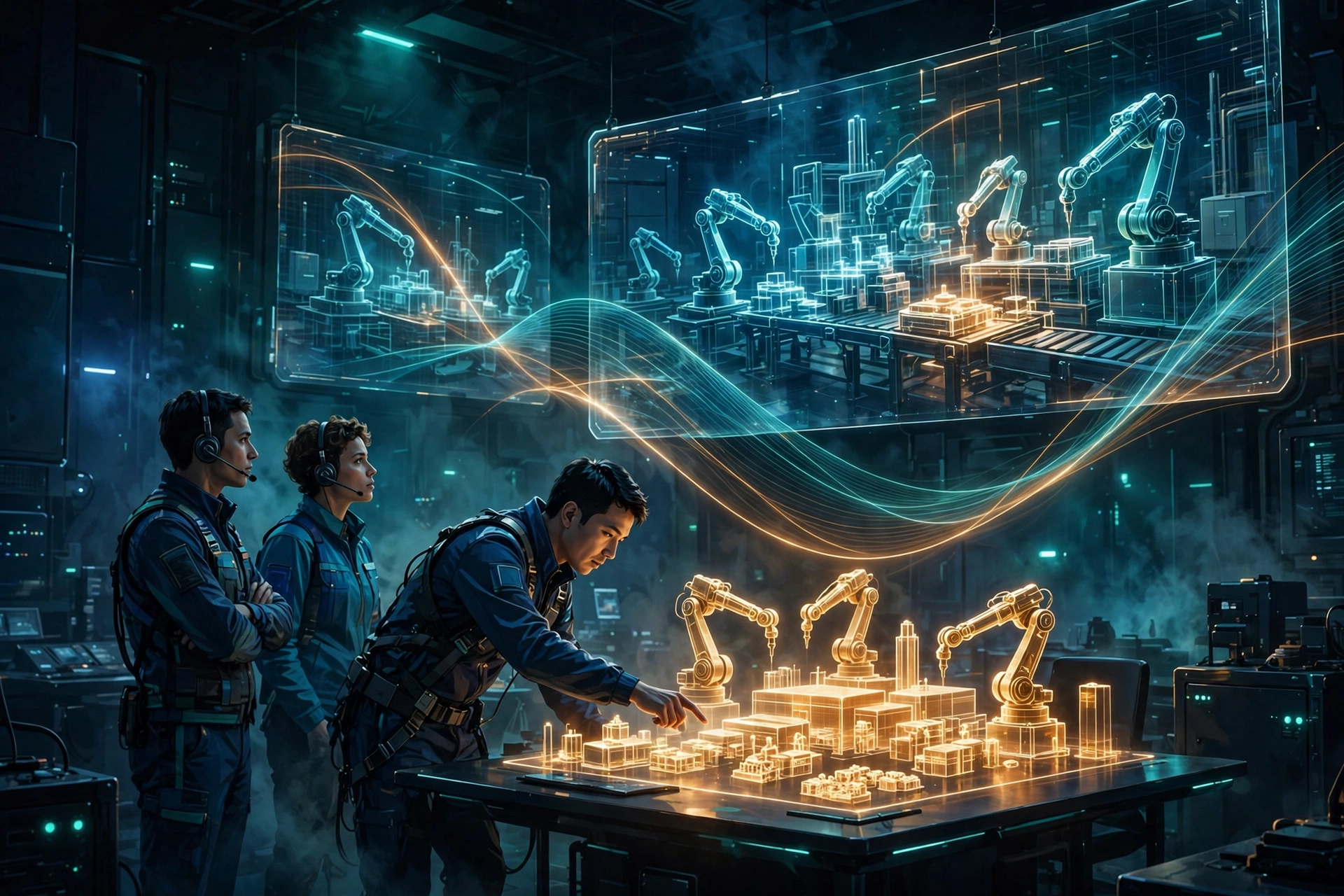
At NVIDIA’s GTC Berlin in October 2026, CEO Jensen Huang suggested a company’s digital twin could one day become the workplace for most of its staff: design would happen in the virtual copy, and robots would build the real thing in the factory. Whether or not that vision fully materializes, it signals how central twins are becoming to industrial strategy.
Massive Market Growth
Analysts project the global digital twin market — valued at roughly $29–36 billion in 2025 — will reach somewhere between $41 and $49 billion in 2026, growing at a compound annual rate of roughly 25–36% through the early 2030s, potentially exceeding $220 billion by the mid-2030s. More than two-thirds of large enterprises already use digital twin technology as part of broader digital transformation initiatives.
Frequently Asked Questions About Digital Twins
What is a digital twin in simple terms?
A digital twin is a live virtual copy of something real — a machine, a building, a city, or even a person. Sensors keep feeding it data, so it always mirrors the current state of the original, letting you monitor, predict, and test things without touching the real thing.
How do digital twins get their data?
Through IoT sensors attached to the physical asset, which measure things like temperature, vibration, pressure, and location. The data travels over wired or wireless networks to a central platform, where it updates the virtual model continuously — often with edge computing preprocessing it near the source.
What is the difference between a digital twin and a simulation?
A simulation is a one-way, static model that predicts what might happen based on set parameters. A digital twin maintains a live, two-way connection with the real asset, continuously updates from sensor data, learns from it with AI, and feeds insights back to improve real-world operations.
What are the main types of digital twins?
Component twins (single parts), asset or product twins (complete machines), system twins (collections of assets working together), and process twins (entire processes, systems, or environments such as supply chains or cities).
Which industries use digital twins?
Manufacturing, energy and utilities, aerospace and defense, automotive, healthcare, construction, real estate, telecommunications, and smart city planning are the leading adopters. Manufacturing and energy account for the largest shares.
Are digital twins expensive to implement?
They require real investment in sensors, platforms, and integration — but standardized protocols and cloud platforms are steadily lowering the cost, and predictive maintenance applications typically show measurable ROI within 14 to 18 months for capital-intensive operators.
Conclusion: Why Digital Twins Matter
Now that you understand how digital twins work, the bigger picture is clear: this technology changes the relationship between the physical and digital worlds from a one-way mirror into a two-way conversation. Physical systems generate data; digital models turn that data into foresight; and that foresight flows back to make physical systems safer, cheaper, cleaner, and more reliable.
From a single factory motor to an entire city, the pattern is the same — sense, mirror, predict, optimize, repeat. As sensors get cheaper, AI gets smarter, and edge computing gets faster, the cost of building a twin keeps falling while the value keeps rising. That is why analysts expect the market to grow several-fold over the next decade, and why more than two-thirds of large enterprises already have digital twins somewhere in their operations.
The next time you hear about a factory that “predicted” a breakdown, a hospital that optimized patient flow overnight, or a city that tested a new transit plan before pouring a single foundation, you will know what was behind it: a living virtual copy of the real world, working around the clock. That is the quiet power of the digital twin — and it is only getting started.