
Imagine walking into a room, switching on the light, and instantly connecting to the internet at speeds far beyond anything your Wi-Fi router can deliver. No passwords leaking through walls, no interference from dozens of neighbouring networks, no dead zones caused by thick concrete. This is not science fiction. It is Li-Fi, short for Light Fidelity, a wireless communication technology that uses visible light — the same light that brightens your room — to transmit data. In this complete guide, you will learn exactly how Li-Fi technology works, why it can be so much faster than Wi-Fi, where it is already being used, and what still stands between it and your home.
What Is Li-Fi Technology?
Li-Fi is a wireless communication technology that transmits data using visible light, ultraviolet, and infrared light instead of radio waves. It belongs to the broader family of Visible Light Communication (VLC). The idea was popularised in 2011 by German physicist Professor Harald Haas, who demonstrated during a TED talk how a simple LED light bulb could stream video data. His famous demonstration showed that a desk lamp, flickering far too fast for the human eye to notice, could carry more data than a cellular base station.
At its core, Li-Fi turns every light fixture into a potential wireless access point. Because modern buildings are already full of LED lights, the infrastructure for Li-Fi is, in a sense, already installed above our heads. The light does double duty: it illuminates the room and it carries data. This dual purpose is one of the reasons Li-Fi is described as both an energy-efficient and a spectrum-efficient technology.
To understand how Li-Fi technology works, it helps to start with a simple analogy. Think of a lighthouse flashing signals to ships, or of Morse code sent with a torch. Li-Fi works on the same principle, except the flashes happen millions of times per second, and the receiver is a light-sensitive sensor rather than a human eye. The result is a data link that is invisible, silent, and extremely fast.
How Li-Fi Technology Works: The Step-by-Step Process
The working of Li-Fi can be broken down into a clear chain of events, from the internet connection entering a building to data arriving on your device.
Step 1: Data Enters the LED Light Source
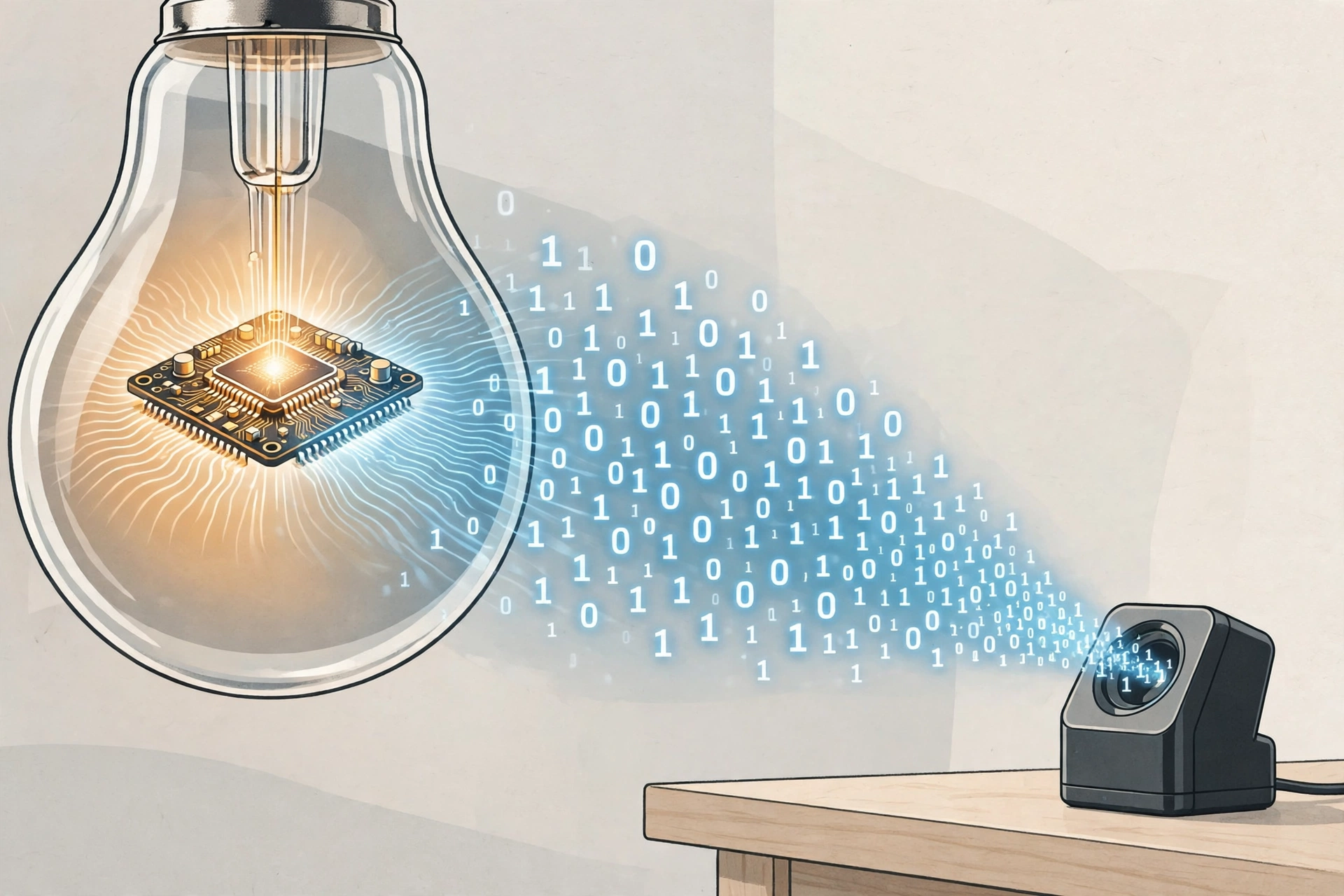
Everything starts with an internet connection, usually delivered to a building through fibre broadband or Ethernet. This data stream is fed into a special LED lamp fitted with a modulator chip, sometimes called a Li-Fi access point or lamp driver. The chip’s job is to convert the digital data into a signal that controls the LED.
Step 2: The LED Flickers to Encode Data
The LED switches on and off at an astonishing rate — millions of times per second. Each “on” state represents a binary 1 and each “off” state represents a binary 0, exactly the same ones and zeros that computers use. Because the flickering is far faster than the human eye can perceive, the light appears steady and constant to anyone in the room. More advanced systems do not simply switch the light fully on and off; they use sophisticated modulation schemes that vary the light’s intensity in subtle ways to pack even more data into each flicker.
Step 3: A Photodetector Receives the Light
On the receiving side, a device equipped with a photodetector — a sensor that converts light into an electrical signal — captures the flickering light. This receiver might be a small USB dongle attached to a laptop, a sensor built into a tablet, or a dedicated Li-Fi receiver module. The photodetector is extremely sensitive and can track the rapid changes in light intensity that carry the data.
Step 4: The Signal Is Decoded Into Usable Data
Once the photodetector has converted the light into an electrical signal, a signal-processing chip decodes it back into the original ones and zeros, and then into the web pages, videos, files, or messages you requested. For two-way communication, the device also needs an uplink: it typically sends data back using an infrared transmitter or, in hybrid systems, a conventional Wi-Fi or radio link, because a laptop screen cannot easily shine a modulated light back at the ceiling.
This complete cycle — data in, light modulated, light detected, data decoded — repeats continuously, thousands of millions of times per second, creating a seamless wireless connection that feels just like Wi-Fi to the user, except that the carrier is light itself.
Why Light? The Spectrum Advantage
One of the most powerful arguments for Li-Fi is spectrum. The radio frequency spectrum used by Wi-Fi, Bluetooth, mobile networks, and countless other devices is finite and increasingly crowded. In a dense apartment building, dozens of routers compete for the same handful of channels, which is why your connection can slow to a crawl in the evening.
The visible light spectrum, by contrast, is roughly 10,000 times larger than the entire radio frequency spectrum. It is also unlicensed, which means nobody needs to buy expensive spectrum rights to use it. Li-Fi taps into this vast, empty highway. Laboratory demonstrations have achieved speeds of up to 224 gigabits per second, and the technology is commonly described as capable of speeds 100 times faster than typical Wi-Fi. Real-world commercial Li-Fi systems today deliver gigabit-class speeds, which is already more than enough for 4K streaming, large file transfers, and cloud applications.
There is another advantage that comes free with light: it does not interfere with radio equipment. Wi-Fi signals can disturb sensitive instruments in hospitals, aircraft, and industrial plants. Li-Fi creates no electromagnetic interference at all, which makes it safe to use in exactly the places where Wi-Fi is restricted.
Li-Fi vs Wi-Fi: A Head-to-Head Comparison
Li-Fi and Wi-Fi are best understood as complements rather than rivals. Each has clear strengths, and the comparison below shows why most experts expect them to work together rather than one replacing the other.
- Transmission medium: Li-Fi uses visible and near-infrared light from LEDs; Wi-Fi uses radio waves, typically at 2.4 GHz, 5 GHz, and now 6 GHz.
- Speed: Li-Fi has demonstrated up to 224 Gbps in laboratory conditions, with real-world systems offering gigabit speeds; Wi-Fi 7 tops out at lower real-world rates in most homes.
- Range and coverage: Wi-Fi passes through walls and covers 30 metres or more; Li-Fi is confined to about 10 metres and requires line of sight to the light source.
- Security: Light cannot pass through walls, so a Li-Fi signal stays inside the room; Wi-Fi signals leak through walls and can be intercepted from outside.
- Interference: Li-Fi suffers no radio interference, but can be affected by strong sunlight; Wi-Fi suffers congestion from neighbouring networks and household devices.
- Energy efficiency: Li-Fi reuses existing LED lighting, adding data transmission with little extra power; Wi-Fi needs dedicated routers running around the clock.
- Maturity: Wi-Fi is in billions of devices; Li-Fi receivers are still specialised hardware, though the IEEE 802.11bb standard ratified in 2023 gave the industry a common rulebook for interoperability.
The practical conclusion is straightforward: Wi-Fi remains the best choice for general mobility and whole-home coverage, while Li-Fi excels where speed, security, and freedom from radio interference matter most.
Key Advantages of Li-Fi Technology
Blazing-Fast Speeds
Because the light spectrum is so wide, Li-Fi can carry enormous amounts of data. Downloading a high-definition movie in seconds, rather than minutes, is the kind of experience laboratory speeds point toward. Even today’s commercial gigabit Li-Fi is a major step up for data-heavy work like video production and cloud computing.
Built-In Security and Privacy
Security is perhaps Li-Fi’s most distinctive advantage. A hacker cannot intercept a Li-Fi signal from the street, because the signal literally cannot leave the room. To eavesdrop, an attacker would need to be physically present in the illuminated space. This makes Li-Fi attractive for defence, finance, and any organisation handling sensitive information.
No Electromagnetic Interference
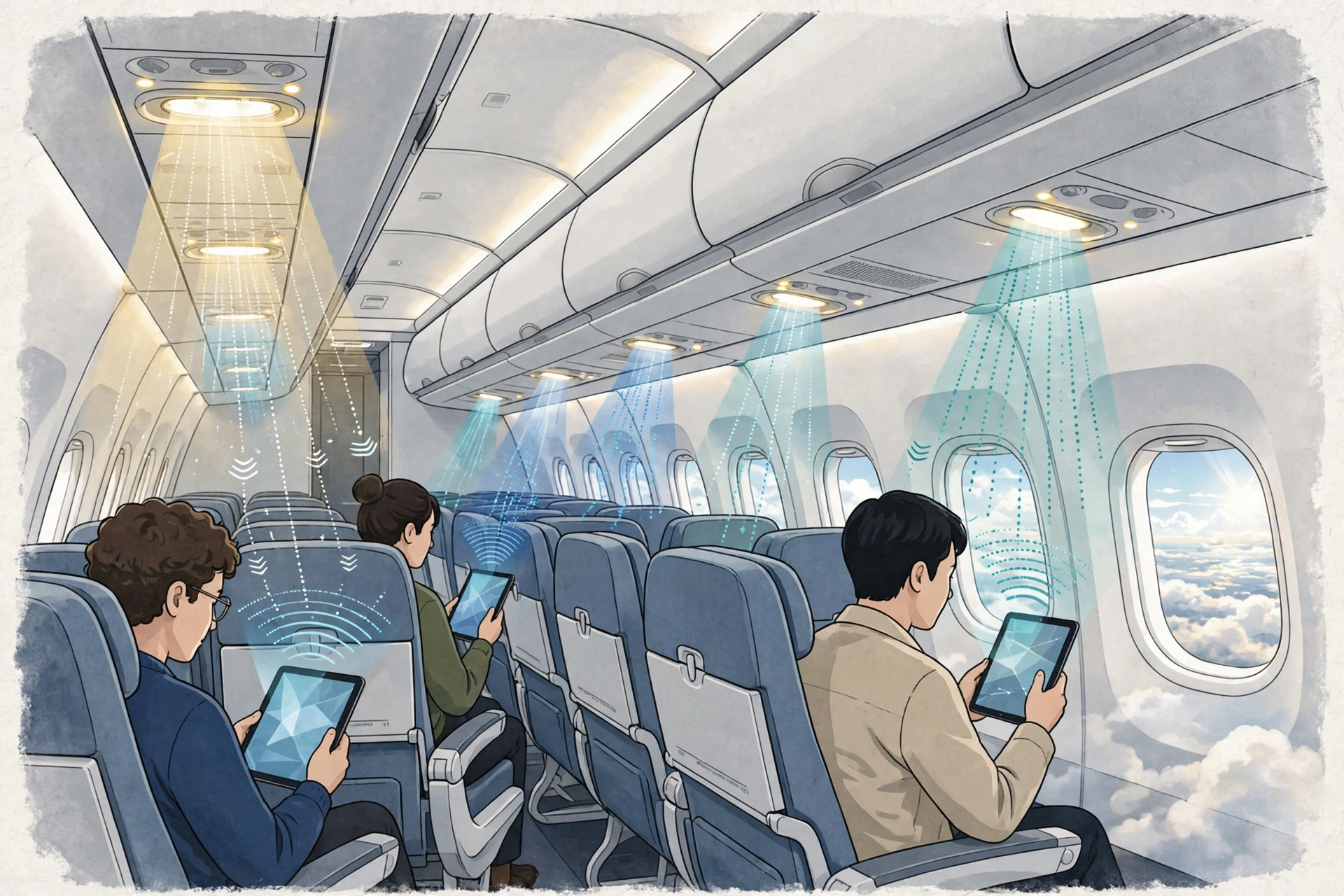
In hospitals, Li-Fi can connect medical devices without disturbing MRI machines or other sensitive equipment. In aircraft cabins, it can offer passengers connectivity without any risk to avionics. In petrochemical plants and other hazardous environments where radio signals are restricted, light-based communication is a safe alternative.
Energy Efficiency and Dual Use
LED lighting is already installed almost everywhere, and it is far more energy-efficient than older lighting. Li-Fi piggybacks on that infrastructure, turning a cost that buildings already pay — lighting — into a communication network as well.

Limitations and Challenges Facing Li-Fi
For all its promise, Li-Fi has real limitations that explain why it has not yet replaced Wi-Fi in homes.
- Line of sight is required: If something blocks the light — a hand over the receiver, a person walking past, a closed book — the connection can drop. Li-Fi cannot pass through walls, so every room needs its own Li-Fi-enabled light.
- It needs light to work: In a dark room, or outdoors on a bright sunny day when sunlight overwhelms the signal, Li-Fi struggles. Dimming the lights too far can also reduce performance.
- Short range: A single Li-Fi access point covers roughly one room, around 10 metres, compared with Wi-Fi’s whole-home reach.
- Limited device support: Almost no mainstream phone or laptop ships with a built-in Li-Fi receiver yet, so users need a dongle or adapter. The IEEE 802.11bb standard is an important step toward built-in support, but adoption takes time.
- Uplink complexity: Sending data back from a device via light is harder than receiving it, which is why many systems use infrared uplinks or fall back to Wi-Fi for the return path.
- Deployment cost: Retrofitting offices with Li-Fi-enabled LEDs and receivers is still more expensive than adding another Wi-Fi access point.
These limitations do not make Li-Fi a failure; they define its niche. The most realistic near-term future is hybrid networks, where Li-Fi handles high-speed, high-security traffic inside rooms, and Wi-Fi provides the blanket coverage between them.
Real-World Applications of Li-Fi
Li-Fi has already moved beyond the laboratory into commercial and institutional deployments around the world.
Hospitals and Healthcare
Hospitals are one of the earliest adopters. Medical wards need reliable wireless data for patient monitors, imaging, and electronic records, but radio signals can interfere with equipment and are restricted in sensitive areas. Li-Fi delivers interference-free connectivity in operating theatres and intensive care units, while its room-confined signals also help protect patient privacy.
Aircraft and Defence
In aircraft cabins, Li-Fi can give every passenger a high-speed connection without any electromagnetic interference with flight systems. Defence organisations, including the French Armed Forces, have deployed Li-Fi for secure communication inside facilities where radio networks pose an unacceptable security risk.
Smart Cities and the Internet of Things
Streetlights fitted with Li-Fi can become data hubs for smart-city services, offering connectivity to pedestrians and sensors without adding to radio congestion. Indoors, Li-Fi-enabled lighting in offices and schools creates fast, interference-free networks for classrooms and lecture halls, where dozens of devices compete for bandwidth.
Underwater Communication
Radio waves travel very poorly through water, but light does much better. Li-Fi and visible light communication are used for short-range underwater links between divers, submersibles, and sensors — an environment where Wi-Fi simply cannot function.
Industrial and Hazardous Environments
In factories, refineries, and chemical plants, radio communication may be restricted because of explosion risks or interference with control systems. Li-Fi provides a safe, high-speed alternative for connecting workers and machines in these settings.
The Road Ahead: Standards, Products, and Hybrid Networks
Several milestones show that Li-Fi is maturing from a research curiosity into a real product category. The IEEE 802.11bb standard, approved in 2023, defines how Li-Fi devices communicate and interoperate with Wi-Fi networks, giving manufacturers a shared target. Companies such as pureLiFi have shipped commercial systems for enterprise and defence, including access points covering large rooms at gigabit speeds and compact portable units for secure field use. At CES 2026, new products such as plug-and-play Li-Fi bridges that beam gigabit connectivity through windows highlighted how the technology is becoming easier to install.
Market analysts now estimate the Li-Fi market at close to one billion dollars in 2025, growing rapidly as hybrid Li-Fi and Wi-Fi networks gain traction. The hybrid model is likely to define the next decade: your device will use Li-Fi when you are under a light for maximum speed and security, and seamlessly switch to Wi-Fi when you move between rooms or step outside.
Longer term, the most exciting prospect is integration. If Li-Fi receivers become as standard as Wi-Fi chips — built into phones, laptops, and tablets — then every light in every building becomes part of the network. Smart lighting companies are already moving in this direction, and as LED adoption continues to grow worldwide, the physical infrastructure for a light-based internet is quietly being installed one bulb at a time.
Frequently Asked Questions About Li-Fi
Does Li-Fi work in the dark?
Not with visible light alone, since the system needs light to carry data. However, Li-Fi can use infrared light, which is invisible to humans, so a room can appear dark while still carrying a connection. Many commercial systems already use near-infrared for this reason.
Is Li-Fi faster than Wi-Fi?
In laboratory conditions, yes — by a large margin, with demonstrations up to 224 Gbps. In real-world products, Li-Fi currently delivers gigabit-class speeds, comparable to or better than typical home Wi-Fi, with far less congestion.
Will Li-Fi replace Wi-Fi?
Almost certainly not entirely. Li-Fi cannot pass through walls and needs light, so it cannot match Wi-Fi’s coverage and mobility. The expected outcome is a hybrid world where both technologies coexist, each doing what it does best.
Is Li-Fi safe for your eyes?
Yes. The flickering is far too fast to perceive, and Li-Fi uses ordinary LED light at normal illumination levels. It does not use lasers or harmful radiation, and it produces no electromagnetic interference.
What do I need to use Li-Fi today?
A Li-Fi-enabled LED access point and a receiver, usually a USB dongle, for your device. Both are available from specialist vendors, though mainstream consumer adoption is still developing.
Conclusion
How Li-Fi technology works is, at heart, beautifully simple: data is encoded into light, light is flashed faster than the eye can see, and a sensor decodes it back into information. From that simple idea flows a technology with extraordinary speed, natural security, freedom from radio congestion, and the ability to work where Wi-Fi cannot. Its limitations — line of sight, room-by-room coverage, and the need for specialised receivers — are real, but they are engineering challenges, not dead ends. With the IEEE 802.11bb standard in place, commercial products reaching the market, and hybrid Li-Fi and Wi-Fi networks on the horizon, the light above your head may soon be doing much more than lighting your room. The next time you flip a switch, you might also be switching on the internet.