
For over two decades, the only way to cross the Atlantic at twice the speed of sound was to read about the Concorde in a museum. Today, that is changing. A new generation of engineers believes supersonic passenger flights can return — this time without the deafening sonic booms, crippling fuel bills, and regulatory dead ends that grounded the Concorde in 2003. Billions of dollars are flowing into sleek new airliners, test aircraft have already broken the sound barrier, and regulators have begun rewriting rules that stood for fifty years. This guide explains how supersonic passenger flights work, why the first attempt failed, and what must still go right before you can board a supersonic airliner yourself.
What Supersonic Flight Really Means
Every airplane you have ever flown on travels slower than the speed of sound. That speed — roughly 1,225 kilometers per hour at sea level, dropping to about 1,060 kilometers per hour at cruising altitude — is not a wall made of anything physical. It is simply the speed at which pressure waves move through air. When an aircraft moves faster than those waves can get out of the way, the air piles up into shock waves, and the entire experience of flight changes.
Mach Numbers Explained Simply
Aviation measures high speed in Mach numbers, named after the Austrian physicist Ernst Mach. Mach 1 is the speed of sound under the current conditions. Mach 0.85 is a typical airliner cruise. Mach 1.7, the target cruise speed of the new Boom Overture airliner, means traveling at 1.7 times the speed of sound — roughly 2,100 kilometers per hour at altitude. The Concorde cruised at Mach 2.02, nearly 2,180 kilometers per hour, which is why a London-to-New York crossing took about three and a half hours instead of seven.
- Subsonic (below Mach 1): all conventional airliners; air flows smoothly around the aircraft.
- Transonic (Mach 0.8–1.2): a turbulent boundary zone where some airflow over the wings is supersonic while the aircraft itself is not; drag spikes dramatically here.
- Supersonic (Mach 1–5): shock waves form and drag drops again after the transonic spike; sustained cruise happens here.
- Hypersonic (above Mach 5): extreme speeds that no passenger aircraft has ever reached; the realm of missiles and experimental vehicles.
The Sound Barrier, Shock Waves, and the Sonic Boom
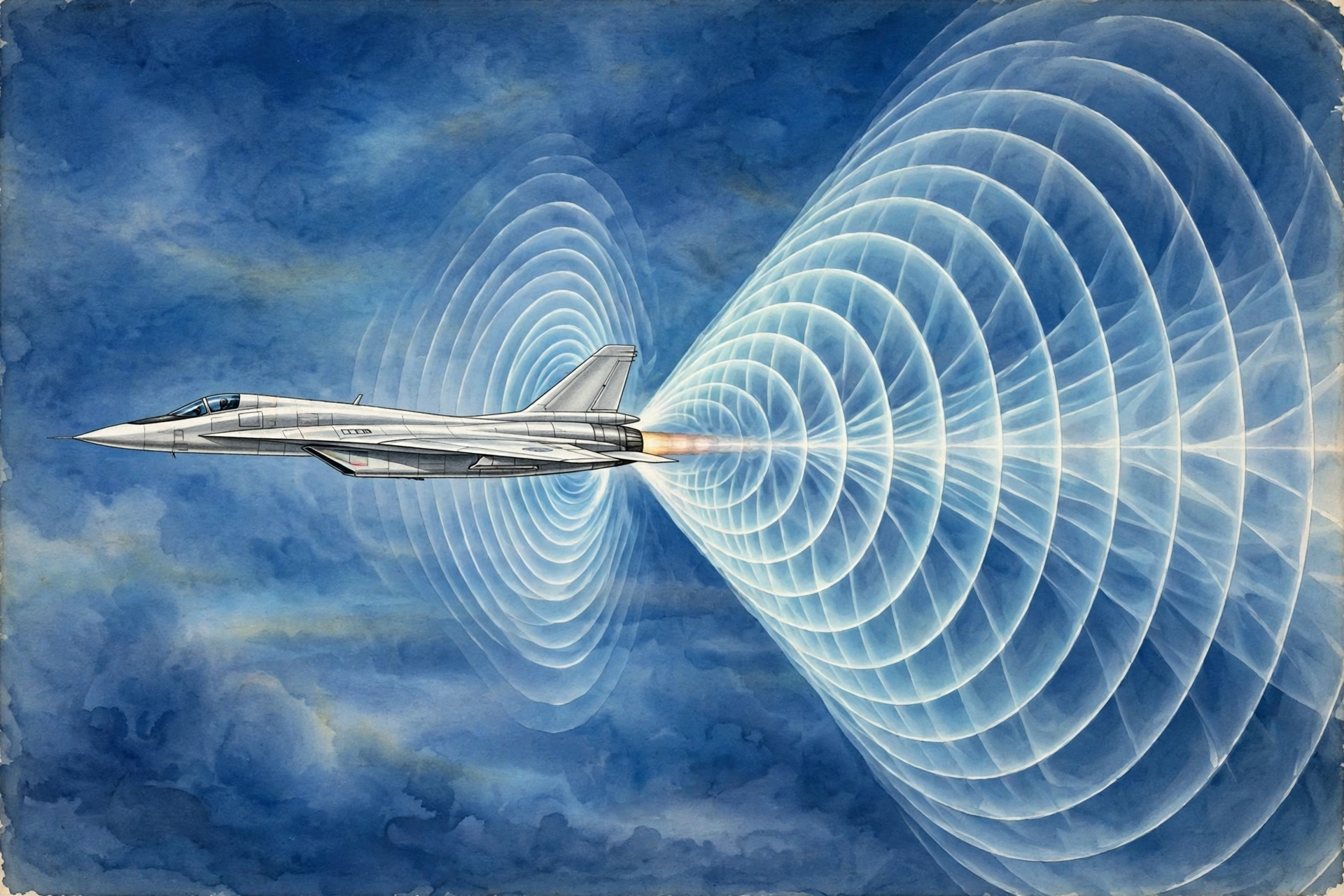
As an aircraft approaches Mach 1, pressure waves it creates cannot outrun it. They compress together into thin, intense shock waves that trail from the nose and tail of the aircraft. When those shock waves reach the ground, a person below hears them as a sudden, explosive crack — the sonic boom. The boom is not a one-time event when the aircraft “breaks” the barrier. It is a continuous carpet of sound dragged along the flight path for as long as the aircraft flies supersonically.
Engineers describe the boom in overpressure: how much the shock wave raises the air pressure it passes through. A traditional airliner shape at Mach 2 produces an overpressure on the ground of roughly 1 to 2 pounds per square foot — enough to rattle windows, startle people, and, over years, generate the complaints that once shaped global aviation law. Reducing that boom is the single most important technical challenge of the supersonic revival, and it is where modern design differs most from the Concorde.
The Rise and Fall of the Concorde
To understand how supersonic passenger flights work today, you have to understand why the first generation stopped working. The story of the Concorde is both an engineering triumph and a cautionary tale.
A Marvel of 1970s Engineering
The Concorde entered passenger service in January 1976 as a joint project of Britain and France. It cruised at Mach 2.02 at 60,000 feet — so high that passengers could see the curvature of the Earth. Only twenty were ever built, and each carried between 92 and 128 passengers in a narrow, all-premium cabin. It remains the only supersonic airliner to operate a sustained commercial service, flying flagship routes such as London–New York and Paris–New York for nearly three decades.
Why the Concorde Could Never Fly Over Land
The Concorde’s sonic boom restricted it to oceanic routes. In 1973, the United States banned civil supersonic flight over land, and other countries followed with similar rules. That ban shaped the entire business: a supersonic airliner that cannot fly over land cannot serve domestic routes, cannot connect most city pairs, and is confined to a handful of transatlantic corridors. The economics of a 100-seat aircraft serving a few routes were always fragile.
The Economics That Grounded It
At full load, the Concorde delivered only about 16 passenger-miles per gallon of fuel, compared with more than 46 for a Boeing 747 of the era — it burned roughly three times the fuel per passenger of a subsonic widebody. Its thirsty engines, small cabin, and restricted route network meant tickets cost far more than even first class on a conventional jet. The fatal crash of Air France Flight 4590 in July 2000 damaged public confidence, and after the September 2001 attacks crushed premium travel demand, both airlines concluded the aircraft could not pay its way. The fleet was retired in 2003, and supersonic passenger service ended.
How Modern Supersonic Airliners Are Designed Differently
The companies building supersonic airliners today are not simply rebuilding the Concorde with better computers. They are attacking the three problems that killed it: the boom, the fuel burn, and the noise around airports.
Quieter Supersonic Design and Boomless Cruise
The loudness of a sonic boom depends on the aircraft’s shape, weight, and length. A long, slender fuselage with a carefully sculpted nose and delta wing spreads the shock waves into a softer, more gradual pressure rise instead of a single sharp crack. This technique, called sonic boom shaping, can reduce ground overpressure dramatically. Some designs also aim for what engineers call “Mach cutoff” cruise: flying at a speed and altitude where the shock waves refract upward in the atmosphere and never reach the ground at all — genuinely boomless flight over land. NASA’s X-59 research aircraft, built specifically to test quiet supersonic flight, is designed to produce a soft “thump” rather than a boom, and its flight data will feed directly into the noise rules regulators write next.
Engines Built for Supersonic Cruise
The Concorde relied on afterburners — fuel-hungry devices that injected raw fuel into the exhaust — to push through the transonic drag spike and sustain supersonic cruise. Modern designs avoid afterburners entirely. The Boom Overture, for example, is being developed around a purpose-built engine called Symphony: a medium-bypass turbofan designed to cruise efficiently at supersonic speed without afterburning, using modern materials and computer-optimized aerodynamics. Higher bypass ratios also make engines quieter around airports, addressing another historical weakness. Developing a brand-new supersonic engine is the single hardest and most expensive part of any new program — no startup has ever certified a clean-sheet airframe and a bespoke engine at the same time — which is why the engine’s progress is the program’s true pace-setter.
Sustainable Aviation Fuel at Supersonic Speeds
Supersonic flight burns more fuel per passenger than subsonic flight; no amount of design will change that physics. The new answer is to change the fuel. Today’s supersonic programs are designed to run on 100 percent sustainable aviation fuel (SAF) — fuel made from waste oils, agricultural residues, and other renewable feedstocks that can cut lifecycle carbon emissions substantially compared with conventional jet fuel. SAF is chemically similar to ordinary jet fuel, so supersonic engines can be designed around it from the start. Whether SAF can scale up affordably remains an industry-wide question, but designing for it now means the next supersonic era does not have to repeat the last one’s emissions profile.
The New Generation: Who Is Building Supersonic Airliners?
Boom Supersonic’s Overture
The furthest along is Boom Supersonic’s Overture. The design calls for a Mach 1.7 airliner carrying 64 to 80 passengers in an all-premium cabin, with a range of about 4,250 nautical miles — enough for New York to London, Los Angeles to Tokyo, or Miami to São Paulo, all over water. In January 2025, Boom’s XB-1 demonstrator became the first independently developed jet to break the sound barrier, reaching Mach 1.122 and validating the company’s aerodynamic design tools. The Overture Superfactory in Greensboro, North Carolina, completed in 2024, is designed to eventually produce dozens of aircraft per year. United Airlines, American Airlines, and Japan Airlines have placed 130 conditional orders and pre-orders — non-binding reservations that signal airline interest but not yet firm purchases. Boom’s public timeline targets a first flight around 2027–2028 and passenger service around 2029–2031, though independent analysts note that certifying a new airframe and a new engine on that schedule would be unprecedented in aviation history.
NASA’s X-59 Quiet Supersonic Research
NASA’s X-59 is not an airliner at all — it is a single-seat research aircraft built to answer one question: how quiet can a sonic boom get? Its extraordinarily long nose and carefully shaped fuselage are designed to produce a boom so soft that people on the ground barely notice it. The data from its community overflight tests will be handed to regulators, who will use it to set the noise standards that future supersonic airliners must meet. In other words, the X-59 is building the rulebook the industry will play by.
Other Contenders and Hard Lessons
Boom is not the first company to attempt this revival. Aerion Supersonic, backed by serious aerospace partners and hundreds of millions of dollars, was developing a supersonic business jet before shutting down in May 2021 when the capital ran out — a reminder that enthusiasm and engineering are not the same as a viable business case. Spike Aerospace continues to develop its S-512 supersonic business jet. The pattern is consistent: the physics is proven, the demonstrators fly, and the survivors are the programs that can fund the brutal decade-long march through certification.
The Rules Are Changing: Why Regulators Are Reopening the Sky
The 1973 Ban and the 2026 Proposal
The American ban on supersonic flight over land has stood since 1973, and it has been the industry’s immovable object: no amount of quiet engineering matters if the law forbids the flight. That is now changing. In July 2026, the U.S. Federal Aviation Administration proposed repealing the blanket speed-based overland ban and replacing it with a noise standard — if an aircraft is quiet enough, it may fly supersonically over land. The proposal’s comment period closed in August 2026, and an executive order issued in 2025 set a June 2027 deadline for finalizing the noise certification standards that would complete the framework. The FAA does not expect manufacturers to apply for supersonic airliner type certificates until those standards exist, so the regulatory timeline and the engineering timeline are now racing each other.
Global Noise Standards
Supersonic aviation is a global business, so international rules matter as much as American ones. The International Civil Aviation Organization, representing 193 countries, agreed in 2026 on new global standards for supersonic aircraft noise, including recommended standards for landing and takeoff noise. The goal is that a future supersonic airliner would have roughly the same airport noise footprint as today’s subsonic long-haul jets — removing one of the Concorde’s most notorious traits, its thunderous takeoffs over the communities near airports.
What Flying Supersonic Will Actually Feel Like
Speeds, Routes, and Flight Times
A Mach 1.7 airliner roughly halves travel time on the routes it can fly. New York to London drops from about seven hours to under four. Los Angeles to Tokyo falls from eleven hours to around six. But the route map will start small: until overland supersonic flight is legal and proven quiet, routes will be overwhelmingly transoceanic. The transatlantic premium market alone is worth tens of billions of dollars a year, and capturing even a slice of the travelers who already pay business-class fares is the core of the business case.
Cabins, Tickets, and Who It Is For
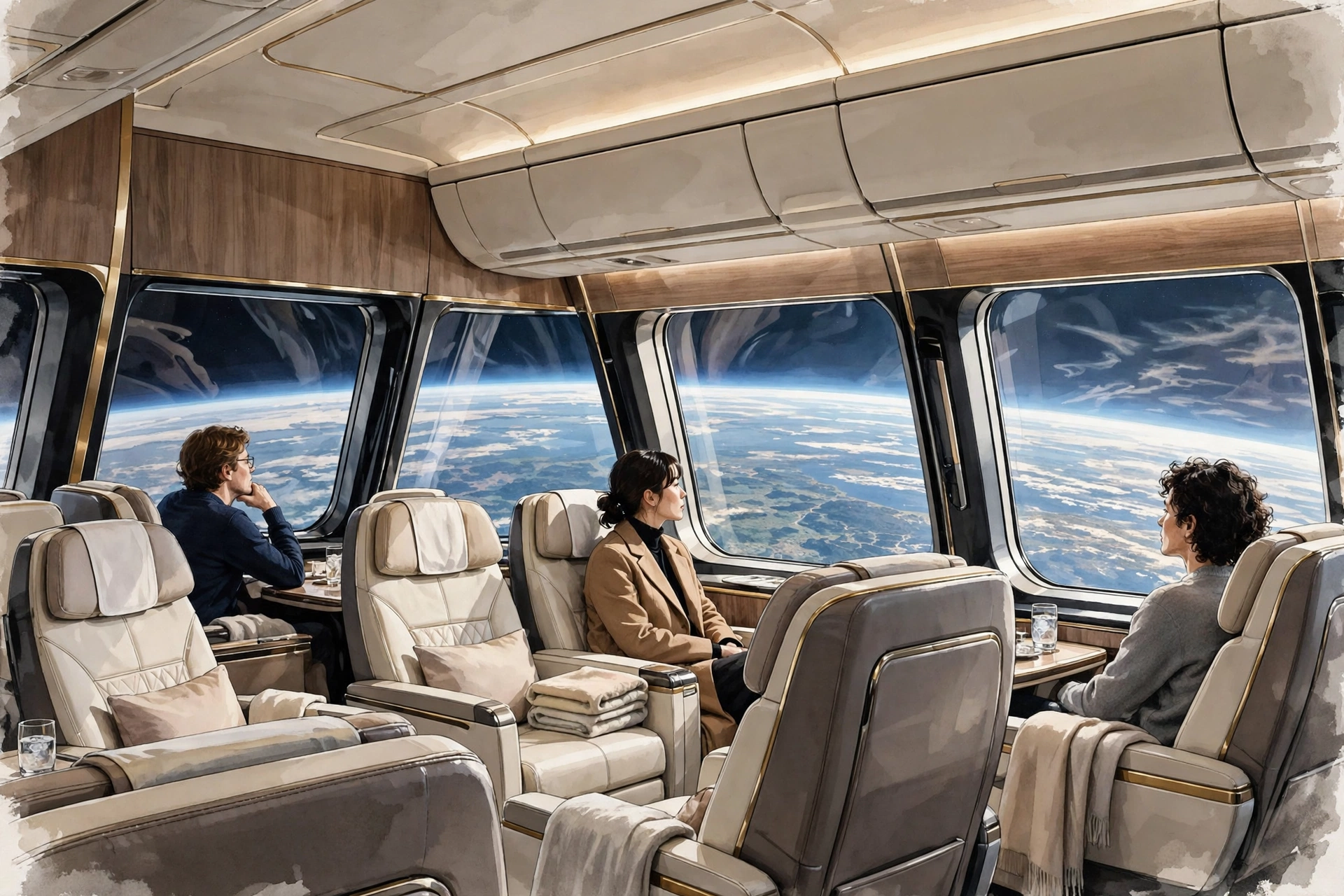
The first supersonic airliners will not be mass-market aircraft. With 64 to 80 seats in an all-premium cabin, they are designed around business-class economics: fares comparable to today’s top-tier business class, aimed at executives and wealthy travelers for whom three saved hours justify a premium. Forget the Concorde’s cramped cabin — modern designs promise lie-flat-style comfort, large windows, and a quieter ride, since cruising at 60,000 feet puts the aircraft above almost all weather and turbulence.
Environmental Questions That Still Need Answers
Honesty requires acknowledging what supersonic flight cannot do. Even with efficient engines and sustainable fuel, a supersonic seat will burn more energy than a subsonic one. There are also open questions about emissions at very high altitudes, where nitrogen oxides and water vapor can affect the ozone layer and the climate more strongly than the same emissions lower down. Researchers are studying these effects now, and future regulations may constrain how high and how often supersonic fleets can fly. The industry’s bet is that SAF, efficient design, and a small initial fleet keep the footprint manageable — but the science is still being written.
Challenges That Still Stand Between Us and Supersonic Travel
The path from demonstrator flights to scheduled service runs through five hard problems:
- Certification: a clean-sheet airliner and a clean-sheet engine must both pass the FAA’s exhaustive safety certification — a process that routinely takes a decade for established manufacturers.
- Engine development: the bespoke supersonic engine has the longest lead time of any component; until it completes testing, the schedule is aspirational.
- Fuel economics: supersonic flight will always cost more per seat than subsonic flight; the business must prove enough travelers will pay the premium consistently.
- Noise rules: final overland noise standards are not yet written; until they are, the true size of the addressable route network is unknown.
- Environment: high-altitude emissions science and SAF supply at scale both need to mature alongside the aircraft.
None of these is a proven impossibility. All of them have ended supersonic programs before.
The Road Ahead: A Realistic Timeline
Here is how the next few years plausibly unfold. NASA’s X-59 continues community overflight testing, feeding data to regulators. The FAA finalizes its overland noise certification standards around its 2027 deadline. Boom rolls out the first Overture and begins flight testing toward the end of the decade, while its Symphony engine completes the testing no one can shortcut. If certification proceeds without major surprises — the largest “if” in aviation — the first paying passengers could board a supersonic airliner in the early 2030s, more than a quarter century after the Concorde’s last flight.
That timeline will almost certainly slip somewhere. New aircraft programs always do. But the direction is unmistakable: the physics is understood, the demonstrators have flown, the regulators are rewriting the rules, and the money is committed. Supersonic passenger flight is no longer a nostalgia act — it is an engineering program with a schedule.
Conclusion
How supersonic passenger flights work comes down to three ideas: fly faster than sound piles up shock waves that must be tamed; build engines and airframes efficient enough to make the fuel bill survivable; and write rules that let quiet aircraft use the sky they were designed for. The Concorde proved the first half of the dream and exposed the second half’s costs. The new generation — quieter shapes, afterburner-free engines, sustainable fuel, and a regulatory system finally catching up — is the most credible attempt yet to finish the job. Whether you will ever cross an ocean in half the time depends on certification timelines, engine test stands, and rulemaking dockets rather than physics. For the first time in twenty years, all three are moving.