
Few industries face a steeper climb to sustainability than aviation. Every year, commercial flights carry billions of passengers and burn hundreds of millions of tonnes of jet fuel, producing roughly 2 to 3 percent of the world’s carbon dioxide emissions — and demand keeps growing. Analysts expect global aviation emissions to surge by 28 percent from 2022 levels if nothing changes. The question is no longer whether flying must get cleaner, but how. In 2026, understanding how sustainable aviation fuel works is the essential starting point for anyone who wants to grasp the future of flight.
This guide explains, in plain language, what sustainable aviation fuel is, how it is made, where it stands in 2026, and what comes after it — from hybrid-electric airliners to hydrogen concepts and the air taxis now nearing certification. By the end, you will have a complete, educational picture of the biggest transformation aviation has faced since the jet age.
Why Aviation Needs to Decarbonize
Aviation is one of the hardest sectors of the economy to clean up. A jet airliner cruising at 35,000 feet needs an enormous amount of energy packed into a small, light package — and for a century, only fossil kerosene has fit the bill. Unlike cars, planes cannot simply switch to batteries: the energy density of jet fuel is roughly fifty times that of today’s best lithium-ion batteries, and weight is everything in flight.
The numbers tell the story of the challenge:
- Emissions share: Aviation accounts for about 2–3% of global energy-related CO2 emissions, a share that grows when demand outpaces efficiency gains.
- Growth trajectory: Analysis cited in 2026 expects global aviation emissions to surge by 28% from 2022 levels without intervention.
- Passenger recovery: Global air travel roared back after the pandemic, with IATA projecting traveler numbers above 4 billion — surpassing pre-pandemic records.
- Long-lived assets: Airliners fly for 20–30 years, so the fleet turns over slowly; technology decisions made today shape emissions for decades.
Because electrifying long-haul flight remains out of reach for now, the industry’s near-term strategy rests on three pillars: cleaner fuels, more efficient aircraft, and entirely new propulsion concepts for shorter routes. Sustainable aviation fuel is the first and most important of these.
What Sustainable Aviation Fuel Actually Is
Sustainable aviation fuel — universally shortened to SAF — is jet fuel made from non-fossil sources. Instead of crude oil, SAF is produced from materials such as used cooking oil, agricultural residues, forestry waste, municipal solid waste, or even captured carbon dioxide combined with renewable electricity. Once produced and certified, it meets the exact same Jet A-1 specification as conventional jet fuel.
That last point is what makes SAF so powerful: it is a drop-in fuel. It is blended with conventional jet fuel, delivered through the same pipelines, hydrants, and fuel trucks, and burned in the same engines. Flight crews notice no performance difference and follow no separate procedures; the blend shows up only in the fuel documentation. An airport does not need new infrastructure to start using it.
The climate benefit comes from the carbon cycle. Burning SAF still releases CO2 from the engine — but the carbon in the fuel was recently drawn out of the atmosphere by plants, or captured from waste streams, rather than dug up from geological reserves. Across its full lifecycle, SAF can cut greenhouse gas emissions by up to 80 percent compared with conventional jet fuel, depending on the feedstock and production pathway.
Today’s certified limit is a 50 percent blend of SAF with conventional fuel under the ASTM D7566 standard. Work to approve 100 percent SAF is well under way, and both Boeing and Airbus have committed to delivering aircraft capable of flying on 100 percent SAF around 2030.
How Sustainable Aviation Fuel Works: From Feedstock to Fuel Tank
Understanding how sustainable aviation fuel works means following it through three stages: sourcing the feedstock, converting it into certified jet fuel, and blending it into the supply chain. Each stage has its own technologies, economics, and constraints.
The Four Production Pathways
There is no single recipe for SAF. Regulators have approved several production pathways, each suited to different raw materials:
- HEFA (Hydroprocessed Esters and Fatty Acids): The dominant pathway today. Waste fats, used cooking oil, and animal fats are treated with hydrogen to produce a clean hydrocarbon fuel. It is the cheapest and most mature route — but it depends on limited waste-oil supplies.
- Alcohol-to-Jet: Ethanol or other alcohols — from agricultural residues or crops — are converted into jet fuel through dehydration and chemical upgrading. Early commercial plants are operating in locations such as Dunkirk and Panipat, though capital costs run higher than HEFA.
- Fischer-Tropsch / BtL (Biomass-to-Liquid): Woody biomass or municipal solid waste is gasified and rebuilt into liquid fuel. Technically proven but extremely expensive, with no full-scale commercial plant operating in Europe yet.
- e-SAF / Power-to-Liquid: Green hydrogen (made with renewable electricity) is combined with captured CO2 to synthesize fuel from scratch. This is the long-term prize — virtually unlimited feedstock — but it remains at pilot scale, with no EU plant having reached a final investment decision as of recent assessments.
The Lifecycle in Practice
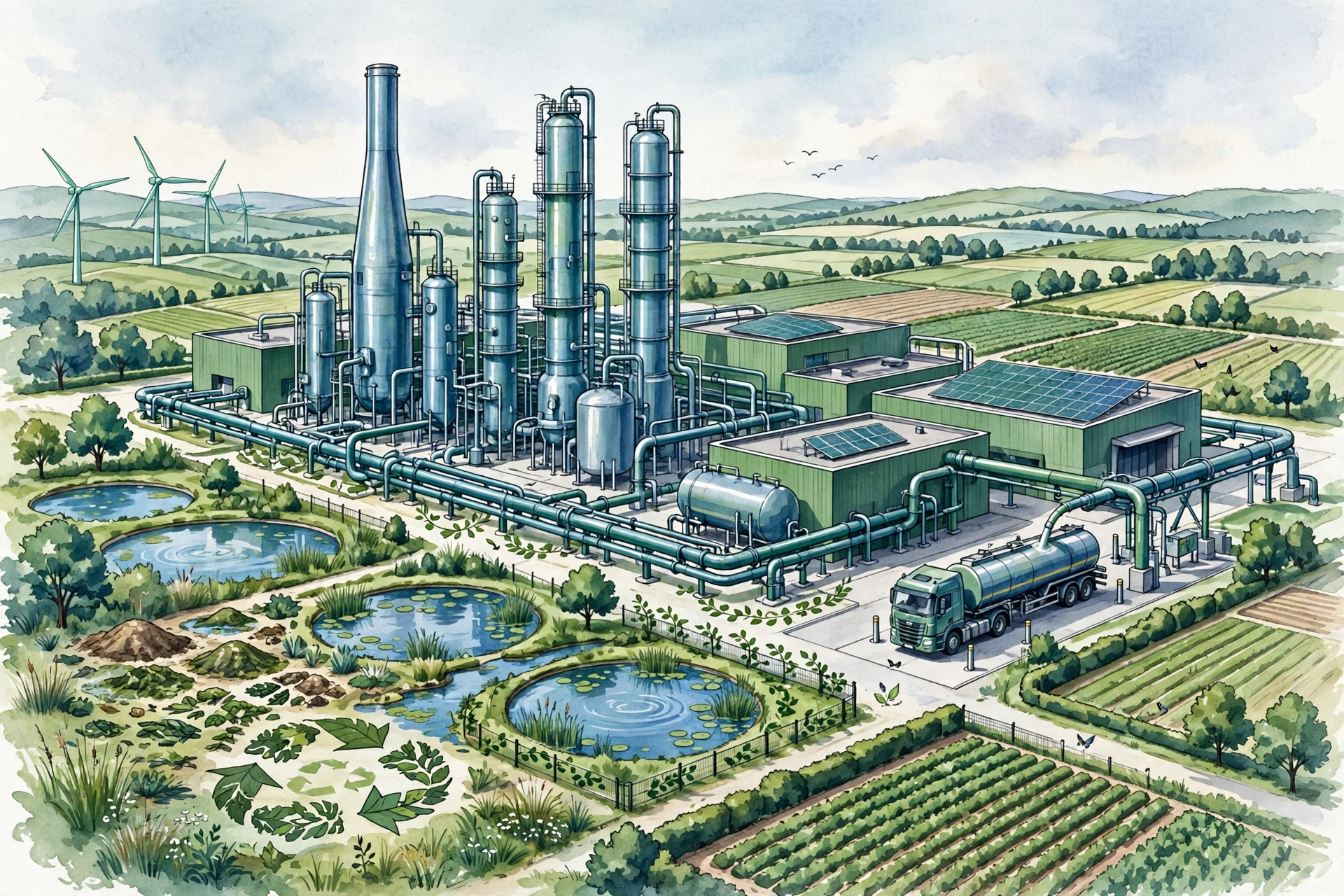
A typical SAF journey looks like this. Used cooking oil is collected from restaurants and food processors, filtered, and shipped to a biorefinery. There, hydrogen treatment strips out oxygen and impurities, leaving pure hydrocarbons that are distilled into the jet-fuel fraction. The finished SAF is tested against the Jet A-1 specification, blended with conventional fuel (up to 50 percent), and pumped into the airport fuel system — indistinguishable from the kerosene it displaces, except for its carbon footprint.
The catch is scale. Every pathway that works today is constrained: HEFA by the finite supply of waste oils, Alcohol-to-Jet by capital costs and feedstock certification, BtL by economics, and e-SAF by the price of green hydrogen and captured CO2. Scaling SAF is an industrial build-out problem as much as a chemistry problem.
SAF in 2026: Mandates, Production, and Prices
If 2024 was the year SAF went mainstream in policy, 2026 is the year its growing pains became impossible to ignore. Mandates are biting, production is climbing — but not fast enough — and prices remain stubbornly high.
Europe’s ReFuelEU Mandate Leads the World
The European Union’s ReFuelEU Aviation regulation is the most ambitious SAF policy on the planet. Since 1 January 2025, fuel supplied at major EU airports must contain at least 2 percent SAF. The share rises to 6 percent in 2030, 20 percent in 2035, and 70 percent by 2050, with a separate sub-mandate for synthetic e-fuels kicking in from 2030. The rule covers more than 95 percent of air transport departing EU airports, replacing a patchwork of national mandates with one EU-wide framework.
Early results beat expectations: the EU Aviation Safety Agency reported that SAF supply in the EU reached 1.1 million tonnes in 2025 — 2.8 percent of total aviation fuel, above the 2 percent minimum. That was nearly six times the 193,000 tonnes supplied in 2024, reaching 121 airports across all 27 member states. The avoided emissions: an estimated 3.77 million tonnes of greenhouse gases. Used cooking oil remained the dominant feedstock at 80 percent of supply, and the Netherlands alone accounted for 29 percent of the EU total.
The Production Gap and the Price Problem
Globally, the picture is more sobering. IATA puts 2025 SAF production at 1.9 million tonnes — barely 0.6 percent of global jet fuel — and forecasts only 2.4 million tonnes for 2026, warning that growth is slowing. The association blames poorly designed mandates and weak policy support, and cautions that many airlines’ pledges to reach 10 percent SAF by 2030 may have to be re-evaluated: the fuel simply is not being produced in sufficient amounts.
Then there is cost. SAF runs about twice the price of conventional jet fuel on average, and up to five times more in mandated markets where suppliers have pricing power. Limited production capacity and competition for feedstocks keep the premium high, and those costs flow straight into airline fuel bills — and eventually ticket prices. Bridging the price gap with production incentives, as the Netherlands is doing with a €300 million SAF scale-up program plus a €90 million airline incentive fund, is the central policy challenge of the next five years.
Beyond Fuel: Electric and Hydrogen Aircraft
SAF cleans up the fuel, but a second revolution is attacking the aircraft itself: replacing hydraulic and pneumatic systems with electric ones, adding electric propulsion, and — further out — burning hydrogen instead of kerosene.
Hybrid-Electric and Battery-Electric Planes
The aircraft electrification market is expanding fast: valued at $7.33 billion in 2025, it is projected to reach $8.28 billion in 2026 — a 12.9 percent annual growth rate — and $12.65 billion by 2030. The related “more electric aircraft” market, covering the shift from hydraulic to electric onboard systems, is forecast to grow from $3.65 billion in 2025 to $6.54 billion by 2030.
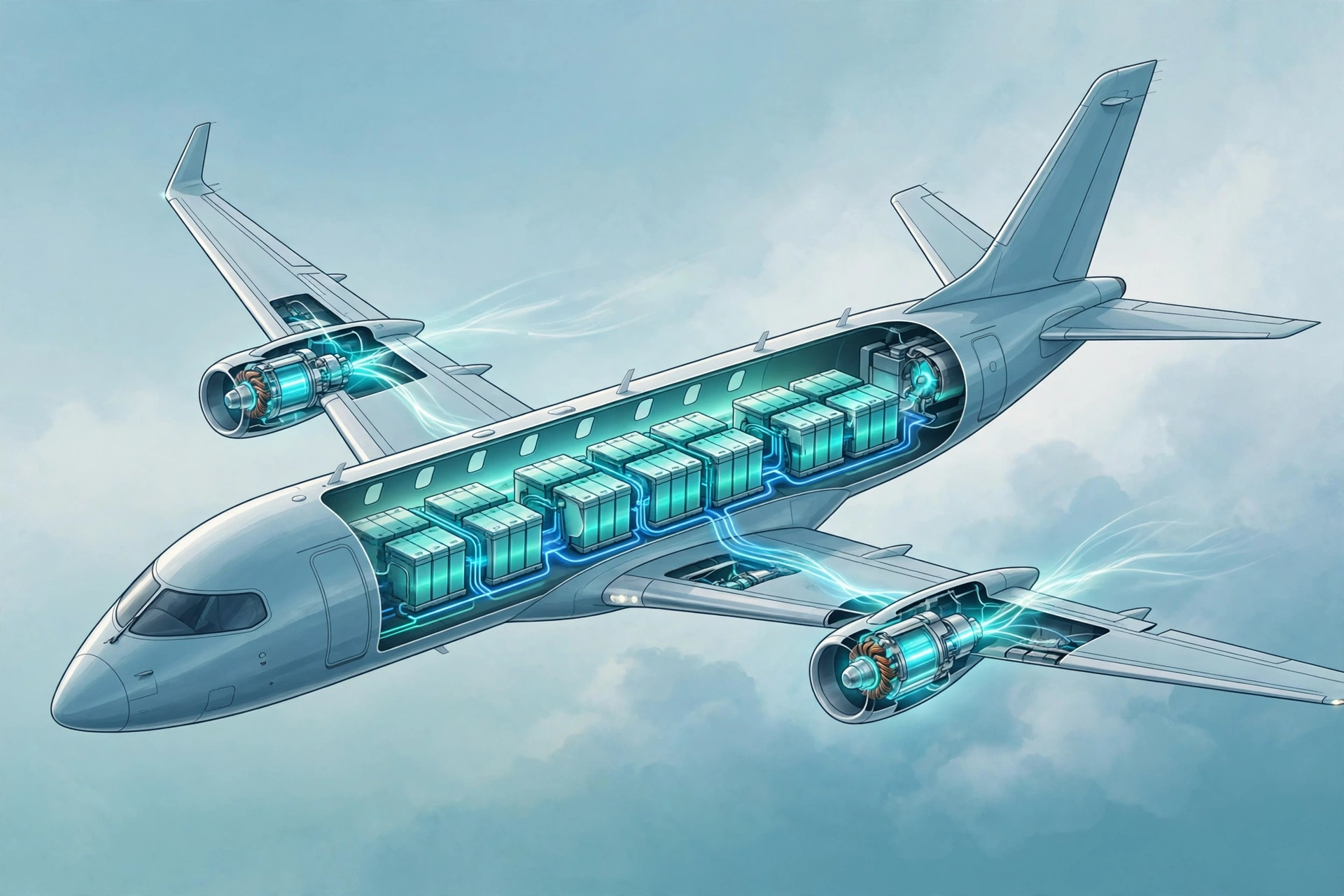
What does this mean in practice? Near-term, it means hybrid-electric regional aircraft that pair a conventional turbine with electric motors for quieter, more efficient short flights. Companies are developing modular electric systems, lightweight motors, and high-power generators — Honeywell, for example, built a 1-megawatt generator for a heavy-lift hybrid-electric airship. Small battery-electric planes are expected to enter commercial service around 2030, with more than a thousand in operation globally by 2040, mostly on short regional hops where batteries’ limited range matters least.
Hydrogen’s Longer Runway
Hydrogen holds the ultimate promise — zero in-flight CO2 — but faces the longest road. It must be kept cryogenically cold as a liquid, needs entirely new airport infrastructure, and demands new aircraft designs with bulky tanks. ZeroAvia is making the most concrete progress, developing hydrogen-electric powertrains aimed at certifying engines for aircraft of up to 90 seats. Long-range scenarios see the first hydrogen test flights in the mid-2030s and initial commercial operations around 2040. Hydrogen is a 2040s story; SAF and hybridization are the 2020s and 2030s story.
The eVTOL Revolution: Air Taxis Take Shape
Perhaps the most visible frontier of aviation in 2026 is not about big airliners at all — it is about small electric aircraft that take off vertically like helicopters and cruise like airplanes. After a decade of bold promises, eVTOL (electric vertical takeoff and landing) air taxis are finally approaching commercial service.
Where the Certification Race Stands
Certifying a radically new aircraft category is the hardest part, and two American companies lead the pack:
- Joby Aviation: In the fifth and final stage of the FAA’s five-stage type certification process (“Show and Verify”), with its first FAA-conforming aircraft beginning Stage 5 flight testing in March 2026. The company has five aircraft flying and twelve more in production, and targets commercial launch — with Delta Air Lines — before the end of 2026.
- Archer Aviation: The first company to close phase three of the FAA’s four-phase process (April 2026) and now working through phase four. Its Midnight aircraft has demonstrated nine-minute hops between cities that take 35 minutes by car, with early operations targeted in Florida, Texas, and New York.
- The regulators are moving too: The FAA’s eVTOL Integration Pilot Program now lets pre-certified aircraft begin operating across 26 US states, building real-world operational data before full certification.
- China is racing: EHang and AutoFlight are pushing toward passenger certification in 2026 under Chinese regulators, potentially beating the Americans to revenue service.
Caution is warranted: certification timelines have slipped before, and industry analysts note that gaps are now about regulatory synchronization — vertiports, pilot training frameworks, airspace integration — rather than the aircraft technology itself. Still, if a paying passenger boards an eVTOL in 2026, it will mark the birth of an entirely new category of air travel.
What Air Taxis Will Actually Look Like
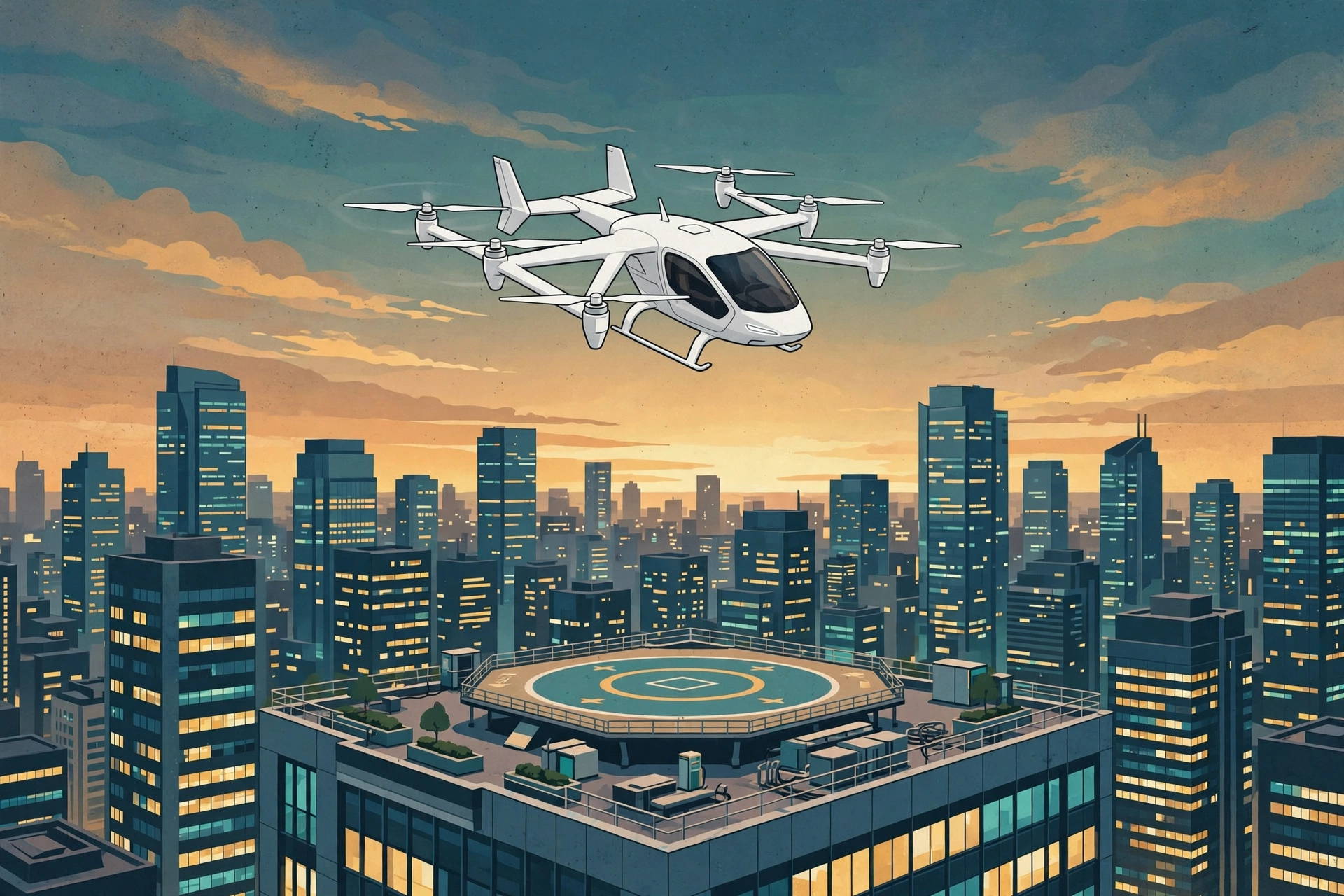
Forget the science-fiction renderings. Early eVTOL services will be piloted, short-hop operations: airport shuttles, cross-city commutes, and connections between business districts. A 90-minute drive becomes a seven-minute flight. The aircraft are dramatically quieter than helicopters — a prerequisite for operating over cities — and produce zero in-flight emissions. Analysts project the urban air mobility market reaching tens of billions of dollars by 2030–2035 if certification, vertiport build-out, and demand align. The endgame, companies like Wisk Aero argue, is autonomous flight cutting operating costs to a few dollars per passenger-mile.
What Airlines and Airports Are Doing Right Now
While future propulsion grabs headlines, airlines are cutting emissions today with less glamorous tools:
- Fleet renewal: Replacing older jets with new-generation aircraft delivers immediate fuel-burn reductions of around 25 percent per seat, thanks to advanced engines, lightweight materials, and better aerodynamics — plus lower noise.
- Operational efficiency: Modernized airspace, optimized flight paths, reduced onboard weight, and less waste. Airline groups such as IAG have set targets to cut waste per passenger and increase recycling across operations.
- SAF procurement: Major carriers are signing long-term offtake agreements that give fuel producers the revenue certainty to build new plants — the single most effective airline action for scaling SAF.
- Government partnerships: Programs like the UK’s Advanced Fuels Fund and the Netherlands’ combined €390 million SAF push (a €90 million airline incentive fund plus €300 million for production scale-up) show how public money is de-risking the build-out.
- Passenger awareness: Surveys show more than half of passengers now factor the environment into airline choice, and 84 percent prioritize sustainable travel — creating commercial pressure airlines cannot ignore.
What It Means for Travelers
For passengers, the green transformation of aviation will arrive gradually, then noticeably. Expect “SAF-powered” flight options and carbon-transparent booking displays to become standard, much as nutrition labels did for food. Ticket prices on some routes may carry a small green premium as SAF mandates phase in — the EU’s 2 percent requirement is modest, but the climb to 6 percent by 2030 and 20 percent by 2035 will be felt. On the positive side, newer aircraft are quieter and more comfortable, and within a few years, travelers in cities like Dallas, New York, or Dubai may be able to book an electric air taxi to the airport instead of sitting in traffic.
The practical advice for eco-conscious flyers in 2026: fly direct when possible (takeoff and landing burn the most fuel), choose newer aircraft types, consider airlines with credible SAF programs rather than vague offset claims, and remember that one SAF-blended flight does more for the climate than a year of skipping plastic straws.
Challenges and Honest Limitations
An educational guide should be honest about the headwinds, which are formidable:
- Feedstock ceilings: There is only so much used cooking oil in the world. HEFA — today’s workhorse — cannot scale to 70 percent of global jet fuel on waste oils alone; the industry must commercialize Alcohol-to-Jet, BtL, and e-SAF pathways.
- The cost gap: At two to five times the price of kerosene, SAF needs sustained policy support — mandates plus production incentives — or airlines will struggle to absorb it.
- Slow fleet turnover: Even with 25-percent-more-efficient new aircraft, it takes decades to replace the global fleet. Long-range scenarios suggest conventional jet fuel demand won’t halve until around 2058.
- Infrastructure lag: Hydrogen and large-scale electrification need new airport infrastructure — cryogenic storage, megawatt charging, vertiports — that barely exists today.
- Greenwashing risk: Not all “sustainable” claims are equal. Credible SAF is certified against strict lifecycle standards; vague carbon-offset marketing is not the same thing.
The Road to 2050
The industry’s destination is net-zero carbon emissions by 2050, endorsed by IATA and the International Civil Aviation Organization. The milestones along the way are now coming into focus: 6 percent SAF in Europe by 2030 with the first synthetic e-fuel quotas, 100-percent-SAF-capable aircraft around 2030, small electric planes in commercial service by 2030, hydrogen test flights in the mid-2030s, and eVTOL networks maturing through the late 2020s.
None of this is guaranteed. It depends on roughly $4–5 trillion of cumulative investment across fuels, aircraft, and infrastructure, on policies that reward production rather than just mandating consumption, and on technologies — especially e-SAF and hydrogen — crossing from pilot scale to commercial reality. The 2026 data gives reason for both optimism (SAF supply up sixfold in the EU in a single year) and urgency (global production still under 1 percent of jet fuel).
Conclusion
Learning how sustainable aviation fuel works reveals the central truth of aviation’s green transition: there is no single breakthrough coming to save the day, but a portfolio of them. SAF — made from waste oils today and from captured carbon and green electricity tomorrow — is the only near-term lever that works with the existing fleet, and its scale-up from under 1 percent of global fuel is the defining industrial challenge of the decade. Behind it come hybrid-electric regional aircraft, hydrogen concepts for the 2040s, and eVTOL air taxis that could redefine short-distance travel within just a few years.
Aviation decarbonized more slowly than almost any other sector, held back by physics that no policy can repeal. But in 2026, for the first time, every piece of the solution exists at least in prototype: the fuel is certified, the mandates are law, the electric aircraft are flying, and the air taxis are in final certification. The sky is not getting cleaner on its own — but the tools to clean it are finally, visibly, taking off.