
Most beginner forex traders obsess over entries: which currency pair to buy, which indicator flashes green, what time of day the market moves. They spend months perfecting the moment they click “buy” and almost no time thinking about the number they type into the volume box. That number — the position size — is the single decision that determines how much money a trade can win or lose. Two traders can take the exact same trade, on the same pair, with the same entry and the same stop-loss, and one can lose nine dollars while the other loses ninety. The difference is not the strategy. It is how to calculate forex position size, and getting it right is the foundation of every professional trading plan.
In this complete guide, you will learn exactly how to calculate forex position size from scratch: the simple formula professionals use, worked examples on real account sizes, how pip values change across currency pairs, where your stop-loss fits into the calculation, and the position sizing mistakes that quietly destroy beginner accounts. By the end, you will be able to look at any trade idea, any stop distance, and any account balance, and compute the correct lot size in under a minute. Let us begin with the most important lesson in trading: position sizing is not optional.
Why Position Sizing Is the Most Important Skill in Forex Trading
Ask a room of experienced traders what separates long-term survivors from accounts that vanish in three months, and you will hear the same answer again and again: risk management, and at the heart of risk management sits position sizing. Your position size decides how many currency units you control on each trade. Control too many, and a routine losing trade carves a devastating hole in your account. Control too few, and even a string of brilliant trades barely moves the needle.
The mathematics are unforgiving. Lose 10% of your account and you need an 11% gain to recover. Lose 50% and you need a 100% gain just to break even. Lose 80% and you need a 400% return — a climb most traders never complete. Position sizing is the tool that keeps losses small enough that recovery is always possible. It is the difference between a bad week that stings and a bad week that ends your trading career.
Here is the mindset shift beginners need: your job as a trader is not to be right about the market. Even excellent strategies lose 40% to 60% of their trades. Your job is to make sure that when you are wrong — and you will be wrong constantly — the damage is small, predefined, and survivable. Professional traders think of each trade as a bet with a known, capped downside. The position size calculation is how you set that cap.
There is also a psychological dimension. When your position size is correct, a losing trade feels like a business expense — annoying, but expected. When your position size is too large, every tick against you triggers fear, and fear leads to the classic beginner behaviors: moving the stop-loss further away, averaging into losers, and revenge trading after a loss. Correct sizing removes the emotional charge from individual trades and lets you execute your plan calmly.
What Forex Position Size Actually Means
Position size in forex is expressed in lots. A lot is simply a standardized unit of currency, and understanding the three common lot sizes is the first step toward calculating position size correctly.
- Standard lot (1.0 lot): 100,000 units of the base currency. Each pip of movement is worth approximately $10 on USD-quoted pairs.
- Mini lot (0.1 lot): 10,000 units of the base currency. Each pip is worth approximately $1 on USD-quoted pairs.
- Micro lot (0.01 lot): 1,000 units of the base currency. Each pip is worth approximately $0.10 on USD-quoted pairs.
- Nano lot (0.001 lot): 100 units of the base currency, offered by some brokers. Each pip is worth approximately $0.01.
The connection between lot size and pip value is what makes the position size calculation work. A larger lot size makes every pip worth more money; a smaller lot size makes every pip worth less. Your stop-loss distance, measured in pips, multiplied by the pip value of your lot size, equals the total money you risk on the trade. That relationship is the entire logic of position sizing.
One crucial point: never confuse margin with risk. Margin is the deposit your broker locks up to open a leveraged position. Risk is the amount you actually lose if your stop-loss is hit. A trader can control a full standard lot with a few hundred dollars of margin and lose thousands if the trade goes wrong. Margin tells you what you can open; position sizing tells you what you should open.
The Forex Position Size Formula Explained
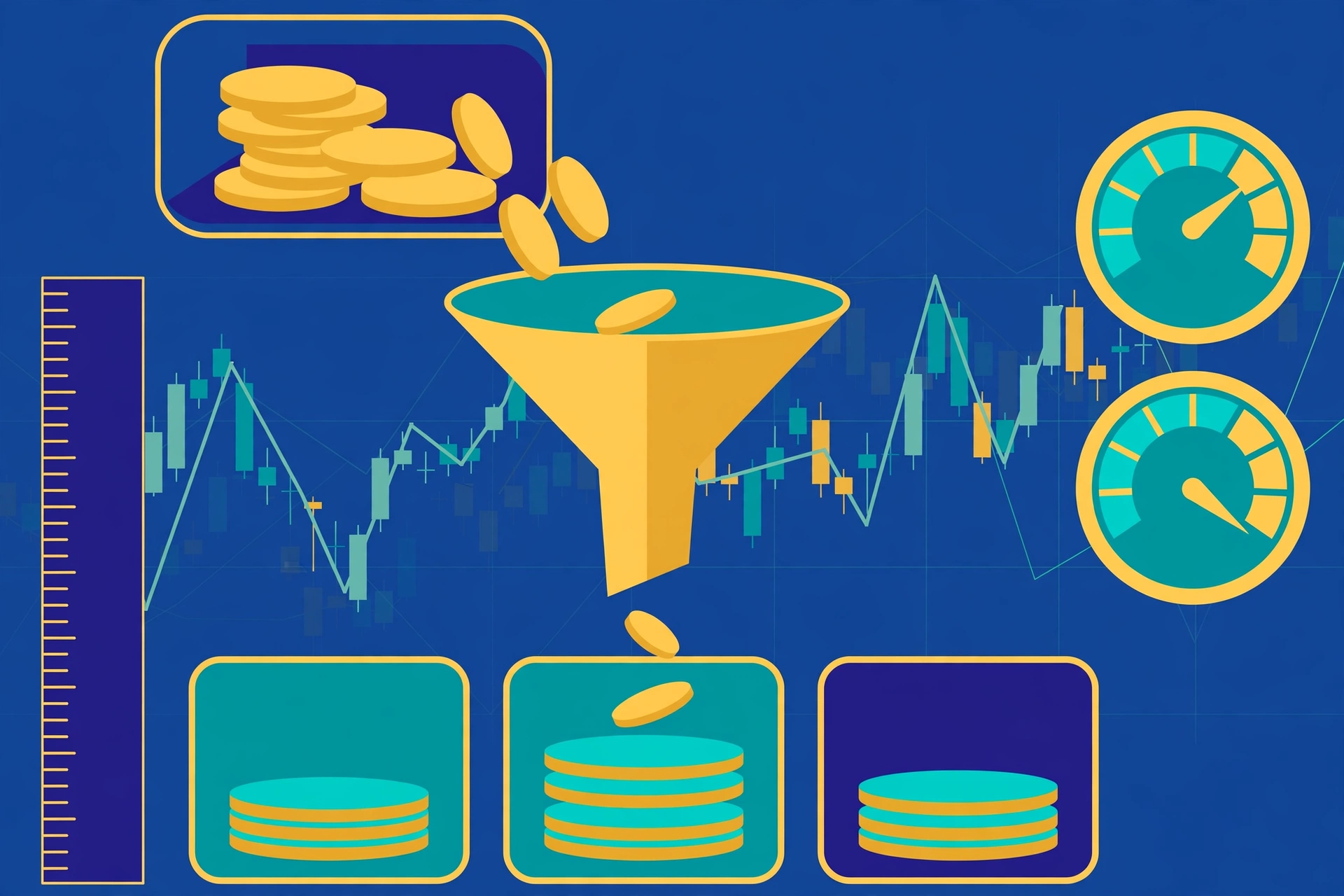
There is one core formula behind every position size calculator, and once you understand it, you will never need to guess at lot sizes again. Here it is:
Position size (in lots) = (Account balance × Risk percentage) ÷ (Stop-loss distance in pips × Pip value per lot)
Or, in the shorter version many traders use day to day:
Lot size = Risk amount ÷ (Stop-loss in pips × Pip value)
The logic is straightforward. The numerator is the maximum amount of money you are willing to lose on this trade. The denominator is how much money you lose per lot for every pip the trade moves against you. Dividing one by the other gives you the number of lots that makes the math work: if the price hits your stop-loss, you lose exactly your planned risk amount — no more, no less.
The Four Inputs You Need
Before you can use the formula, you need four numbers:
- Account balance: the total equity in your trading account right now.
- Risk percentage: the fraction of your account you are willing to risk on a single trade. Most professionals use 1% to 2%. Beginners should start at 1%.
- Stop-loss distance in pips: how far, in pips, your stop-loss sits from your entry price. This comes from your trade idea, not from your comfort level.
- Pip value: how much one pip is worth for one lot of the pair you are trading, in your account currency.
A Complete Worked Example
Let us walk through the calculation step by step with realistic numbers. Suppose you have a $1,000 account, you risk 1% per trade, and your analysis gives you a trade on EUR/USD with a 30-pip stop-loss.
Step 1: Calculate the risk amount.
$1,000 × 1% = $10. This is the maximum you will lose if the stop is hit.
Step 2: Note the stop-loss distance.
Your stop is 30 pips away from entry.
Step 3: Find the pip value.
For EUR/USD (a USD-quoted pair), one mini lot (0.1 lots) has a pip value of $1. In formula terms using standard lots, one standard lot has a pip value of $10.
Step 4: Apply the formula.
Lot size = $10 ÷ (30 pips × $10 per standard lot) = $10 ÷ $300 = 0.033 lots.
Step 5: Round down to a tradeable size.
Brokers typically allow lot sizes in steps of 0.01. Round down to 0.03 lots (3 micro lots). Rounding down — never up — keeps you at or below your planned risk.
Check the result: 0.03 lots × $10 per pip per standard lot = $0.30 per pip. A 30-pip loss × $0.30 = $9.00, just under your $10 risk limit. That is a correctly sized position.
A Second Example With a Larger Account
Now consider a $10,000 account, risking 1%, with a 50-pip stop-loss on GBP/USD.
Risk amount = $10,000 × 1% = $100. Lot size = $100 ÷ (50 × $10) = 0.2 lots, or 2 mini lots. Verification: 0.2 lots gives $2.00 per pip, and 50 pips × $2.00 = $100. Exactly on target.
Notice how the stop distance changes the answer. A wider stop does not mean you risk more money — it means you trade a smaller position so that the dollar risk stays identical. This is the insight most beginners miss: position size is derived from the stop, never chosen first.
How to Calculate Forex Position Size on Any Currency Pair
Pip value is not the same on every pair. It depends on which currencies are involved and what currency your account is denominated in. Getting this wrong is one of the most common calculation errors beginners make, so let us break it down by pair type.
Pairs Quoted in USD (EUR/USD, GBP/USD, AUD/USD, NZD/USD)
When USD is the quote currency (the second currency in the pair) and your account is in USD, pip value is beautifully simple:
- 1 standard lot = $10 per pip
- 1 mini lot (0.1) = $1 per pip
- 1 micro lot (0.01) = $0.10 per pip
This is why most beginner examples use EUR/USD. The math is clean and the formula from the previous section applies directly. If your account is in another currency, such as EUR or GBP, you convert the final dollar value at the current exchange rate.
Pairs With USD as the Base Currency (USD/JPY, USD/CHF, USD/CAD)
When USD is the first currency, the pip value per lot in USD is not a fixed round number — it depends on the current exchange rate. The calculation is:
Pip value per standard lot = (0.01 ÷ current exchange rate) × 100,000
For example, if USD/JPY is trading at 150.00: (0.01 ÷ 150.00) × 100,000 = $6.67 per pip per standard lot. So a 30-pip stop on one standard lot of USD/JPY risks about $200, not $300. Plug that $6.67 figure into the position size formula in place of the $10, and your answer will be correct.
In practice, most traders do not compute this by hand every time. Your trading platform shows the tick or pip value for the exact symbol you are trading, and free online position size calculators handle the conversion automatically. But understanding the mechanics means you can spot when a number looks wrong — a valuable safety net.
Cross Pairs (EUR/GBP, GBP/JPY, EUR/JPY)
Cross pairs contain no USD at all. To find the pip value in USD terms, you calculate the pip value in the quote currency and then convert it to USD using the relevant exchange rate. For GBP/JPY, you would compute the pip value in JPY and convert through the USD/JPY rate. This is exactly the kind of conversion a calculator does instantly, but the concept is worth knowing: the further a pair is from your account currency, the more conversion steps hide inside the number.
Gold, Indices, and Other CFDs
Many forex brokers also offer gold (XAU/USD), indices, and oil on the same platform. These instruments use tick values rather than pip values, and the tick size and tick value differ between brokers. Always check the contract specification of the exact symbol in your own platform before calculating. The formula still works — you just replace “pip value” with “tick value” and “pips” with “ticks.”
The 1%–2% Risk Rule and Why It Protects Your Account
The 1%–2% rule states that you should never risk more than 1% to 2% of your account equity on any single trade. It is the most widely recommended risk guideline in trading, and the mathematics behind it are worth understanding rather than just memorizing.
| Account size | 1% risk per trade | 2% risk per trade |
|---|---|---|
| $500 | $5 | $10 |
| $1,000 | $10 | $20 |
| $5,000 | $50 | $100 |
| $10,000 | $100 | $200 |
| $50,000 | $500 | $1,000 |
The table shows the dollar risk, but the real power of the rule is what it does to losing streaks. Every trader — even professionals — hits stretches where nothing works. Suppose you endure ten consecutive losses, a streak that would shake most beginners:
- Risking 1% per trade: after 10 straight losses, you keep roughly 90.4% of your account.
- Risking 2% per trade: after 10 straight losses, you keep roughly 81.7%.
- Risking 10% per trade: after 10 straight losses, you keep only about 34.9% — and need a 187% gain to recover.
This is why position sizing matters more than entry accuracy. A trader who wins only 40% of trades but risks 1% with a 1:2 risk-reward ratio can be consistently profitable. A trader who wins 70% per trade but risks 10% per trade can be wiped out by one bad month. The risk percentage is the master dial of your entire trading business.
Choosing Between 1% and 2%
Beginners should start at 1%. The smaller number gives you more room to make mistakes while you learn — and you will make mistakes. A 1% risk also keeps emotions in check: when ten dollars are on the line, you can think clearly; when two hundred are, most beginners cannot. Move toward 2% only after you have months of disciplined execution behind you and a proven, backtested strategy.
Also consider your account size realistically. Sources across the industry note that starting with too little capital forces uncomfortable trade-offs: with a very small account, even 1% risk can push you toward lot sizes below your broker’s minimum or stops so tight that normal market noise triggers them. A realistic starting point for implementing proper position sizing with micro lots is typically a few hundred to a few thousand dollars — enough that 1% risk translates into a tradeable, sensible lot size.
Where to Place Your Stop-Loss (Because It Defines Your Position Size)
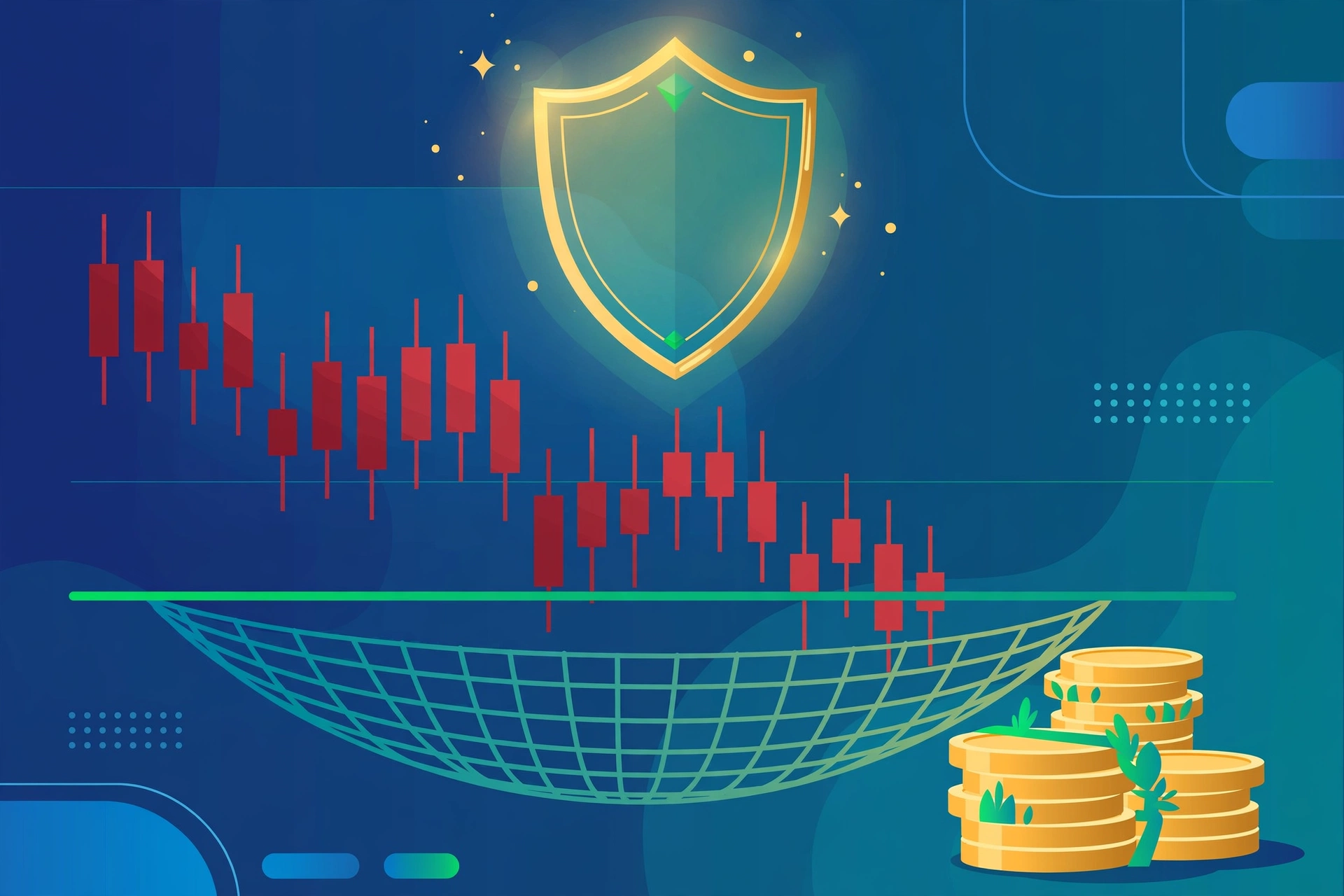
Here is the rule that ties everything together: the stop-loss comes first, and the position size is calculated from it. This is the correct sequence for every single trade:
- Identify a valid trade setup according to your trading plan.
- Choose your entry price or entry zone.
- Place your stop-loss where the trade idea is proven wrong — based on market structure.
- Measure the distance from entry to stop-loss in pips.
- Decide your risk percentage for this trade.
- Calculate the position size using the formula.
- Round down to the nearest size your broker allows.
- Verify margin, total open risk, correlated positions, and upcoming news — then place the trade.
Never do it backwards. Choosing a lot size first and then squeezing a stop to fit is how traders end up with stops placed at random distances that the market hits effortlessly. The stop belongs at a logical technical level; the lot size is whatever the math says it must be.
Structure-Based Stops vs. Arbitrary Stops
A structure-based stop sits beyond a level that, if broken, invalidates your trade idea — beyond a recent swing high or low, outside a consolidation range, or past a key support or resistance zone. An arbitrary stop sits a fixed number of pips away because it “felt right” or because you wanted a bigger lot size. Arbitrary stops get harvested by normal market noise; structure-based stops get hit only when your analysis was genuinely wrong.
Using the Average True Range (ATR)
The Average True Range is an indicator that measures how much a pair typically moves per period. Many traders set stops as a multiple of ATR — for example, 1.5× the 14-period ATR on the daily chart. This adapts your stop to current volatility: wider stops in wild markets, tighter stops in calm ones. Because your position size shrinks as the stop widens, ATR-based stops automatically reduce your lot size when the market is more dangerous. That is position sizing and volatility working together exactly as they should.
Tight Stops Do Not Mean Small Risk
A common beginner misunderstanding is that a 10-pip stop is “safer” than a 100-pip stop. Risk is not the stop distance — risk is the stop distance multiplied by the position size. A 10-pip stop with a huge lot size can risk $500, while a 100-pip stop with a tiny lot size can risk $10. The stop distance shapes the lot size through the formula, but the dollar risk is whatever percentage you chose. Focus on the dollar risk, not the pip distance.
Common Forex Position Sizing Methods
The fixed-percentage method from this guide is the standard, but it helps to know the alternatives — and why professionals mostly avoid them.
Fixed Percentage Risk (Recommended)
Risk a fixed percentage of your account (1%–2%) on every trade, recalculated as your balance changes. When the account grows, positions grow with it; when it shrinks, positions shrink automatically. This built-in compounding and self-protection is why it is the professional standard.
Fixed Lot Size (Not Recommended)
Trading the same lot size on every trade regardless of account size or stop distance. This is simple but dangerous: as your account shrinks, the same lot size represents an ever-larger percentage of your equity, accelerating losses exactly when you are most vulnerable. It also ignores stop distance entirely, so dollar risk swings wildly from trade to trade.
Volatility-Based Sizing
Adjusting position size based on market volatility, often using ATR as described above. This is a refinement of the fixed-percentage method rather than a replacement: you still risk 1%–2%, but the stop distance (and therefore the lot size) adapts to conditions. More complex to run, but excellent for traders who hold positions across different market regimes.
The 3-5-7 Rule for Portfolio-Level Risk
Beyond per-trade risk, experienced traders cap their total exposure. One popular framework: risk no more than 3% on any single trade, no more than 5% across all open trades combined, and stop trading for the month if total losses reach 7% of account equity. This protects you from the correlated-loss scenario where three “independent” trades all go wrong on the same news event.
Mistakes That Destroy Position Sizing Plans
Knowing the formula is only half the battle. These are the errors that undo it:
- Risking 5%–10% per trade. A handful of losses in a row can erase months of progress. The math of drawdown recovery is brutal, and high risk percentages make it nearly unavoidable.
- Trading without a stop-loss. Without a stop, position sizing is meaningless — there is no defined maximum loss, and a single runaway trade can do catastrophic damage.
- Moving the stop further away mid-trade. Widening a stop to “give the trade room” increases your loss if the trade keeps failing. It also breaks the calculation your position size was built on.
- Doubling down on losers. Adding to a losing position (martingale-style) means your largest position is on your worst trade idea. Professionals scale out of losers, not into them.
- Overtrading. Ten trades at 1% risk each can expose you to far more total risk than you realize, especially when positions are correlated and move together on the same news.
- Changing lot sizes on emotion. Increasing size after a win (overconfidence) or after a loss (revenge trading) turns a disciplined plan into gambling. The percentage stays fixed; your feelings do not get a vote.
- Ignoring correlated positions. Being long EUR/USD and short USD/CHF at the same time is essentially one large USD-short position. Size correlated trades as a group, not in isolation.
- Forgetting about news events. Major releases like central bank decisions can cause spreads to widen and prices to gap past stops. Reduce size — or sit out — around high-impact news.
Building Your Personal Position Sizing Routine
Turn the formula into a habit with a repeatable pre-trade routine. Run through this checklist before every trade:
- Confirm the setup meets every rule in your written trading plan. If it does not qualify, there is no trade to size.
- Mark entry and stop-loss on the chart, with the stop at a structural invalidation point.
- Measure the stop distance in pips using your platform’s measuring tool.
- Check the pip value for the exact symbol and your account currency.
- Calculate the lot size with the formula, and round down to your broker’s permitted step.
- Add up total open risk including this trade, and confirm it stays within your portfolio cap.
- Check the economic calendar for high-impact news during the trade’s expected lifetime.
- Place the trade with the stop attached — never enter first and “add the stop later.”
- Log everything in a trading journal: entry, stop, target, lot size, risk amount, and whether you followed the plan. The journal is where sizing discipline becomes visible and improvable.
After a month of running this routine, review your journal. You will see exactly how much each trade risked, whether your actual losses matched your planned risk, and where the plan broke down. That feedback loop — calculate, execute, review — is how position sizing evolves from a formula into a genuine professional skill.
Frequently Asked Questions
What is a good position size for a $100 forex account?
With a $100 account and 1% risk, you risk $1 per trade. On EUR/USD with a 20-pip stop, that works out to 0.005 lots — which is below most brokers’ 0.01 minimum. This is why very small accounts struggle with proper position sizing: the math demands sizes the platform cannot offer. Consider practicing on a demo account, or funding to a level where 1% risk produces a tradeable lot size, rather than skipping the risk rules.
Should I use a position size calculator or do it manually?
Use a calculator for speed, but learn the manual formula first. Calculators save time and prevent arithmetic errors, and most platforms include one. But understanding the underlying math means you are never dependent on a tool, and you can instantly recognize when a suggested size looks wrong — which is exactly when manual knowledge protects you.
Does leverage change my position size calculation?
No. Leverage determines how much margin your broker requires to open a position, but it does not change the dollar risk of the trade. A 0.2-lot trade with a 50-pip stop risks the same $100 whether your leverage is 1:10 or 1:500. High leverage tempts traders into oversized positions because the margin requirement looks small — but the loss at the stop is identical. Size from risk, not from margin.
What risk-reward ratio should I combine with position sizing?
Position sizing controls how much you lose; risk-reward controls how much you need to win to be profitable. Most educators suggest targeting at least a 1:2 risk-reward ratio — risking $1 to potentially make $2. With a 1:2 ratio, you can be wrong on 6 out of 10 trades and still come out ahead. The two concepts work as a pair: sizing keeps you alive, and favorable risk-reward makes survival profitable.
Can I risk more than 2% once I am experienced?
Experienced traders occasionally risk more on exceptionally high-conviction setups, but the industry consensus remains conservative for good reason: even professionals hit losing streaks, and larger risk percentages turn normal streaks into account-threatening events. If you ever increase risk, do it as a deliberate, pre-planned exception with its own rules — never as an emotional reaction to a previous result.
Conclusion
Learning how to calculate forex position size is the highest-leverage skill a beginner can develop — pun intended. The formula itself is simple: divide your planned dollar risk by the product of your stop distance and pip value. But the discipline behind it is what separates traders who last from traders who donate their deposits to the market.
Remember the sequence that professionals follow on every trade: find the setup, place the stop where the idea dies, measure the distance, choose your risk percentage, calculate the size, and round down. Keep your risk at 1% while you learn, respect the math of losing streaks, and let your position sizes shrink automatically when volatility rises. Do this consistently, and you give yourself the one thing most beginners never have: the staying power to still be trading — and improving — a year from now.
Disclaimer: This article is for educational purposes only and is not financial advice. Forex trading involves substantial risk of loss and is not suitable for every investor. Past performance does not guarantee future results. Always practice on a demo account and consider consulting a qualified financial professional before trading with real money.