
Choosing a cloud provider used to feel like choosing a car brand: pick one, learn to drive it, and stay loyal for years. In 2026, that approach is officially outdated. According to Flexera’s 2026 State of the Cloud Report, 87% of organizations now operate a multi-cloud strategy, and 92% use two or more public clouds. Multi-cloud has quietly become the default enterprise architecture — not an experiment, but the operational norm.
This guide breaks down the multi-cloud strategy benefits that matter most, explains how enterprises are putting them into practice, and walks you through building a multi-cloud strategy that delivers real business value rather than just added complexity. Whether you are an IT leader evaluating your next move or a developer curious about where the industry is heading, you will find practical, up-to-date guidance here.
What Is a Multi-Cloud Strategy?
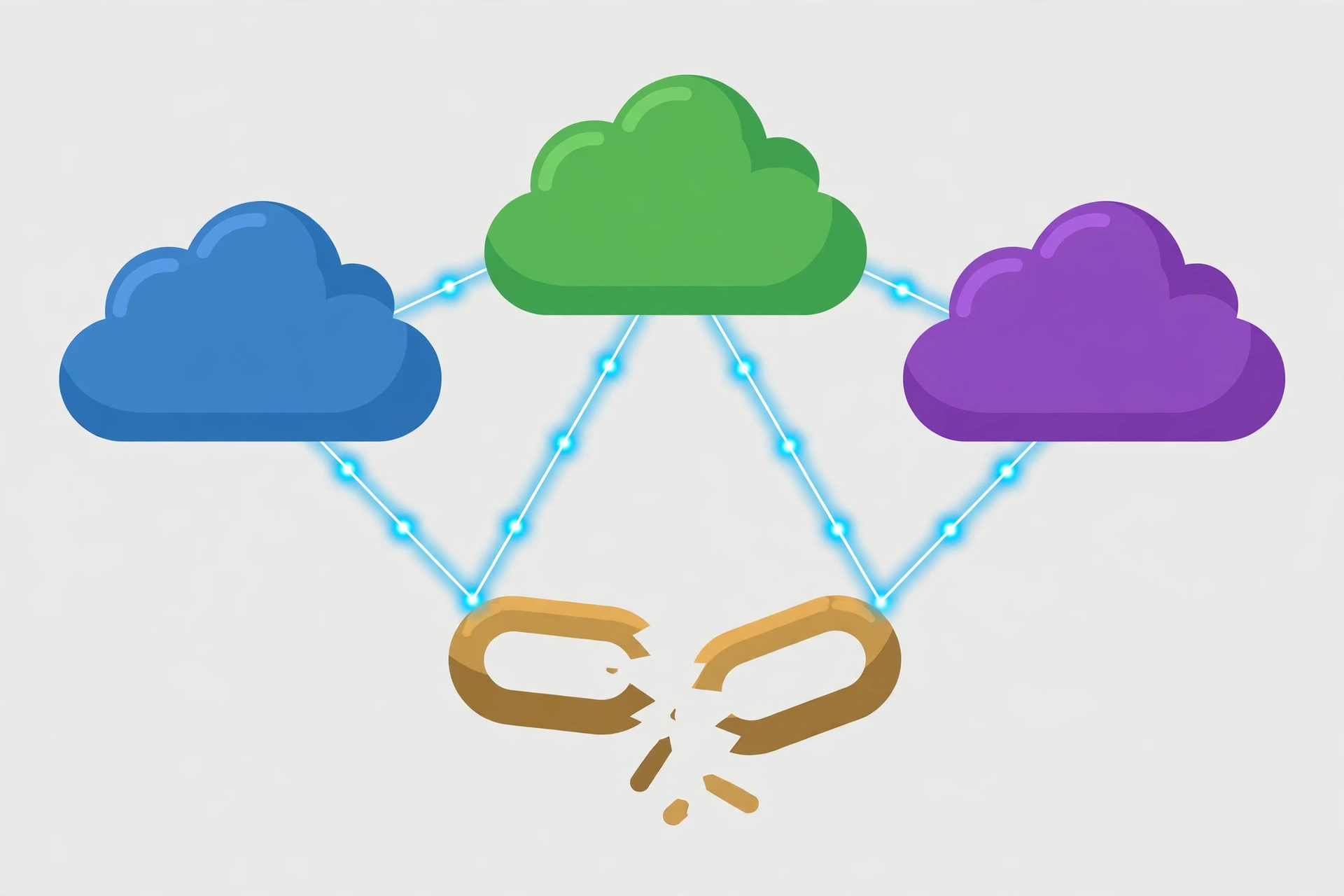
A multi-cloud strategy is the deliberate use of two or more public cloud service providers — such as Amazon Web Services (AWS), Microsoft Azure, and Google Cloud Platform (GCP) — within a single enterprise architecture. Rather than committing all workloads to one vendor, organizations distribute applications, data, and services across several platforms, placing each workload where it performs best.
It is important to distinguish multi-cloud from hybrid cloud. Hybrid cloud combines private (on-premises or private cloud) infrastructure with one or more public clouds. Multi-cloud specifically refers to using multiple public clouds, though in practice most enterprises run a hybrid-multi-cloud blend: private infrastructure for sensitive data, plus two or more public clouds for scale, innovation, and geographic reach.
How Multi-Cloud Works in Practice
In a typical 2026 enterprise setup, multi-cloud looks something like this:
- AWS handles the broadest set of production compute workloads, thanks to its unmatched service breadth.
- Microsoft Azure supports enterprise integrations, identity management, and productivity ecosystems built around Microsoft 365.
- Google Cloud powers data analytics, machine learning, and AI workloads with its strength in data platforms and AI accelerators.
- Specialist clouds or sovereign regions serve regulated workloads and data-residency requirements, particularly in the EU and GCC regions.
A unified management layer — covering identity, security policy, cost tracking, and observability — sits across all of these so that operations teams get a single pane of glass instead of three separate consoles.
Why Enterprises Are Adopting Multi-Cloud in 2026
The shift toward multi-cloud is not fashion; it is driven by hard economics and operational reality. Consider the numbers:
- 87% of organizations use a multi-cloud strategy (Flexera 2026).
- 73% run hybrid cloud environments alongside their multi-cloud footprint.
- The global public cloud market is projected to grow from USD 0.91 trillion in 2026 to USD 3.51 trillion by 2035, a 16.2% CAGR — with AI workloads as a primary catalyst.
- Gartner research cited in 2026 estimates that top-quartile enterprises with mature multi-cloud strategies reduced infrastructure unit costs by 31–38% while accelerating deployment velocity 2.4x versus predominantly on-premises peers.
- Nearly 49% of organizations now use cloud unit economics to connect consumption directly to business outcomes.
Two major catalysts are accelerating the trend. First, the generative AI revolution has created explosive demand for GPU-dense compute and flexible model-serving infrastructure — and no single provider wins on every AI workload. Enterprises increasingly split AI work across clouds: training on one provider with the best GPU availability, inference on another with lower latency or cost. Second, sovereignty rules in Europe, Asia, and the Middle East are pushing regulated workloads into sovereign cloud regions, which practically guarantees a multi-provider footprint.
Multi-Cloud Strategy Benefits Explained
The headline multi-cloud strategy benefits fall into six categories. Each one matters differently depending on your industry, scale, and risk profile.
1. Freedom from Vendor Lock-In
The most cited benefit is also the simplest: no single vendor can hold you hostage. When your entire infrastructure lives on one cloud, that provider controls your pricing, your feature roadmap, and even your contractual terms. Multi-cloud gives you negotiating leverage — the ability to shift workloads if a provider raises prices, degrades service, or changes policies in ways you cannot accept.
This leverage is not theoretical. Enterprises that can credibly threaten to move workloads secure materially better enterprise discount programs and committed-use pricing. The multi-cloud architecture turns a monologue with one vendor into a competitive marketplace for your IT budget.
2. Resilience and Business Continuity
Single-provider outages still happen, and when they do, they make headlines. A multi-cloud strategy lets you design for failure independence: critical applications run active-active or active-passive across providers, so an outage in one region of one cloud does not halt your business.
Real-world results are striking. Organizations cited in 2026 multi-cloud analyses report achievements such as 99.999% availability, 10x performance gains, and connectivity cost reductions exceeding 60% after moving to multi-cloud architectures with high-performance cloud-to-cloud networking.
3. Best-of-Breed Service Selection
No cloud provider is best at everything. AWS offers the deepest catalog of services, Azure integrates most naturally with Microsoft-centric enterprises, and Google Cloud leads in data analytics and AI platforms. Multi-cloud lets you match each workload to the provider that does it best:
- Raw compute breadth and global region coverage → AWS
- Enterprise identity, Microsoft 365 integration, and hybrid tooling → Azure
- BigQuery analytics, Kubernetes (GKE), and AI/ML platforms → Google Cloud
- Edge delivery and ultra-low-latency compute → CDN-edge providers and edge-native platforms
This best-of-breed approach means your developers get the right tool for each job instead of settling for a single vendor’s equivalent.
4. Cost Optimization and Financial Control
Contrary to the fear that multi-cloud automatically means higher cost, mature implementations reduce spending. Competitive bidding between providers, the ability to place price-sensitive workloads on the cheapest suitable infrastructure, and arbitrage between spot-instance markets all push unit costs down.
The discipline that makes this work is FinOps — cloud financial management. With unified billing dashboards and unit-economics tracking, enterprises measure cloud cost per customer, per transaction, or per feature. Analysts estimate that unmanaged multi-cloud configurations waste roughly 30% of spend; mature FinOps eliminates most of that waste and turns cost visibility into a strategic advantage.
5. Regulatory Compliance and Data Sovereignty
Data-residency laws in Europe (GDPR), the Gulf states, and Asia require certain data to stay within national or regional borders. AWS, Azure, and Google Cloud have all launched dedicated sovereign cloud offerings in the EU, operating under European legal frameworks — but regulated enterprises often combine these with regional providers to satisfy national regulators who demand genuine infrastructure independence.
Multi-cloud makes compliance a design feature: route EU customer data to sovereign EU regions, keep financial records on a compliant regional cloud, and run global marketing workloads wherever they are cheapest. One architecture, many jurisdictions.
6. AI Workload Placement Flexibility
Perhaps the newest and most powerful of the multi-cloud strategy benefits: AI demands flexibility that no single cloud satisfies. Different models, accelerators, and data platforms live on different providers. An enterprise might train models on one cloud with the best GPU availability, serve inference from edge locations on another, and store sensitive training data in a private environment for security.
As AI-related cloud spending climbs — already 19% of total cloud spend in 2026, up from 8% in 2023 — the ability to place AI workloads dynamically by price, latency, accelerator availability, and data gravity is becoming a competitive advantage in its own right.

Multi-Cloud vs. Hybrid Cloud: Key Differences
The terms are often used interchangeably, but they describe different things. Here is a practical comparison:
- Definition: Multi-cloud = multiple public clouds. Hybrid cloud = private infrastructure + public cloud(s).
- Primary goal: Multi-cloud optimizes across providers (resilience, best-of-breed, leverage). Hybrid optimizes across deployment models (control vs. elasticity).
- Typical use case: Multi-cloud suits globally distributed digital businesses and AI-heavy enterprises. Hybrid suits regulated industries (banking, healthcare, government) that must keep sensitive data on-premises.
- Management challenge: Multi-cloud must unify identity, networking, and billing across vendors. Hybrid must bridge on-premises and cloud tooling.
- The 2026 reality: Most large enterprises run both — a hybrid-multi-cloud architecture with private infrastructure plus two or more public clouds.
How to Build a Successful Multi-Cloud Strategy
The benefits above are real, but they are not automatic. Industry analyses consistently warn that multi-cloud without governance creates complexity instead of value — and that more than half of implementations risk failing to meet expectations. Here is a step-by-step approach that works.
Step 1: Define Workload Placement Principles
Start with a clear decision framework: which workloads go where, and why. Common criteria include performance requirements, cost, data residency, latency, accelerator needs, and team expertise. Document the principles so placement decisions are repeatable, not political.
Step 2: Standardize on Cloud-Native Abstractions
The single biggest technical enabler is Kubernetes and containers. When applications run in standardized containers orchestrated by Kubernetes, they become portable across clouds. Add infrastructure-as-code (Terraform, OpenTofu), service meshes, and API-first design, and workload portability moves from aspiration to routine.
Step 3: Unify Identity and Security
Multi-cloud expands the attack surface if each cloud keeps its own identity silo. Implement a Zero Trust architecture: federated identity (single sign-on across clouds), centralized policy management, consistent encryption, and continuous monitoring. Security posture must be provider-agnostic.
Step 4: Invest in Cloud-to-Cloud Networking
Data transfer between clouds is the hidden cost and latency trap of multi-cloud. High-performance inter-cloud networking — dedicated interconnects or optimized transit architectures — is what separates the success stories (60%+ lower connectivity costs, 10x performance) from the cautionary tales.
Step 5: Build a FinOps Practice
Stand up centralized FinOps with unit-economics reporting: cost per customer, per transaction, per environment. Give engineering teams real-time cost visibility so they optimize as they build. Reports show 78% of FinOps teams now report to the CTO or CIO, and 48% also manage data center costs — FinOps has become central IT finance.
Step 6: Automate Everything
Manual multi-cloud operations do not scale. Automate provisioning, compliance checks, backups, disaster-recovery failover, and cost guardrails. Platform engineering teams increasingly build internal developer platforms that hide cloud-provider complexity behind self-service interfaces.
Common Multi-Cloud Challenges and How to Solve Them
- Complexity and skills gaps: Each provider has its own services, APIs, and quirks. Solution: abstract with Kubernetes and infrastructure-as-code; invest in cross-cloud training and platform teams.
- Data transfer (egress) costs: Moving data between clouds can be expensive. Solution: design data gravity deliberately — keep heavy data where it is processed, use caching and edge delivery, negotiate enterprise egress discounts.
- Inconsistent security policies: Misconfigurations multiply across clouds. Solution: policy-as-code (OPA, cloud security posture management tools) applied uniformly.
- Cost sprawl: Without governance, teams spin up resources on every cloud. Solution: FinOps guardrails, tagging standards, budgets with automated alerts.
- Interoperability gaps: Providers do not natively integrate identity, networking, or cost tooling. Solution: accept that a third-party or open-source unification layer is part of the architecture, not an add-on.
Real-World Multi-Cloud Success Stories
Enterprise examples from 2026 illustrate the payoff:
- HDFC Bank achieved 99.999% availability with 40% faster release cycles on a multi-cloud foundation.
- stc (Saudi Telecom) reported 10x performance gains and over 60% lower connectivity costs.
- A2A generated €1.5 million in annual savings through optimized multi-cloud placement.
- Activision Blizzard recorded 30% better performance by placing workloads on the best-fit infrastructure.
The pattern is consistent: these organizations treat multi-cloud as a workload-placement strategy — the goal is not to maximize the number of providers, but to place each workload where it delivers the strongest combination of performance, economics, resilience, AI capability, security, and compliance.
Best Practices for Multi-Cloud Cost Management
Cost discipline deserves its own section because it is where multi-cloud strategies most often stumble — and where they win biggest when done right.
- Right-size continuously: 61% of professionals admit they do not right-size instances. Automated rightsizing tools close that gap.
- Use committed and spot pricing: 58% do not use reserved instances or savings plans, which can cut costs up to 90%; 71% skip spot orchestration. Both are free money for suitable workloads.
- Track unit economics: Connect cloud spend to business metrics — cost per order, per active user, per API call. This is how 49% of organizations now measure cloud value.
- Include SaaS in FinOps: 65% of enterprises plan to bring SaaS spending (130+ subscriptions on average) under FinOps in 2026.
- Eliminate idle resources: Unattached storage, idle VMs, and zombie snapshots are the easiest savings in any multi-cloud estate.

The Future of Multi-Cloud: What Comes Next
Looking beyond 2026, several forces will deepen the multi-cloud trend:
- AI infrastructure splits will intensify — training, inference, and data services will each gravitate to their optimal home, often on different providers.
- Quantum-safe networking is emerging as leaders begin protecting long-lived intellectual property against future decryption risks.
- Sustainability-driven routing will let enterprises “follow the sun,” shifting workloads to regions currently powered by renewable energy as carbon reporting becomes mandatory.
- Edge integration will extend multi-cloud to the edge, with data processed on-site for latency and the public cloud handling analytics — a model already dominant in manufacturing and logistics.
Conclusion
The multi-cloud strategy benefits are compelling: freedom from vendor lock-in, stronger resilience, best-of-breed services, optimized costs, regulatory compliance, and the flexibility to place AI workloads wherever they perform best. With 87% of organizations already multi-cloud and AI demand accelerating, the question is no longer whether to go multi-cloud, but how well you execute it.
Success comes down to governance: unified identity and security, high-performance inter-cloud networking, centralized FinOps, automation, and a clear workload-placement framework. Get those right, and multi-cloud stops being a complexity tax — it becomes the architecture that lets your business move fastest, spend smartest, and stay standing when any single provider stumbles.
Frequently Asked Questions
What is a multi-cloud strategy in simple terms?
A multi-cloud strategy means using two or more public cloud providers (like AWS, Azure, and Google Cloud) for different workloads, instead of relying on a single vendor. It is about placing each workload where it gets the best performance, cost, and resilience.
Is multi-cloud more expensive than single cloud?
It can be if unmanaged — roughly 30% of multi-cloud spend is wasted without governance. But mature multi-cloud strategies with FinOps discipline typically reduce unit costs by 31–38% through competitive pricing, workload arbitrage, and committed-use discounts.
What is the difference between multi-cloud and hybrid cloud?
Multi-cloud uses multiple public clouds. Hybrid cloud combines private (on-premises) infrastructure with public cloud. Most large enterprises in 2026 use both: a hybrid-multi-cloud architecture.
Which companies use multi-cloud?
87% of organizations now use multi-cloud, including major enterprises like HDFC Bank, stc, A2A, and Activision Blizzard, which report gains in availability, performance, and cost savings.
How do I start a multi-cloud strategy?
Begin with workload-placement principles, standardize on Kubernetes and infrastructure-as-code for portability, unify identity and security under Zero Trust, invest in inter-cloud networking, build a FinOps practice, and automate operations.