
Large language models like ChatGPT, Claude, and Gemini can write essays, draft emails, and answer questions on an astonishing range of topics. But ask one of them about your company’s refund policy, a procedure that changed last month, or a technical manual that was never published on the public internet, and you will quickly hit a wall. These models only know what was in their training data, and training data is a frozen snapshot of the past. This limitation — combined with the well-known tendency of AI systems to invent confident-sounding but false answers — is one of the biggest practical barriers to using AI with real organizational knowledge.
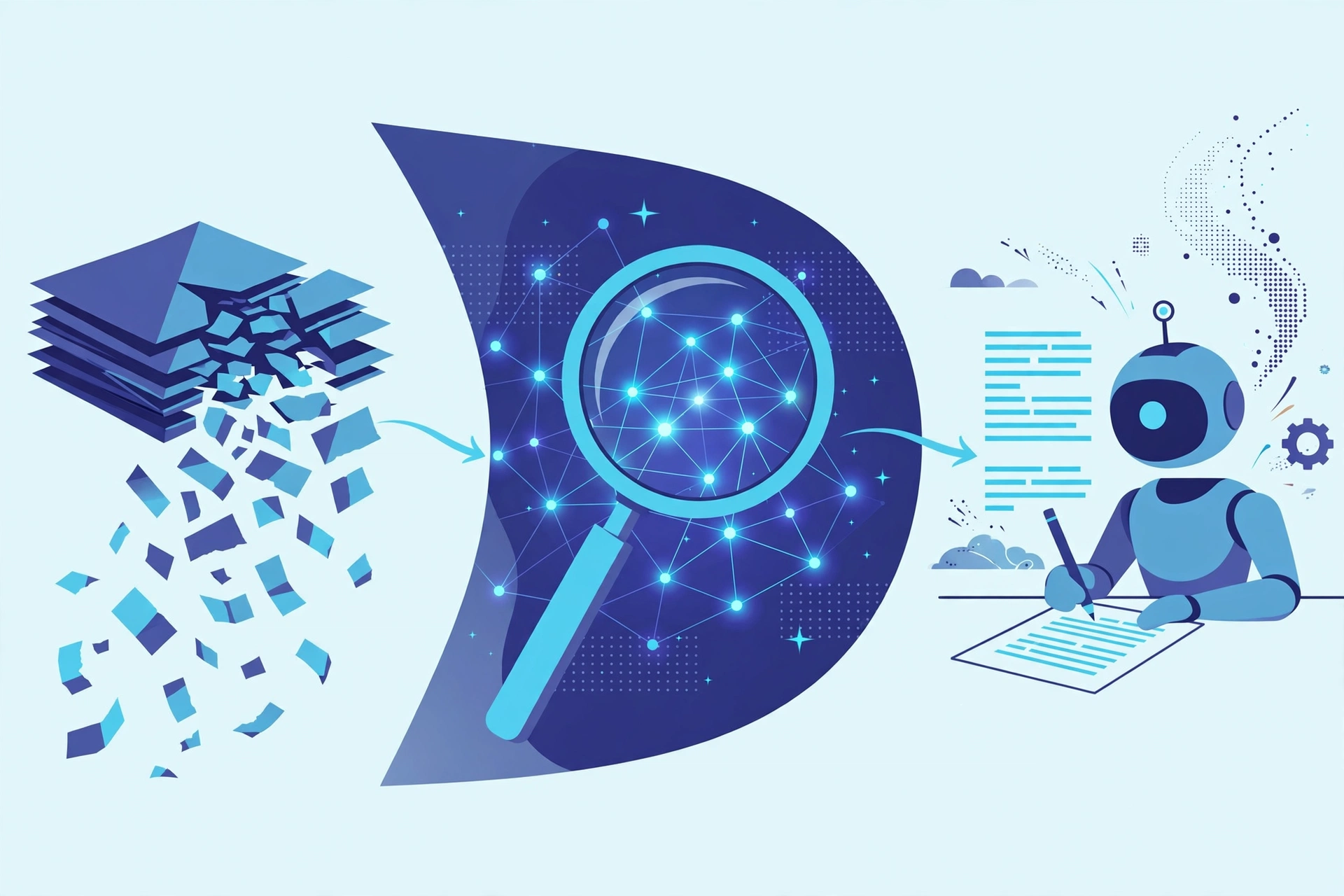
Retrieval-augmented generation, usually shortened to RAG, is the technique that fixes this. In plain language, RAG is a way of giving an AI model access to the right documents at the moment it answers. Instead of relying only on what the model “remembers” from training, the system searches your documents, pulls out the most relevant passages, and hands them to the model alongside your question. The model then reads those passages and writes its answer from them — much like a student answering an exam with an open textbook.
In this complete beginner’s guide, we will explain what retrieval-augmented generation is, how it works step by step, why it matters, where it is used in the real world, and how it differs from alternatives like fine-tuning. By the end, you will understand one of the most important ideas in modern AI — and why almost every serious business AI assistant in 2026 is built on it.
What Is Retrieval-Augmented Generation?
Retrieval-augmented generation is an architectural pattern for AI systems. It connects a large language model (LLM) to an external knowledge source so the model can retrieve relevant information before it generates an answer. Think of it as a two-step process: first look things up, then write the response.
The idea was introduced in a 2020 research paper by Patrick Lewis and colleagues, titled “Retrieval-Augmented Generation for Knowledge-Intensive NLP Tasks,” presented at the NeurIPS conference. The key insight was simple but powerful: if you keep the model separate from the knowledge, you can change what the system knows simply by swapping or updating the documents — without the enormous cost and time of retraining the model.
To understand why this matters, consider how a traditional language model works. A model is trained on vast amounts of text, and its “knowledge” is baked into its parameters — the numerical weights adjusted during training. This gives it a knowledge cutoff: everything it knows reflects the world as of the date training data was collected. It cannot know:
- Private information, such as your company’s internal policies, product manuals, or customer records
- Recent events, such as news from last week or a policy change that happened yesterday
- Specialized documents, such as a technical manual that was never published publicly
When asked about something it does not know, a model may confidently invent an answer — a phenomenon known as hallucination. RAG reduces this problem by grounding the model’s answer in real, retrieved documents. It does not eliminate hallucinations entirely, but it dramatically cuts them by making sure the model is reading before it writes.
How Retrieval-Augmented Generation Works: The Two-Phase Pipeline
A RAG system has two halves: a preparation phase that runs ahead of time, and a question-answering phase that runs every time someone asks a question. Understanding both phases is the key to understanding RAG explained in practical terms.
Phase 1: Indexing — Preparing Your Documents
Before the system can answer any questions, your documents must be prepared and stored in a searchable index. This happens in four steps:
1. Document loading. The system collects the source documents — PDFs, web pages, Word files, support tickets, database records, or any other text you want the AI to be able to use.
2. Chunking. Large documents are split into smaller pieces called “chunks,” typically a few paragraphs each (commonly 300–500 tokens of text). Chunking matters because the model works best with focused, relevant passages rather than entire documents. Many systems use overlapping chunks — where each chunk shares some text with its neighbors — so that a sentence split at a boundary is not lost.
3. Embedding. Each chunk is converted into an embedding: a long list of numbers (a vector) that represents the meaning of the text. Texts with similar meanings end up with similar vectors. For example, the sentences “How do I reset my password?” and “I forgot my login credentials” would produce vectors that are close together, even though they share few words. Embedding models — specialized AI models like OpenAI’s text-embedding models or the open-source nomic-embed-text — do this conversion.
4. Storing in a vector database. The chunks and their embeddings are stored in a vector database (popular options include Pinecone, Weaviate, Chroma, and pgvector) or in the vector-search feature of a database you already run. This index is optimized for one operation: given a new vector, quickly find the stored vectors closest to it.
Phase 2: Retrieval and Generation — Answering a Question
Once the index is built, the system can answer questions. When a user asks something, the following steps happen in seconds:
1. Embed the question. The user’s question is run through the same embedding model, producing a vector in the same numerical “space” as the document chunks.
2. Retrieve. The system searches the vector database for the chunks whose vectors are closest to the question’s vector (usually measured with cosine similarity). It returns the top matches — often the top 3 to 10 chunks. This is semantic search: it finds passages that are similar in meaning, not just ones that share the same words.
3. Re-rank (optional but valuable). Many production systems add a re-ranking step, where a second, more careful model re-scores the retrieved chunks and orders them by true relevance. Reranking is often described as the single best upgrade to a RAG pipeline, with reports of improving answer quality by 20–30 percent.
4. Generate. The retrieved passages are inserted into the model’s prompt as context, together with instructions like: “Using only the passages below, answer the following question. Cite which passage supports each claim.” The language model then reads the passages and writes a grounded answer, ideally with citations back to the sources.
The entire trick of retrieval-augmented generation, then, is almost disappointingly simple: find the right passages and put them in the prompt. Everything else — embeddings, vector databases, chunking strategies — is plumbing in service of that one step.
Why RAG Matters: The Problems It Solves
RAG addresses three of the most important practical problems in applied AI:
1. Hallucinations: Making Answers More Trustworthy
When a language model answers purely from its training data, it is essentially predicting the most likely-sounding continuation of your question — and “likely-sounding” is not the same as “true.” This is why models invent plausible but nonexistent facts, citations, and procedures. By forcing the model to answer from retrieved passages, RAG grounds responses in real evidence. Research has shown the difference concretely: in one Google Research experiment reported in October 2026, a Gemma model answered incorrectly about 10.2 percent of the time with no context, versus 66.1 percent with insufficient context — a stark illustration of how much context quality matters. RAG reduces invented answers, but honest systems still show their sources and let users verify claims, because grounding reduces rather than removes the risk.
2. The Knowledge Cutoff: Keeping Answers Current
A model’s training data ends at some point in the past, so it knows nothing about events, product launches, price changes, or policy updates that came after. RAG sidesteps this completely: because knowledge lives in the document store rather than in the model, you update the system by updating the documents. Swap in the new price list, and the assistant immediately answers with current prices. No retraining required.
3. Private Knowledge: Answering From Your Own Data
Most valuable business knowledge was never in any model’s training data: internal wikis, contracts, support tickets, product documentation, HR policies. RAG is what makes “chat with your documents” products possible. The model never saw your employee handbook during training — but with RAG, it can read the relevant page at answer time and quote it back.
RAG vs. Fine-Tuning: Which Should You Use?
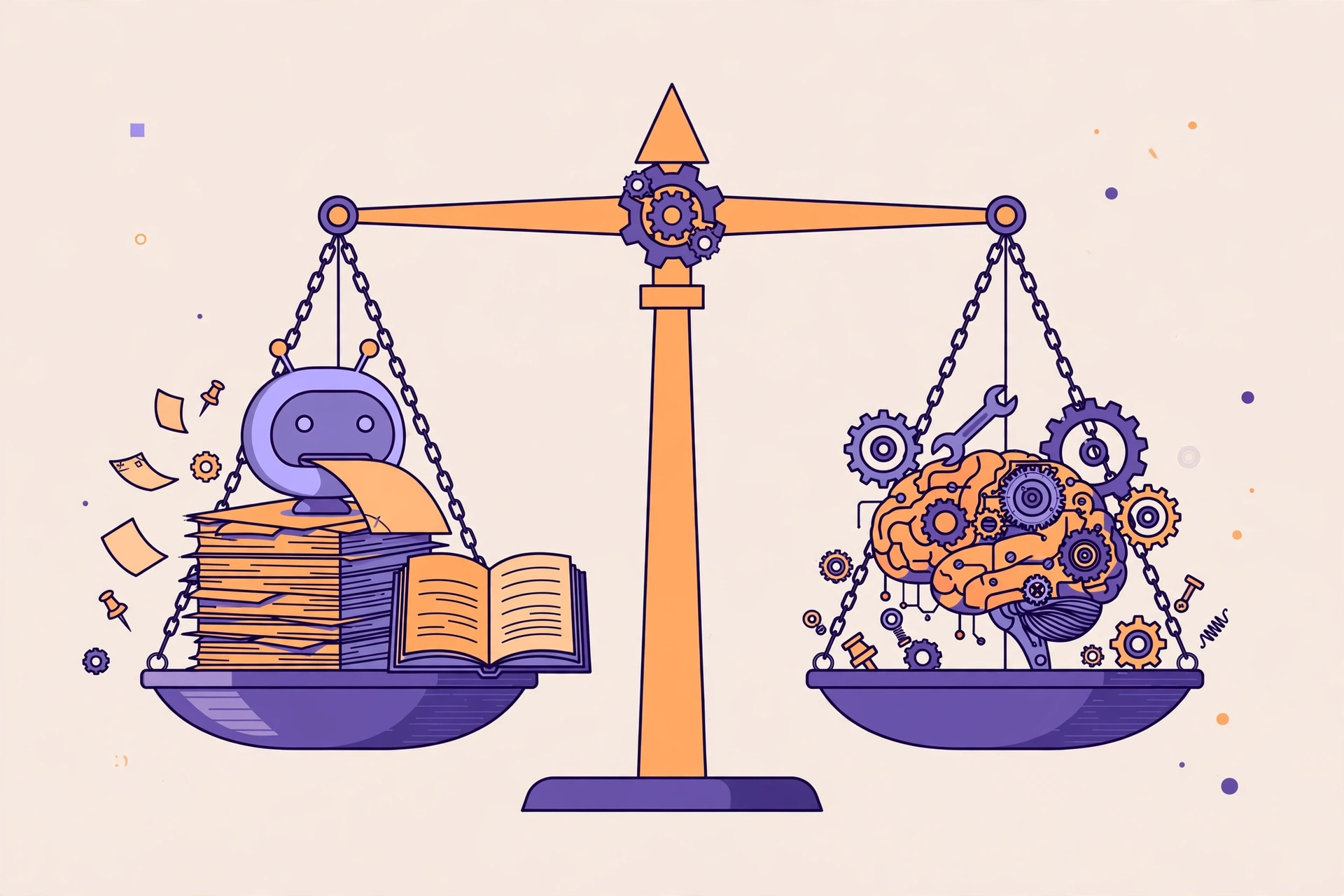
RAG is often compared with fine-tuning, the other major technique for customizing AI behavior. They solve different problems, and confusing them is one of the most common beginner mistakes.
Fine-tuning edits the model’s parameters by training it further on your examples. It is the right tool when you want to change the model’s behavior, tone, or output format — for instance, making it consistently answer in a specific style, follow a domain-specific format, or adopt specialized reasoning patterns. It is expensive, slow, and the knowledge it adds is frozen at training time.
RAG, by contrast, leaves the model untouched and updates the data instead. It is the right tool when you want the model to use facts that change — current documents, private knowledge, or large collections the model could never memorize. It is cheaper, faster to update, and naturally keeps answers current.
In practice, the two are often combined: fine-tuning shapes how the model behaves and formats answers, while RAG supplies the facts it reasons from. But if you have to pick one for knowledge-intensive questions, RAG is almost always the first choice.
- Choose RAG when: facts change over time; knowledge lives in documents you own; you need citations and source links; you want updates without retraining.
- Choose fine-tuning when: you need a consistent style, tone, or format; the task requires specialized behavior; the knowledge is stable and can be baked in.
Key Components of a Modern RAG System
Basic RAG is simple, but production systems add several refinements that make a large difference in answer quality. Here are the components you will encounter in 2026-era RAG pipelines:
Hybrid Search
Pure vector (semantic) search is excellent at meaning but can miss exact matches — a specific error code, a product SKU, a person’s unusual name. Hybrid search combines semantic search with traditional keyword search (the BM25 algorithm, the classic behind search engines) and merges the results. This gives you the best of both worlds: conceptual understanding plus exact-term precision.
Chunking Strategies
How you split documents has an outsized effect on quality. Chunks that are too large bury the relevant sentence in noise; chunks that are too small lose context. The common default of 300–500 tokens with 10–20 percent overlap works well for many document types, but sophisticated systems adapt chunking to the content — keeping tables intact, respecting document structure, and preserving metadata like the document title, date, and section with each chunk.
Query Rewriting and Expansion
Users do not always phrase questions well. Advanced systems rewrite or expand the query before retrieval — for example, turning “it broke again” into a fuller query using conversation history, or generating several search variations and merging their results. This small step often fixes retrieval failures that look like model failures.
Reranking
As mentioned above, a reranker takes the initial set of retrieved chunks and re-scores them with a heavier, more accurate model. Because the reranker only looks at a handful of candidates, it can afford to be much more careful than the fast vector search. This step consistently delivers some of the biggest quality gains in the pipeline.
Access Controls and Permissions
In business settings, not every user may see every document. A well-built RAG system applies access rules to the retrieval step itself: the search only returns chunks the asking user is authorized to see. Applying permissions at retrieval time — rather than filtering the model’s answer afterward — prevents sensitive information from ever entering the prompt.
Citations and Groundedness Checks
The best systems require the model to cite the passages behind each claim and then verify that the answer is actually supported by those passages. A citation is not proof by itself — the cited text must genuinely support the sentence — but citations let users check sources and build trust.
Real-World Applications of Retrieval-Augmented Generation
RAG has moved from research curiosity to everyday infrastructure. Here are some of the places it shows up:
- Customer support chatbots: support assistants that answer from the company’s actual help articles, manuals, and past ticket resolutions — with links to the source pages — instead of guessing.
- Enterprise knowledge assistants: internal tools where employees ask questions in plain language and get answers drawn from wikis, policies, contracts, and project documentation.
- Legal and compliance research: systems that search case law, regulations, and internal compliance documents, where citations to exact sources are not optional but required.
- Healthcare information systems: clinical assistants that retrieve from approved medical guidelines and hospital protocols, reducing the risk of invented medical advice.
- Developer tools: coding assistants that answer questions using a company’s own codebase, API documentation, and internal engineering notes.
- Education: tutoring systems grounded in a specific curriculum or textbook, so explanations stay aligned with what students are actually being taught.
What these applications share is a common shape: valuable knowledge exists in documents, the questions change constantly, and wrong answers have real costs. That is the sweet spot for RAG.
Common RAG Failures — and How to Avoid Them
Beginners are often surprised to learn that most RAG failures happen before the language model is even involved. The model gets blamed, but the real culprits are usually upstream:
- Bad document parsing: if PDFs, tables, or scanned documents are extracted as garbled text, retrieval will be built on garbage. Clean, faithful parsing is the unglamorous foundation of every good RAG system.
- Poor chunking: chunks that split sentences mid-thought or separate a table from its headers will confuse both retrieval and generation.
- Retrieval misses: the right document exists, but the search did not find it — often fixed with hybrid search, better chunking, or query rewriting.
- “Lost in the middle”: research shows models pay less attention to information buried in the middle of a long context. Feeding the model twenty chunks can be worse than feeding it the five best ones.
- Missing permissions: retrieving documents the user should not see — a security failure, not just a quality one.
- No evaluation: teams that never measure retrieval accuracy, groundedness, or citation quality cannot tell whether changes help or hurt. Good practice is to run the same question set every time you change a chunk size, model, or prompt.
The practical lesson: spend your effort on the retrieval half of the pipeline. A modest model with excellent retrieval will outperform a giant model with sloppy retrieval on knowledge-intensive questions.
Agentic RAG: Where the Technology Is Heading
In 2025 and 2026, RAG has evolved beyond the simple retrieve-then-generate pipeline. Modern systems are increasingly agentic: the model does not just receive retrieved passages passively but actively decides what to search for, runs multiple searches, follows links between documents, and checks its own work.
Other trends reshaping RAG include:
- Graph-aware retrieval: using knowledge graphs to follow relationships between entities (for example, from a product to its components to their suppliers), which helps with questions that span multiple documents.
- Multimodal RAG: retrieving not just text but images, charts, tables, and even video clips, so the model can answer questions about visual content.
- Governance and compliance: especially in regulated regions, RAG deployments now routinely include audit trails, data-residency controls, and alignment with frameworks like the EU AI Act and GDPR.
Despite these advances, the core idea remains unchanged: retrieve the right evidence, then generate the answer from it.
How to Get Started With RAG
If you want to experiment with retrieval-augmented generation yourself, the barrier to entry is lower than ever:
- Start with a small document set. Pick 10–50 documents you know well — a product manual, a policy handbook, a set of FAQs. Familiar content makes it easy to judge whether answers are correct.
- Use a managed platform first. Many cloud AI platforms and open-source frameworks (such as LangChain and LlamaIndex) offer RAG templates where you upload documents and get a working pipeline. Learn the concepts before building plumbing from scratch.
- Try a local experiment. Tools like Ollama let you run embedding models such as nomic-embed-text entirely on your own machine. You can embed a few paragraphs and a question, compare the vectors with cosine similarity, and watch the retrieval step work in miniature — no cloud account needed.
- Evaluate from day one. Write 20–30 test questions with known answers from your documents. Run them after every change. This single habit separates successful RAG projects from frustrating ones.
- Focus on retrieval quality. Before upgrading the language model, improve chunking, add hybrid search, and try reranking. Most quality gains live there.
Frequently Asked Questions About RAG
Does RAG completely stop AI hallucinations?
No. RAG significantly reduces hallucinations by grounding answers in retrieved documents, but it does not eliminate them. The model can still misread a passage or combine facts incorrectly. That is why citations and groundedness checks matter.
Is RAG the same as giving a model a long document in the prompt?
Not exactly. Pasting a document into the prompt is a manual, one-off version of the idea. RAG automates it at scale: it finds the relevant passages from thousands of documents automatically, every time, and it keeps working as documents are added or updated.
Do I need a vector database for RAG?
For small experiments, no — simple similarity search over a handful of embeddings works fine. For production systems with thousands of documents, a vector database (or a database with vector search) makes retrieval fast and scalable.
Can RAG work with images and videos?
Yes. Multimodal RAG extends the same pattern to non-text content: images, charts, and video frames are embedded into the same search space and retrieved alongside text.
Is RAG expensive to run?
Compared with fine-tuning, RAG is generally cheaper and faster to set up, because you are indexing documents rather than retraining a model. The ongoing costs are embedding, storage, search, and the language model calls themselves — all modest for typical business volumes.
Conclusion
Retrieval-augmented generation is one of those rare ideas that is both simple and transformative. The entire technique boils down to a librarian’s instinct: before answering, look it up. By pairing a retrieval step — search your documents for the relevant passages — with a generation step — let the language model write the answer from those passages — RAG gives AI systems access to private, current, and specialized knowledge they could never have memorized during training.
It reduces hallucinations, keeps answers current without retraining, and unlocks the “chat with your documents” experiences that now power customer support, enterprise knowledge tools, legal research, and more. It is not magic, and it does not remove the need for careful engineering — most failures live in the retrieval half of the pipeline, in parsing, chunking, and search quality — but it is the most practical foundation available for knowledge-intensive AI.
As RAG continues to evolve with agentic workflows, graph-aware retrieval, and multimodal search, its core principle will remain the same. The smartest AI answer is not the one the model remembers — it is the one the model looks up. Check current pricing and product details on vendor sites before making purchasing decisions, as offerings change frequently.