
Every few decades, the way we use computers changes completely. We went from room-sized mainframes that only specialists could operate, to desktop PCs that sat on every desk, to smartphones that live in our pockets. Each shift made technology smaller, faster, and more personal. But the next shift is different: instead of making devices smaller, it is making them disappear.
Imagine walking into your home after a long day. The lights adjust themselves to a warm, relaxing glow. Your thermostat has already set the perfect temperature because it noticed you were on your way home. Calm music fades in — the playlist you usually reach for at this hour. You did not open a single app, press a single button, or say a single command. The technology around you simply understood what you needed and responded.
This is ambient computing: a world where intelligent technology is woven into the environment itself, working quietly in the background. In this complete guide, you will learn what ambient computing is, how it works, the technologies that power it, real-world examples, its benefits and challenges, and where this invisible technology revolution is heading next.
What Is Ambient Computing?
Ambient computing is a design philosophy and technology approach in which connected devices, sensors, and intelligent software are embedded into our physical environment so that they can anticipate our needs and respond automatically — with little or no direct input from us.
Unlike traditional computing, where you actively interact with a device (typing on a keyboard, tapping a screen, clicking a mouse), ambient computing flips the relationship. Technology adapts to you, instead of you adapting to technology. The computer becomes the room, the car, the home — not a separate object you pick up and operate.
Here are the defining traits of ambient computing:
- Always present, rarely noticed: The system runs continuously in the background.
- Context-aware: It understands where you are, what you are doing, and what you probably want.
- Proactive, not reactive: Instead of waiting for commands, it anticipates needs based on patterns and context.
- Natural interaction: When you do interact, it happens through voice, gesture, or simply presence — not menus and screens.
- Coordinated: Many devices work together as one system rather than as isolated gadgets.
A smart speaker that answers your questions is a glimpse of it. But true ambient computing goes much further: the light, the thermostat, your watch, your phone, and your car all share an understanding of your day and coordinate without being asked.
A Brief History: From Ubiquitous Computing to Ambient Intelligence
The idea behind ambient computing is older than the name. In 1991, computer scientist Mark Weiser wrote a famous paper describing “ubiquitous computing” — the vision that the most profound technologies are those that disappear. He argued that computers would weave themselves into everyday life until they became indistinguishable from it.
That vision took decades of supporting technology to become real: cheap wireless connectivity, tiny affordable sensors, cloud computing, and powerful artificial intelligence. By the 2010s, voice assistants brought a taste of it into living rooms. In the 2020s, the convergence of AI, the Internet of Things (IoT), and edge computing finally made Weiser’s vision practical — and the industry gave it the modern name: ambient computing.
How Ambient Computing Works: The Three Stages
Although the experience feels effortless — the lights simply turn on — a lot is happening under the surface. Most ambient computing systems operate through three connected stages: sensing, understanding, and acting.
Stage 1: Sensing — The System’s Eyes and Ears
Everything begins with a distributed network of sensors that continuously observe the environment. These sensors are the system’s eyes and ears, collecting raw data about the world around you:
- Motion and presence sensors detect whether someone is in a room and where they are moving.
- Light sensors measure daylight levels so artificial lighting can adjust naturally.
- Temperature and humidity sensors track climate conditions for comfort and energy efficiency.
- Microphones listen for voice commands or recognize sounds like breaking glass or a smoke alarm.
- Wearable sensors monitor your body — heart rate, activity level, sleep patterns, and sometimes blood oxygen.
- Location sensors use GPS, Bluetooth beacons, or Wi-Fi signals to know where you are, indoors and outdoors.
Many of these sensors already hide inside devices you own. Your smartphone alone carries a microphone, camera, GPS, accelerometer, gyroscope, and ambient light sensor. In an ambient computing setup, all of these become part of the larger sensing fabric.
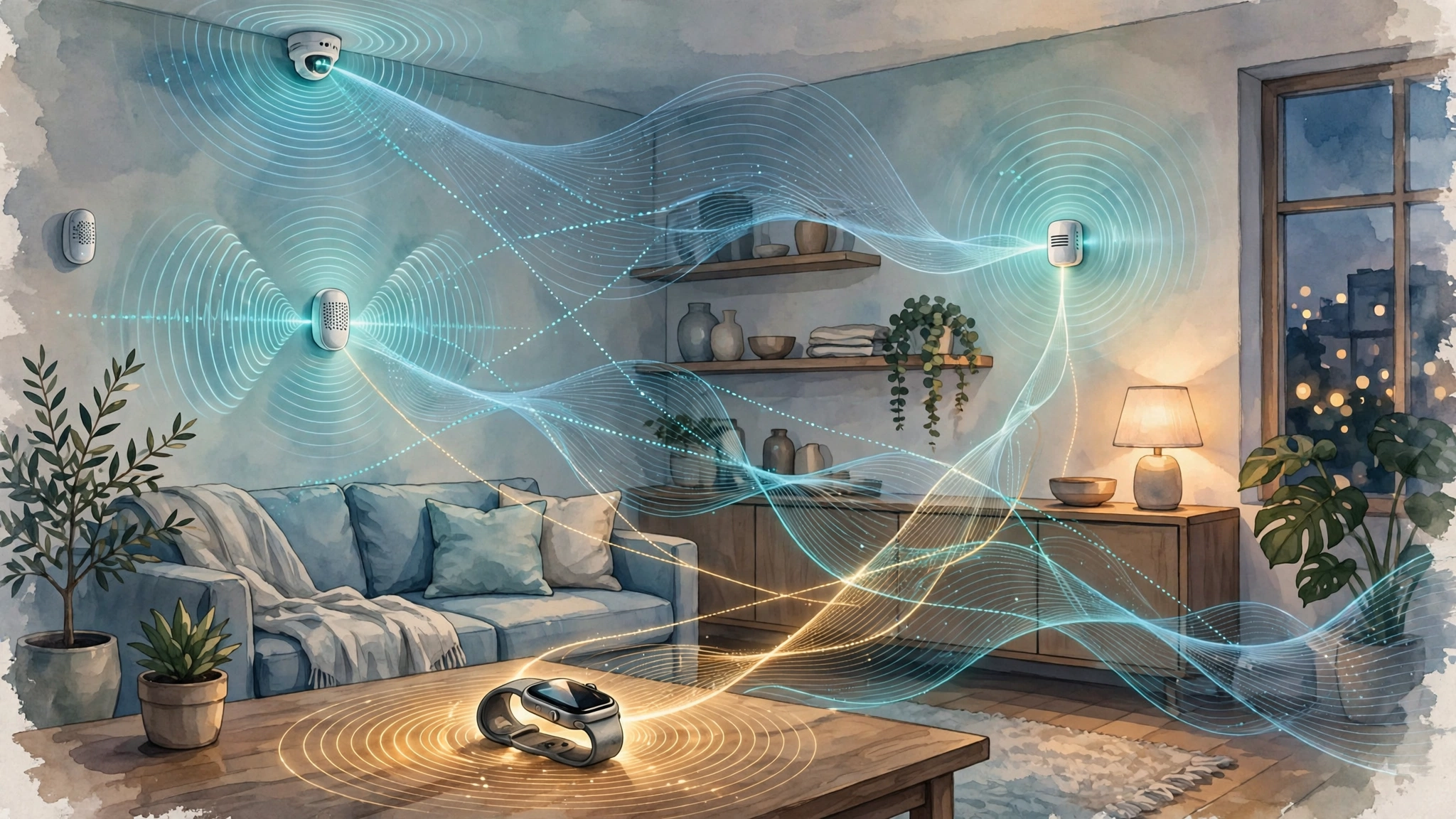
Stage 2: Understanding — AI and Context Awareness
Raw sensor data is meaningless on its own. The second stage sends this data to be processed — increasingly on the device itself or at the “edge” of the network for speed and privacy — where artificial intelligence and machine learning turn it into understanding.
This is where context awareness comes in. The system does not just see “motion in the kitchen at 7:00 AM.” It combines that signal with history, time, location, and your habits to reach a richer conclusion: “The homeowner has started their morning routine.”
The AI performs several kinds of reasoning:
- Pattern recognition: Learning that you lower the thermostat to 68°F and turn on the kitchen lights on weekday mornings.
- Intent inference: Predicting what you probably want next — for example, that arriving home after 6 PM usually means you want relaxing lighting.
- Anomaly detection: Noticing unusual events, like a water leak sensor triggering at midnight, that deserve an alert rather than a quiet adjustment.
- Natural language understanding: Interpreting spoken requests in normal conversation, including follow-up questions and context (“Turn that up” — what is “that”?).
The more the system observes, the better it becomes. Every manual adjustment you make — dimming a light it set too bright, overriding a thermostat setting — becomes feedback that refines its models. This self-improving loop is what makes ambient computing feel personal rather than generic.
Stage 3: Acting — Seamless, Invisible Responses
In the final stage, the system converts its understanding into action by sending commands to actuators — the devices that change the physical world: smart bulbs, thermostats, speakers, locks, coffee makers, motorized blinds.
The key word is seamless. The ideal ambient action is one you barely notice. The lights do not flash or announce themselves; they simply reach the right level. Your morning playlist starts at a modest volume. The front door unlocks as you approach with your hands full of groceries.
All three stages repeat in a continuous loop: sense → understand → act → learn. The environment is always watching, always interpreting, and always improving — which is exactly why the technology feels invisible.
The Building Blocks of Ambient Computing
Ambient computing is not one invention. It is the convergence of several mature technologies working together:
- Artificial intelligence and machine learning: The brain of the system — responsible for recognizing patterns, predicting intent, and understanding natural language.
- The Internet of Things (IoT): The connected network of smart devices — lights, appliances, locks, cameras — that the system can sense with and act through.
- Sensors and actuators: The input and output hardware: motion detectors, microphones, thermometers, plus the devices that adjust the environment.
- Edge computing: Processing data close to where it is collected (on a smart speaker or a home hub) instead of sending everything to a distant data center. This cuts latency and keeps sensitive data local.
- Cloud computing: The heavy-duty processing and storage backend for training AI models, syncing across locations, and handling complex analytics.
- Voice and gesture recognition: Natural interfaces that let you communicate with the system the way you communicate with people.
- 5G and advanced wireless: Fast, low-latency connectivity that lets countless devices share data in real time.
No single company owns all of these layers, which is why the ambient computing ecosystem includes device makers, AI labs, cloud providers, chip manufacturers, and open standards bodies all building pieces of the same puzzle.
Ambient Computing vs. Traditional Computing
To see what makes ambient computing different, compare it with the computing you already know:
- Interaction: Traditional computing is active — you open apps and issue commands. Ambient computing is passive — the system acts on your behalf.
- Interface: Traditional computing uses screens, keyboards, and mice. Ambient computing uses voice, presence, gestures, and no interface at all.
- Location: Traditional computing happens on a device in front of you. Ambient computing happens all around you, across many devices.
- Timing: Traditional computing responds after you ask. Ambient computing anticipates and acts before you ask.
- Visibility: Traditional computing demands your attention. Ambient computing aims to earn your trust and then get out of the way.
Think of the difference this way: traditional computing is a tool you pick up; ambient computing is an environment you live inside. Both have their place — nobody wants their oven to guess its way through a recipe — but for routine comfort and convenience, the ambient model removes friction that screens and apps add.
Real-World Examples of Ambient Computing
Ambient computing is not a distant dream. Pieces of it are already operating in homes, hospitals, offices, and cars around the world.
Smart Homes
The smart home is the most familiar showcase. Thermostats learn your schedule and pre-heat the house before you arrive. Lighting systems adjust brightness and color temperature based on the time of day, supporting your natural sleep cycle. Robot vacuums map your floors and clean while you are away. Doorbells recognize familiar faces and announce visitors by name. Together, these form an environment that maintains itself.
Healthcare and Wearables
In healthcare, ambient computing saves lives quietly. Smartwatches continuously monitor heart rhythm and can detect irregular patterns like atrial fibrillation, alerting the wearer to see a doctor. Fall-detection sensors in elderly care homes summon help automatically when a resident falls and cannot reach a phone. Hospital rooms use ambient sensors to track patient movement and vital signs without tangling patients in wires, while AI listens for signs of distress.
Workplaces
Modern offices are becoming ambient. Meeting rooms detect who has entered, pull up the right agenda on the shared display, adjust lighting for the video call, and start transcription. Hot-desking systems guide employees to available seats with the equipment they need. Building systems optimize heating, cooling, and lighting based on real occupancy rather than fixed schedules, cutting energy waste dramatically.
Retail, Hospitality, and Transportation
Stores use ambient systems to adjust music, signage, and lighting based on foot traffic and time of day. Hotels are experimenting with rooms that set your preferred temperature and lighting as soon as you check in. In cars, ambient computing adjusts the seat, mirrors, and climate to the recognized driver, suggests rest stops on long journeys, and preconditions the battery for the next charging stop — all without the driver digging through menus.

Benefits of Ambient Computing
Why is the industry investing so heavily in making technology invisible? The benefits are substantial:
- Unmatched convenience: Routine tasks — adjusting lights, locking doors, setting temperatures — happen automatically, freeing your attention for things that matter.
- Accessibility: Voice-based, screen-free interaction is transformative for people with visual impairments, limited mobility, or anyone who struggles with complex interfaces.
- Energy efficiency: Buildings that heat, cool, and light themselves based on real occupancy waste far less energy than those running on timers.
- Personalization at scale: The system adapts to each individual — your lighting preferences, your commute, your health patterns — without manual configuration.
- Safety and health: Continuous monitoring can catch problems early, from a water leak under the sink to an irregular heartbeat.
- Productivity: In workplaces, eliminating the friction of setting up meetings, finding rooms, and managing equipment adds up to real time saved.
Challenges and Concerns
The same qualities that make ambient computing powerful also raise serious questions. Any honest guide must address them.
Privacy and Data Security
An environment that is always sensing is, by definition, always watching and listening. Microphones, cameras, and biometric sensors collect deeply personal data — your conversations, your routines, your health. The central question is: who controls that data, where is it stored, and who can access it?
The industry is responding with several safeguards. Edge processing keeps sensitive data on local devices instead of sending it to the cloud. Visual indicators — like LED rings that change color when a device is listening — make sensing visible and accountable. Local-only modes let users run systems without any data leaving the home network. Still, privacy remains the number one concern, and users should review permissions, choose vendors with clear data policies, and use physical mute switches where available.
Reliability and Context Errors
Prediction is never perfect. An ambient system can misread context — turning off the lights while you are reading quietly, or blasting music because it misheard a conversation. These “context errors” range from amusing to dangerous (imagine a smart lock misjudging who is at the door). Good systems fail gracefully: they confirm before high-stakes actions, offer easy manual overrides, and learn from corrections. But reliability standards for ambient systems are still maturing.
Interoperability and Cost
A truly ambient environment requires devices from different brands to cooperate, and the smart-home industry has historically been fragmented — gadgets that refuse to talk to each other. Open standards are improving this, but setup can still be complex. There is also the cost: outfitting a home or office with sensors, smart devices, and AI-capable hubs is a real investment, which risks making the benefits available mainly to those who can afford them.

The Future of Ambient Computing: What’s Next
Ambient computing in 2026 is still in its early chapters. Here is where the technology is heading:
- Agentic AI as the orchestrator: Autonomous AI agents will coordinate entire environments — managing your calendar, home, car, and office as one continuous experience rather than isolated automations.
- Health-aware environments: Wearables detecting stress through heart-rate variability could trigger your home to dim lights, play calming soundscapes, and adjust room scent — a wellness response without a single command.
- Displays that appear only when needed: Micro-projectors built into lamps, mirrors, and kitchen counters will create temporary, data-rich displays that vanish when idle, reducing screen clutter.
- Deeper on-device intelligence: As chips get more powerful, more AI will run locally — faster responses, better privacy, and systems that work even when the internet is down.
- Ambient workplaces and cities: The same principles will scale from rooms to buildings to neighborhoods — traffic systems that adapt to flow, public spaces that respond to crowds.
The long-term vision, first imagined by Mark Weiser more than thirty years ago, is a world where the computer as a distinct object fades away entirely — and what remains is simply an environment that takes care of you.
Frequently Asked Questions
What is ambient computing in simple terms?
Ambient computing is technology that works in the background of your environment — sensing what is happening, understanding what you need, and responding automatically, without you needing to use screens, apps, or buttons.
What is an example of ambient computing?
A smart thermostat that learns your schedule and adjusts the temperature before you get home is a classic example. Others include lights that turn on when you enter a room, cars that adjust seats and climate to the recognized driver, and smartwatches that detect irregular heart rhythms.
How does ambient computing work?
It works in three stages: sensors collect data about the environment, AI processes that data to understand context and predict intent, and connected devices take action — adjusting lights, temperature, sound, and more — in a continuous learning loop.
Is ambient computing the same as the Internet of Things?
No. The Internet of Things (IoT) is one building block — the network of connected devices. Ambient computing is the broader vision: IoT plus AI, sensors, edge computing, and natural interfaces working together so the whole environment behaves intelligently.
What are the privacy risks of ambient computing?
Always-on sensors can collect sensitive personal data. Key protections include on-device (edge) processing so data never leaves your home, clear indicators when devices are listening or watching, local-only modes, and strong vendor data policies. Users should review permissions regularly.
Conclusion
Ambient computing represents one of the most profound shifts in the history of technology: the move from computers we operate to environments that understand us. By combining sensors, artificial intelligence, the Internet of Things, and edge computing into a continuous loop of sensing, understanding, and acting, it promises a future where technology finally fades into the background — and simply takes care of the details of daily life.
The road there has real challenges: privacy, reliability, interoperability, and cost all need honest solutions. But the direction is clear. The next great computing platform will not be a device you hold. It will be the room you are standing in — and you may never notice it working at all.